
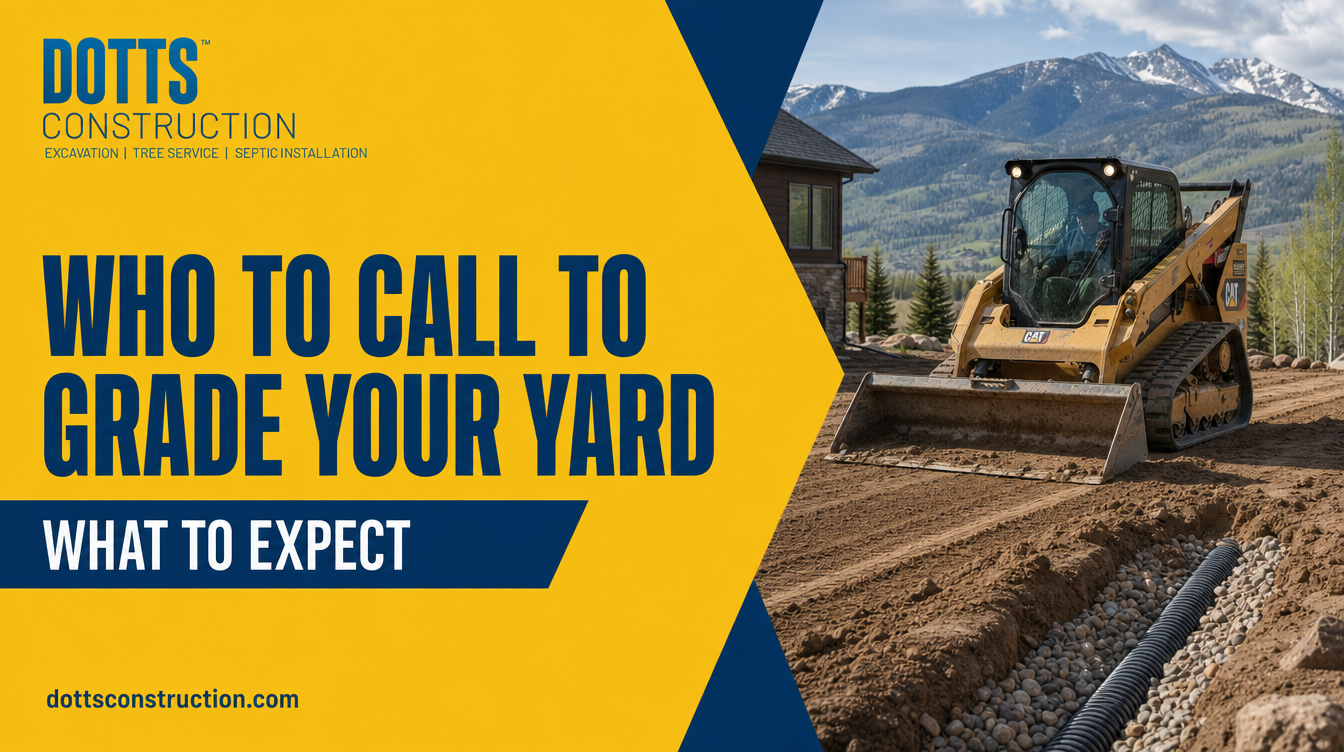
Need Someone to Grade Your Yard?
To grade your yard, call a grading and excavation contractor near you. These professionals use heavy equipment to level, slope, and prepare land for drainage, foundations, driveways, and septic systems. A qualified grading contractor handles everything from rough site work to final grade, so your construction project can move forward without delay.
What Does a Grading Contractor Actually Do?
A grading contractor reshapes the surface of your land. That means cutting high spots, filling low spots, and establishing the correct slope so water drains away from your home, foundation, or planned structure.
Here is what grading work typically covers:
- Site grading: Preparing raw land for a new build, addition, or outbuilding
- Yard regrading: Correcting drainage problems around an existing home
- Driveway grading: Creating a stable, properly sloped base for gravel or paved drives
- Foundation excavation: Digging and leveling for footings and poured foundations
- Road grading: Building and maintaining private access roads on rural properties
- Septic system site prep: Meeting code-required slope and soil specifications for drain fields
Grading contractors use heavy equipment including bulldozers, track excavators, skid steers, and graders. This is not a shovel-and-wheelbarrow job. The scale and precision of the machinery is what separates a true grading contractor from a general landscaper.
Who Should I Call to Grade My Yard? (The 3 Types of Professionals)
Not every contractor who touches dirt is the right call for your project. Here is a breakdown of the three types of professionals who do grading work, and when to hire each one.
1. Grading and Excavation Contractors
This is the right call for most grading projects. Grading and excavation contractors specialize in earthmoving, site preparation, and land clearing. They own the equipment, know soil behavior, and understand how to establish proper drainage slopes to code.
Call a grading and excavation contractor when you need:
- Land cleared and leveled for a home, garage, shop, or addition
- Foundation excavation for a new structure
- A driveway cut in or re-graded
- A private road built or improved
- A septic system designed and installed
Pro Tip: Always verify that your grading contractor is licensed, bonded, and insured to operate heavy equipment on your property. One wrong cut near a utility line or foundation can cost more than the entire project.
2. Landscape Contractors
Landscape contractors handle smaller-scale grading, often as part of a broader yard improvement project. They are the right choice when your grading needs are minor (a few inches of slope correction) and you are also installing sod, garden beds, or retaining walls.
They are not the right choice when you need significant earthmoving, heavy slope correction, or site preparation for construction. Most landscapers do not own the heavy machinery required for true grade work.
3. Stormwater and Drainage Specialists
These contractors focus specifically on water management: French drains, catch basins, underground pipe systems, and swales. If your primary problem is standing water and flooding rather than construction readiness, a drainage specialist might be a narrow-scope solution.
That said, a grading and excavation contractor often handles drainage correction as part of comprehensive site grading. You may not need a separate specialty contractor.
| Contractor Type | Best For | Heavy Equipment | Handles Construction Prep |
|---|---|---|---|
| Grading & Excavation Contractor | Major leveling, foundations, driveways, septic | Yes | Yes |
| Landscape Contractor | Minor slope fixes, sod, retaining walls | Rarely | No |
| Stormwater / Drainage Specialist | Flooding, French drains, basin installs | Sometimes | No |
What Is the Difference Between Grading and Excavating?
Grading means shaping the surface of the land to a precise elevation and slope. Excavating means digging below the surface to remove earth for a foundation, utility trench, or septic system.
Most major site preparation projects require both. You excavate to the required depth, then grade the surrounding area to ensure proper drainage and a stable surface. That is why grading contractors and excavation contractors are almost always the same company. The two trades are inseparable on real construction projects.
A contractor who offers only one without the other is often not equipped to handle complex site work.
Why Does Proper Yard Grading Matter So Much?
Here is the honest answer: improper grading is one of the most expensive mistakes you can make on a property.
According to the National Association of Home Builders (NAHB), poor drainage and improper grading are among the leading causes of foundation failure in residential construction. Water that pools against a foundation wall does not stay there: it seeps in, weakens the footing, and over years causes structural movement and cracking that costs tens of thousands of dollars to repair.
Correct yard grading prevents foundation damage, eliminates standing water, and creates a stable surface for everything built above it. There is no cosmetic fix for a poorly graded site. You either do it right the first time, or you pay twice.
On top of that, septic systems are legally required to meet specific slope and soil absorption standards. A grading contractor who also designs and installs septic systems (like Dotts Construction) can coordinate both phases so your site passes inspection without rework.
How Does the Dotts 3M Method Work?
Most grading contractors show up, move dirt, and leave. What happens to your project after they're gone is your problem.
At Dotts Construction, we built our process around what actually derails construction projects: poor communication, vague scopes of work, and crews that disappear between phases. The Dotts 3M Method addresses each of those failure points directly.
The three pillars are:
- Measure: We assess the site, identify soil conditions, drainage requirements, and construction specifications before a single bucket of dirt moves. You get a clear scope of work, not a vague estimate that doubles later.
- Mobilize: We show up when we say we will, with the right equipment for your specific project. No rescheduling. No surprises. No standing around waiting for a crew that is stretched across six other jobs.
- Make it ready: We do not hand off a half-finished site. We leave your land graded, drained, and genuinely construction-ready, whether that means a level pad for your foundation, a properly sloped driveway base, or a fully installed and inspected septic system.
When your site work is done right the first time, your entire construction timeline accelerates. You do not lose days waiting for corrections. Your framing crew, your concrete crew, or your paving crew can walk onto a site that is actually ready for them.
[Quote: Insert unique insight from a licensed site engineer or excavation professional about how improper initial grading delays downstream construction trades here]
What Services Should a Grading Contractor Near Me Offer?
A full-service grading and excavation contractor should be able to handle every phase of site preparation under one roof. Here is what to look for when you are evaluating grading contractors in your area:
- Land clearing and tree removal: Stumps, brush, and timber removed before grading begins
- Rough grading: Establishing the general elevation and drainage direction for the site
- Foundation excavation: Precise digging for footings, basements, or crawl spaces
- Driveway and road grading: Proper base preparation for gravel, asphalt, or concrete surfaces
- Septic system design and installation: Full permitting, engineering, and installation to local code
- Final grade: Smoothing and finishing the site surface to meet construction specifications
Dotts Construction delivers all of these services. That matters because every time you hand off between contractors, you introduce a coordination gap. One contractor grades. Another installs the septic. A third does the driveway. Each blames the others when something does not line up.
A single contractor who manages the full scope eliminates that risk entirely.
How Do I Know If My Yard Needs Grading?
You do not need a professional assessment to recognize the most obvious signs. Look for:
- Water pooling near your foundation after rain, which means the grade is sloping toward the house instead of away from it
- Standing water in low spots that takes 24 hours or more to drain
- Erosion channels where water is cutting paths through soil during heavy rain
- Uneven ground on a lot where you plan to build, add a driveway, or install a septic system
- A failed or failing septic system where the drain field has saturated or backed up
Pro Tip: The standard for residential drainage is a minimum 6-inch drop over the first 10 feet away from your foundation. If your yard does not meet that, you have a grading problem even if it is not obvious after a light rain.
What Questions Should I Ask a Grading Contractor Before I Hire Them?
Hiring the wrong excavation crew is not just expensive. It can permanently damage your property and delay your construction project by weeks or months. Before you sign anything, ask these questions:
- Are you licensed, bonded, and insured for heavy equipment operation in this state? Get proof of insurance in writing, not just a verbal yes.
- Who specifically will be on my job site, and who supervises the crew? You want to know that experienced operators are running the machines, not unsupervised day labor.
- What does your scope of work include, and what is excluded? A vague estimate is a blank check for disputes later. Get every phase itemized.
- What is your communication process during the project? Will you get daily updates, or will you be chasing someone down when you have questions?
- Can you provide references from similar projects in the last 12 months? Grading a flat suburban lot is different from site work on a steep rural parcel. Make sure the experience matches your project type.
- How do you handle unexpected soil conditions? Rocky subsoil, high clay content, and unexpected water tables all affect cost and timeline. Know the plan before it happens.
The best grading contractors welcome these questions. If a contractor gets defensive or vague when you ask about licensing, communication, or scope, that is your answer.
FAQ: Grading Contractors Near Me
How much does it cost to hire a grading contractor?
Yard grading costs typically range from $1,000 for minor residential regrading to $10,000 or more for full site preparation on a new construction lot. Large projects involving land clearing, foundation excavation, and septic installation can run significantly higher. The only accurate number comes from an on-site assessment of your specific property.
How long does yard grading take?
Most residential grading projects take one to three days with the right equipment on site. Larger site preparation jobs, including land clearing, rough and final grading, and septic system installation, may take one to two weeks depending on site conditions, permit timelines, and project scope.
Do I need a permit for yard grading?
Permit requirements vary by location. Minor cosmetic regrading often does not require a permit. But significant earthmoving near a foundation, a new septic system installation, or grading that changes drainage patterns typically does. Your grading contractor should know local requirements and handle permitting as part of the project.
What is the difference between grading and leveling?
Grading establishes a precise slope for drainage and structural stability. Leveling typically refers to creating a flat surface. Most construction grading is not perfectly flat: it is sloped intentionally to direct water away from structures. A grading contractor will establish whatever grade the project requires, which may include both level pads and sloped drainage areas.
Can a landscaper grade my yard?
For small slope corrections of an inch or two, some landscapers can help. But for significant earthmoving, foundation prep, driveway construction, or septic system installation, you need a licensed grading and excavation contractor with proper heavy equipment. Landscapers typically lack the machinery and licensing for true grading work.
How do I find a reputable grading contractor near me?
Ask neighbors, local builders, and contractors for referrals. Check reviews on Google and verify that any contractor you contact is licensed, bonded, and insured. Request itemized written estimates from at least two or three contractors. The lowest price is rarely the best choice when heavy machinery is operating on your property.
What happens if grading is done incorrectly?
Improper grading causes water to drain toward your foundation instead of away from it, leading to basement flooding, foundation cracking, and long-term structural damage. According to the NAHB, foundation problems are among the most expensive residential repairs, often exceeding $20,000 to $100,000 depending on severity. Getting grading right the first time is not optional.
Ready to Get Your Site Graded? Here Is Your Next Step
If your yard or construction site needs grading, the time to act is before your project stalls. Every week your site work sits incomplete is a week your builder, your concrete crew, or your septic installer cannot move forward.
Dotts Construction serves property owners who need their land cleared, graded, and construction-ready without the contractor drama that derails timelines and budgets. We handle excavation, grading, septic system design and installation, tree removal, and land clearing under one roof, so you have one point of contact from rough site to final grade.
Call Dotts Construction today to schedule your on-site assessment. We will walk your property, assess your soil and drainage conditions, and give you a clear, itemized scope of work before we ever start an engine.
Request a free consultation or call (719) 280-4141
Related Guides
Need the pros? See Site Preparation & Grading. More reading:
About the Author
Michael Dotts brings over 15 years of hands-on experience in heavy construction and grading, with a specialty in the unique demands of building in the Rocky Mountains, where steep terrain, rocky ground, and harsh weather change the rules most flatland contractors are used to. Because Michael knows what it really takes to get the job done right in Colorado’s high country, you can count on honest, accurate quotes that won’t creep up halfway through the job.