
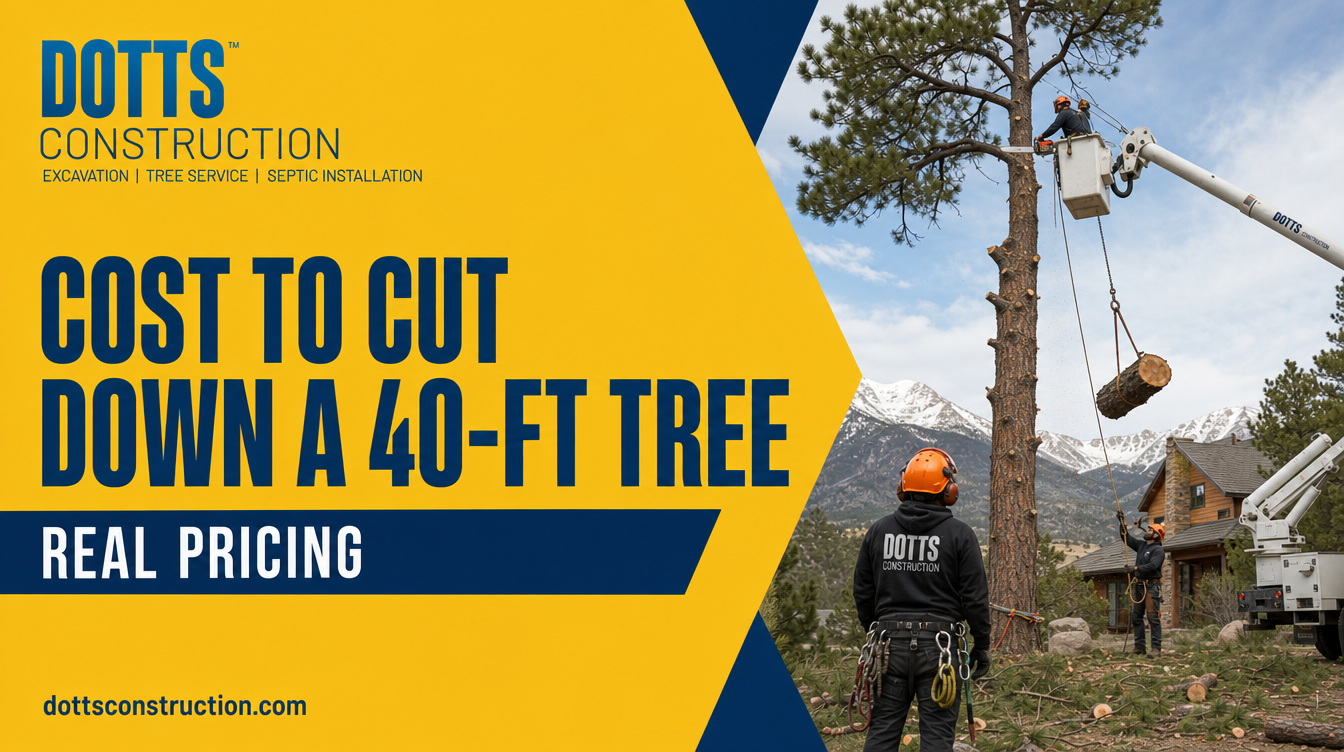
Removing a 40-Foot Tree?
What Dotts actually charges: the tree removal jobs we take on typically run $3,000 to $6,000, and can reach $10,000 for large or high-risk trees close to buildings and power lines. We focus on bigger removals and don’t quote jobs under $3,000. Every tree is different, so request a free on-site estimate or call (719) 280-4141.
Cutting down a 40-foot tree typically costs between $450 and $1,500, with most homeowners landing around $850 for a standard removal. That range shifts fast depending on the tree's location, species, condition, and what you want done with the debris afterward. Here is exactly what drives the price and how to avoid overpaying.
Why Does Tree Removal Cost So Much?
Let's be honest: most homeowners are shocked when they get their first tree removal quote. The number feels high until you understand what is actually happening on your property.
Professional tree removal is a combination of arboriculture, rigging engineering, and heavy equipment operation. A crew is not just swinging chainsaws. They are calculating fall zones, rigging limbs to prevent structural damage, operating bucket trucks that cost $150,000 or more, and managing liability on your property. When you understand that, the price makes complete sense.
Here's the thing: a 40-foot tree falls squarely in what arborists call the "medium tree" category, defined as trees between 30 and 60 feet tall. That size bracket carries its own labor and equipment demands that differ significantly from small ornamental trees or massive 80-foot hardwoods.
What Is Included in a Standard 40 ft Tree Removal Quote?
Most quotes for cutting down a 40-foot tree cover basic felling and sectional cutting down to a stump. Everything beyond that is usually an add-on.
Here is what each line item typically costs:
| Service | Estimated Cost | Notes |
|---|---|---|
| Basic Felling and Cutting | $3,000 to $6,000 | Cuts the tree down, sections the trunk |
| Wood Chipping | $3,000 to $6,000 per hour | Converts branches into mulch |
| Debris Hauling | $3,000 to $6,000 | Removes all wood from your property |
| Stump Grinding | $3,000 to $6,000 | Grinds the stump below ground level |
| Full-Service Removal (all included) | $3,000 to $6,000+ | Felling, chipping, hauling, grinding |
Pro Tip: Always ask whether the quote is for felling only or full-service removal. A $500 quote that leaves a 40-foot log pile in your yard and a stump in the ground is not the deal it appears to be.
What Factors Push the Price Higher or Lower?
How Does Tree Location Affect the Cost?
Location is the single biggest cost lever in any tree removal job. A 40-foot tree in an open field can cost half as much to remove as an identical tree wedged against a fence line, a structure, or a power line.
Here is how access changes the price:
- Open access with truck access: Bucket trucks and chippers park close. Crew works efficiently. Cost stays near the low end of $3,000 to $6,000.
- Tight backyard, no vehicle access: Workers must climb and hand-rig every limb down piece by piece. Labor time doubles or triples. Expect $3,000 to $6,000+.
- Trees near power lines: Utilities must sometimes be notified. The crew works under stricter safety protocols, and liability is higher. Hazard premiums of $3,000 to $6,000 are common.
- Trees leaning over a roof or structure: Every cut becomes a precision rigging operation. The margin for error is zero. Expect the high end of the range.
How Does Tree Species Impact the Price?
Species matters more than most people realize.
A slender 40-foot pine has a relatively narrow canopy, a single trunk leader, and wood that falls in predictable ways. A 40-foot oak or maple at the same height can have a spread of 30 to 40 feet, multiple heavy limb unions, and a trunk diameter of 18 to 24 inches at the base. The oak costs significantly more to remove, even though both are listed as "40-foot trees."
Common species and their relative removal complexity:
- Pine, poplar, tulip tree: Lower complexity, lower cost
- Maple, ash, birch: Moderate complexity
- Oak, elm, hickory: Higher complexity, heavier wood, more labor
- Leaning or multi-trunk trees of any species: Always carry a hazard premium
Does Tree Health Change the Price?
Yes, but not in the direction most people expect. A dead or rotting tree is often more expensive to remove, not less, because it is structurally unpredictable.
A healthy 40-foot tree is heavy and hard to cut. But it behaves predictably under a chainsaw. A dead tree with internal rot or hollow sections can fail unexpectedly mid-climb, creating serious injury risk for the crew. Companies price this risk into a hazard premium that can add $3,000 to $6,000 to the base quote.
Note: Always disclose a tree's condition when getting quotes. Hiding rot or storm damage creates liability issues and can invalidate your agreement if something goes wrong on the job.
How Does Trunk Diameter Change the Removal Cost?
Two trees can both be 40 feet tall and carry wildly different price tags based on trunk diameter alone. Trunk diameter at breast height (DBH) is the measurement arborists use at 4.5 feet off the ground.
A 40-foot pine might have a DBH of 8 to 10 inches. A 40-foot white oak could have a DBH of 24 to 30 inches. The oak has 9 times the wood volume at the base. It requires more chainsaw passes, more time per cut, faster chain wear, and more muscle to roll and section. Labor time scales with diameter, not just height.
DBH and cost impact:
- Under 12 inches: Minimal impact on base price
- 12 to 18 inches: Moderate upcharge, $3,000 to $6,000
- 18 to 24 inches: Significant upcharge, $3,000 to $6,000
- Over 24 inches: Major upcharge, $3,000 to $6,000+
Tree Removal vs. Land Clearing: What Is the Difference?
This question comes up constantly, and the answer matters if you have more than one tree to deal with.
Single tree removal is a precision job. Crews protect the surrounding landscape, your lawn, your garden beds, and your structures. Price is per-tree.
Land clearing is a volume operation. When you need multiple trees removed across an area to prepare for construction, a driveway, a foundation, or a septic system, the economics shift entirely. A land clearing crew uses different equipment (bulldozers, track hoes, brush cutters) and prices by the acre rather than by the tree.
| Service | Unit | Best For | Equipment |
|---|---|---|---|
| Single Tree Removal | Per tree | One to a few hazard trees | Bucket truck, chainsaw, chipper |
| Lot Clearing | Per acre | Construction site prep | Excavator, bulldozer, brush cutter |
| Selective Clearing | Per tree or zone | Wooded lots, keeping some trees | Mixed equipment |
If you are clearing land for a construction project, a single-tree service is almost never the right call. A company like Dotts Construction, which handles tree removal as part of full land clearing and site preparation, will give you a far more efficient and cost-effective solution than hiring a traditional arborist for each tree individually.
[Citation needed: industry-standard pricing comparison between per-tree arborist removal and per-acre land clearing rates from a trade association source such as the Tree Care Industry Association]
How to Save Money on 40 ft Tree Removal (Without Cutting Corners)
Saving money on tree removal does not mean finding the cheapest crew. It means making smart decisions before, during, and after the job. Here are the approaches that actually work.
Keep the wood on-site. If you ask the crew to skip hauling, you can shave $3,000 to $6,000 off the invoice. You take responsibility for moving or disposing of the sections yourself. Offer split rounds to neighbors for firewood and the pile disappears fast.
Get three quotes minimum. Pricing varies between companies by as much as 40% for identical work. Do not accept the first number you hear. Three quotes give you a real market price for your specific job.
Schedule in late winter. February and March are the slowest months for tree crews in most of the country. Companies want to keep crews busy and are more likely to negotiate on price. According to the Tree Care Industry Association (TCIA), late winter is the lowest-demand period for residential arborist services.
Bundle jobs if you have multiple trees. If you have two or three trees to remove, ask for a multi-tree discount. Mobilizing a crew and equipment to your property has a fixed cost. Spreading that fixed cost across multiple trees lowers the per-tree price.
Never skip the insurance check. Always verify that any tree removal company carries worker's compensation and general liability insurance before they step foot on your property. Ask for certificates of insurance. If an uninsured worker is injured on your property, you may face legal and financial exposure. A low-bid uninsured contractor is not a deal. It is a financial risk with a chainsaw.
Pro Tip: Ask your homeowner's insurance company whether tree removal from a storm-damaged tree is covered before you pay out of pocket. Many policies cover removal when a fallen tree has damaged a covered structure.
What Happens to Your Property After the Tree Comes Down?
Tree removal does not end when the tree hits the ground. What happens next depends on your goals for the property.
If you just want the tree gone: Stump grinding brings the stump 6 to 12 inches below grade, leaving a smooth area you can cover with topsoil and seed. Cost: $3,000 to $6,000 depending on diameter.
If you are preparing for construction: A ground stump is not enough. Root systems from a 40-foot tree can extend outward 1.5 to 3 times the tree's height, or up to 60 to 120 feet, according to research from the University of Florida IFAS Extension. Those roots must be addressed before pouring foundations, installing driveways, or running septic lines.
If you are planning land clearing for a construction project, this is exactly where Dotts Construction's experience becomes critical. We do not just take the tree. We evaluate what the root system means for your foundation excavation, driveway grading, or septic system installation. That full-site perspective prevents expensive surprises after the tree is gone.
[Quote: Insert unique insight from verified arborist or excavation contractor about the hidden costs of tree stumps and root systems on construction-ready lots here]
How Does Dotts Construction Approach Tree Removal and Land Clearing?
At Dotts Construction, tree removal is not a standalone service we bolt onto a truck. It is the first step in a larger process we call the Dotts 3M Method: a systematic approach to moving, managing, and making land ready for whatever comes next.
We built this method because we kept seeing the same problem: homeowners or builders would hire a tree service, get the trees down, then call an excavation company to prep the site, and discover that the two crews had not coordinated at all. The result was duplicate mobilization costs, unexpected root obstructions, and project delays.
The Dotts 3M Method treats your property as a single system, not a collection of separate problems. Tree removal, land clearing, grading, drainage, foundation excavation, and septic system installation are sequenced and planned together from day one.
We have seen projects derailed because a tree crew left root balls that interfered with septic line installation. We have seen driveways fail because clearing crews did not account for drainage patterns when removing tree rows. These are not fringe scenarios. They happen on a regular basis when you hire disconnected contractors.
Here is what we do differently: before we touch a tree, we know where your driveway is going, where your foundation sits, and where your septic system will be installed. Every cut we make is informed by where the project is going, not just where the tree is standing.
FAQ: Tree Removal Costs and What to Expect
How much does it cost to cut down a 40 ft tree?
Cutting down a 40-foot tree costs between $450 and $1,500, with a typical average of $850. Final price depends on accessibility, species, trunk diameter, tree health, and what services you include such as stump grinding and debris hauling.
Is a 40 ft tree considered large or medium?
A 40-foot tree is classified as a medium tree by most arborists, who define the medium category as 30 to 60 feet tall. Large trees are generally over 60 feet and carry significantly higher removal costs, often starting at $1,500 and reaching $3,000 or more.
Does stump grinding add a lot to the cost?
Stump grinding adds $3,000 to $6,000 to a removal job depending on stump diameter and ground conditions. It is worth the cost in most cases because a surface stump creates a tripping hazard, attracts termites, and prevents future landscaping or construction in that area.
Can I get tree removal covered by homeowner's insurance?
Homeowner's insurance sometimes covers tree removal if the fallen tree damaged a covered structure such as your house, fence, or garage. Removal of a standing tree that has not yet caused damage is almost never covered. Always call your insurer before assuming coverage applies.
How long does it take to remove a 40 ft tree?
A 40-foot tree in an accessible location with open drop space takes a professional crew 2 to 4 hours to fell, section, and chip. Trees in tight locations requiring hand-rigging can take 6 to 8 hours or a full day, which directly increases labor cost.
What is the difference between tree removal and land clearing?
Tree removal is a precision service for individual trees, priced per tree. Land clearing is a volume operation for multiple trees and brush across an area, typically priced per acre. Land clearing uses different equipment and is far more cost-effective when you need more than 3 to 5 trees removed.
How far do tree roots extend after removal?
According to the University of Florida IFAS Extension, tree roots typically extend 1.5 to 3 times the tree's height in radius. A 40-foot tree can have roots extending 60 to 120 feet from the base. Root systems must be assessed before any foundation, driveway, or septic installation.
Ready to Clear Your Land the Right Way? Here Is What to Do Next
If you have a 40-foot tree (or a full lot of trees) to deal with before your construction project can move forward, the worst thing you can do is hire a tree service in a silo. The second worst thing is doing nothing and watching your timeline slip.
Dotts Construction handles the full sequence: tree removal, land clearing, site grading, foundation excavation, driveway prep, and septic system design and installation. You get one coordinated crew, one plan, and a site that is actually ready for construction when we leave.
Call us directly or request a free site evaluation for your property. We will walk the land with you, map out the obstacles, and give you a clear plan and price before any equipment rolls.
Request a free consultation or call (719) 280-4141
Do not let a tree or a pile of brush hold your construction project hostage. Let's move the land and get your project started.
Related Guides
Need the pros? See Tree Removal Services. More reading:
About the Author
Michael Dotts brings over 15 years of hands-on experience in heavy construction and grading, with a specialty in the unique demands of building in the Rocky Mountains, where steep terrain, rocky ground, and harsh weather change the rules most flatland contractors are used to. Because Michael knows what it really takes to get the job done right in Colorado’s high country, you can count on honest, accurate quotes that won’t creep up halfway through the job.