
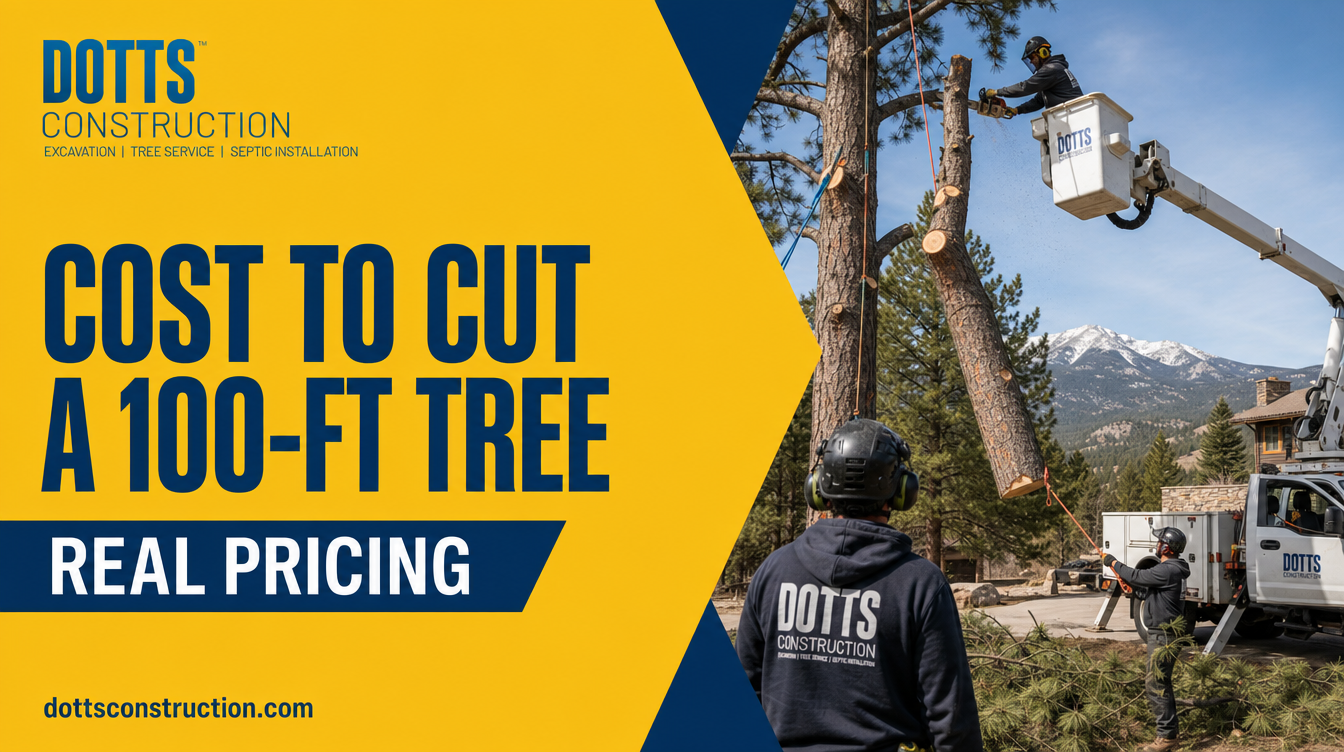
Removing a Towering 100-Foot Tree?
What Dotts actually charges: a tree this size is exactly the kind of job we specialize in. These removals typically run $3,000 to $6,000, and jobs needing cranes, aerial lifts, or sectional rigging near structures or power lines often land at $10,000 or more. We focus on bigger removals and don’t quote jobs under $3,000. Every tree is different, so request a free on-site estimate or call (719) 280-4141.
Cutting a 100 ft tree typically costs between $1,500 and $4,500, with most homeowners paying around $2,500 when all factors are averaged out. The final price depends on species, access, lean direction, proximity to structures, and whether stump removal is included. Prices vary by region, so local quotes are essential.
Why Does Tree Size Matter So Much for Removal Cost?
Tree height is the single biggest cost driver in any removal job. And a 100 ft tree is not a small job.
At that height, you are looking at a tree that likely weighs several tons. The crew needs specialized rigging equipment, often a crane or aerial lift, and at least 3 to 4 skilled climbers or operators working together. That means more labor hours, more fuel, more disposal volume, and more insurance liability on the job site.
Here is a simple way to think about it: a 30 ft tree might cost $3,000 to $6,000. A 60 ft tree runs $3,000 to $6,000. A 100 ft tree can push $4,500 or higher depending on conditions.
The cost of tree removal scales non-linearly with height. Every 10 ft of additional height adds risk, rigging complexity, and disposal volume, which is why the price jump from a medium tree to a very large one feels dramatic.
What Is the Average Cost Breakdown for a 100 ft Tree Removal?
Let's break this down into the actual line items a professional crew will price out.
Typical cost components for a 100 ft tree removal:
- Labor: $3,000 to $6,000 depending on crew size and hours on site
- Equipment (crane/lift/chipper): $3,000 to $6,000 for rental or mobilization
- Debris hauling and disposal: $3,000 to $6,000 depending on volume and local dump fees
- Stump grinding: $3,000 to $6,000 depending on stump diameter
- Permits (if required): $3,000 to $6,000 depending on local municipality
- Emergency or hazard surcharge: $3,000 to $6,000 if the tree is leaning, dead, or storm-damaged
Total estimated range: $1,500 to $4,500+
That wide range exists because a 100 ft oak in an open field with direct equipment access is a very different job from a 100 ft dead pine leaning over your roof in a tight suburban yard.
Pro Tip: Always get a minimum of 3 written quotes before committing. Price variation of 40% to 60% between contractors is common on large tree jobs.
What Factors Drive the Price of Tree Removal Near You Up or Down?
This is where most cost guides fall short. They give you a number but not the logic behind it. Here is every variable that actually moves the needle.
Is the Tree Dead or Diseased?
Dead trees are more dangerous to remove, not less. A dead tree has unpredictable structural integrity. Branches can snap during cutting. The trunk can split unexpectedly. Crews charge a hazard premium of 25% to 50% above the standard rate for dead or structurally compromised trees.
How Close Is It to Your House, Power Lines, or Other Structures?
This is the biggest site-specific cost driver. When a tree is within falling distance of a structure, crews cannot use the fastest (and cheapest) method of felling it in one piece. Instead, they section it from the top down, piece by piece, rigging each section to control its descent. That process takes 3 to 5 times longer than a simple fell.
Trees within 10 ft of a structure or power line should always be handled with sectional removal techniques, which adds $3,000 to $6,000 to the base price.
What Species Is It?
Wood density and branch structure affect how long the job takes.
| Tree Species | Approximate Weight per Cubic Foot | Removal Difficulty |
|---|---|---|
| White Oak | 47 lbs | High (dense, heavy limbs) |
| Eastern Pine | 29 lbs | Moderate (tall, manageable) |
| Cottonwood | 24 lbs | Lower (lighter wood) |
| Silver Maple | 33 lbs | Moderate (brittle, fast-growing) |
| Black Walnut | 38 lbs | High (dense, valuable wood) |
Pro Tip: If you have a black walnut at 100 ft, ask the removal company if they will buy the lumber or credit you for it. High-quality walnut logs can offset $3,000 to $6,000 in removal costs.
What Is the Equipment Access Like?
Can a crane truck or large chipper get to within 50 ft of the tree? If yes, the job is significantly easier. If your tree is in a back yard behind a fence line or on a steep slope, all that equipment has to stay at the street. That means more hand work, more rope rigging, and longer job time.
No-access tree removals can cost 30% to 60% more than standard access jobs.
Does Your Municipality Require a Permit?
Some cities and counties, particularly those with heritage tree ordinances, require a permit before removing any tree over a certain diameter or height. Permit fees themselves are usually minor ($3,000 to $6,000). But failing to pull a permit can result in fines of $500 to $5,000 or more depending on the jurisdiction.
Always ask your contractor: "Do I need a permit for this tree?" A professional crew will know the local rules.
How Does Tree Removal Near Me Fit Into a Larger Land Clearing Project?
Here is something most homeowners do not realize until they are already mid-project: tree removal and land clearing are not the same service, and pricing them separately is almost always more expensive than bundling them.
If you are removing a 100 ft tree because you are preparing land for a driveway, foundation, or construction project, you should be talking to an excavation and land clearing company, not just a tree service.
Here is why. A dedicated tree removal crew cuts the tree and leaves. An excavation company with land clearing capabilities will:
- Remove the tree
- Grind or extract the stump below grade
- Clear surrounding brush
- Grade the raw soil
- Prepare the site for construction
When you bundle those services, you eliminate the double mobilization cost (two separate companies showing up with two sets of trucks and trailers). You save $3,000 to $6,000 in redundant hauling and setup fees, and the final site is actually construction-ready instead of just "tree-less."
At Dotts Construction, we handle tree removal as part of our full land clearing and site preparation services. We do not just cut your tree. We use the Dotts 3M Method to leave your ground transformed and ready for whatever comes next, whether that is a foundation, a driveway, or a septic system install. Rough ground becomes construction-ready ground.
What Should You Expect on the Day of a Large Tree Removal?
If you have never watched a professional crew work a 100 ft tree, here is the process.
Standard large tree removal sequence:
- Site assessment (30 to 60 minutes): The crew walks the property, identifies hazards, and determines the felling or sectioning plan. They mark the drop zone and secure the perimeter.
- Equipment setup: The crane or aerial lift is positioned. Ground crew sets up chipper and debris staging area.
- Top-down sectioning: Starting from the crown, climbers or lift operators work down in 10 to 20 ft sections. Each section is rigged to prevent uncontrolled falls.
- Trunk removal: Once the canopy is cleared, the trunk is sectioned from the top down. Larger diameter sections may be left as rounds for you to split as firewood (ask in advance if you want this).
- Stump grinding (if included): A stump grinder reduces the stump to 6 to 12 inches below grade. The wood chips are often left as mulch or hauled off depending on your agreement.
- Site cleanup: A professional crew leaves your yard clean. Brush is chipped, rounds are stacked or removed, and the equipment is packed out.
A 100 ft tree in moderate conditions takes a crew of 3 to 4 workers approximately 4 to 8 hours.
Note: If your contractor quotes less than 3 hours for a 100 ft tree near structures, ask detailed questions about their process. Speed on a large hazardous tree job is not a feature. It is a warning sign.
How Do You Hire a Reliable Tree Removal Company Near You?
This is where the industry earns its bad reputation. Let's be honest: the tree service world is full of storm chasers, unlicensed crews, and operators who quote low and add costs once they are on your property.
Here is how to avoid a bad hire.
The 5 non-negotiables when hiring a tree removal contractor:
- Proof of liability insurance and workers' comp: Ask for a certificate of insurance naming you as an additional insured for the day of the job. If they balk at this, walk away.
- Written, itemized quote: Every line item should be spelled out, including debris hauling, stump grinding, and any permit fees. Verbal quotes are not quotes.
- References from similar jobs: Ask specifically for references from large tree removals (70 ft or taller), not just general landscaping or small tree work.
- Clear communication before and during the job: The best companies, in every industry review we have read, get praised for one thing more than anything else: they communicate. They show up when they say. They call when plans change. They explain what they are doing and why.
- No upfront cash payment requirements: A deposit of 10% to 30% is reasonable. Requiring full payment before work starts is a red flag.
We hear this from customers constantly: "I just needed someone to show up when they said they would and do what they promised." It sounds like a low bar. But in the contractor world, clearing that bar consistently is what separates great crews from ones you warn your neighbors about.
Does Stump Removal Cost Extra After Tree Cutting?
Yes, almost always. Stump removal is a separate service in most tree removal contracts. Here is what to expect.
Stump grinding vs. stump removal:
| Method | What It Does | Average Cost | Best For |
|---|---|---|---|
| Stump grinding | Grinds stump 6 to 12 inches below grade | $3,000 to $6,000 per stump | Lawn areas, cosmetic removal |
| Full stump extraction | Pulls entire root ball from ground | $3,000 to $6,000+ per stump | Construction sites, foundation prep |
| Chemical treatment | Accelerates decay over 12 to 24 months | $3,000 to $6,000 | Non-urgent removal in open areas |
For construction or land prep projects, full stump extraction is almost always the right choice. Buried wood rots and creates voids under driveways and foundations. Grinding leaves roots in place. Extraction leaves a clean, buildable substrate.
Frequently Asked Questions About Cutting a 100 ft Tree
How long does it take to cut down a 100 ft tree?
A professional crew of 3 to 4 workers typically needs 4 to 8 hours to remove a 100 ft tree. Variables include proximity to structures, equipment access, whether stump grinding is included, and overall site conditions. Budget a full day for safe, thorough work.
Is it cheaper to cut a tree yourself instead of hiring a professional?
DIY tree removal on a tree over 30 ft is dangerous and often illegal without permits. A 100 ft tree presents fatal fall, snap, and crush hazards that require specialized training and equipment. The potential liability and injury cost far exceeds any savings from skipping a professional crew.
Does homeowner's insurance cover tree removal near me?
Standard homeowner's insurance typically covers tree removal only when the tree falls on a covered structure (house, fence, garage). Preventive removal of a standing tree, even a hazardous one, is almost never covered. Confirm with your insurer before assuming coverage.
What time of year is cheapest for tree removal?
Late winter (January through March) is typically the slowest season for tree services, and some companies offer 10% to 20% discounts. Avoid calling during or immediately after major storms when demand spikes and prices follow.
Can I keep the wood after my tree is removed?
Yes. Most contractors will split the trunk and leave rounds for firewood if you request it. If your tree is a high-value hardwood like walnut or cherry, a sawyer may purchase the logs from you, which can offset removal costs by $3,000 to $6,000 or more.
What happens if a tree removal company damages my property?
This is why liability insurance matters. A licensed, insured contractor carries coverage for property damage caused during the job. Get that certificate of insurance before work starts. Uninsured contractors leave you with no recourse if a section drops on your roof.
How much does land clearing cost if I have multiple large trees?
Land clearing pricing shifts to a per-acre model when you have multiple trees and brush across a larger area. Most land clearing projects run $1,500 to $6,000 per acre depending on density, terrain, and what needs to happen after clearing. Bundling tree removal with full site prep almost always saves money versus hiring separate contractors.
Ready to Get Your Site Cleared and Construction-Ready?
If you are looking at a 100 ft tree (or five of them) and you need more than just a tree cut, you need your ground ready for what comes next. A driveway. A foundation. A septic system. A building pad. That is exactly what Dotts Construction does.
We use the Dotts 3M Method to take raw, rough land and transform it into a meticulously prepared site that keeps your construction project moving. We show up when we say we will. We communicate every step. And we do not leave until the ground is ready.
No contractor drama. No vague estimates that balloon on day two. Just a site that is ready for your build.
Call Dotts Construction today for a written, itemized quote on tree removal, land clearing, grading, excavation, or septic system design and install.
Request a free consultation or call (719) 280-4141
Related Guides
Need the pros? See Tree Removal Services. More reading:
About the Author
Michael Dotts brings over 15 years of hands-on experience in heavy construction and grading, with a specialty in the unique demands of building in the Rocky Mountains, where steep terrain, rocky ground, and harsh weather change the rules most flatland contractors are used to. Because Michael knows what it really takes to get the job done right in Colorado’s high country, you can count on honest, accurate quotes that won’t creep up halfway through the job.