
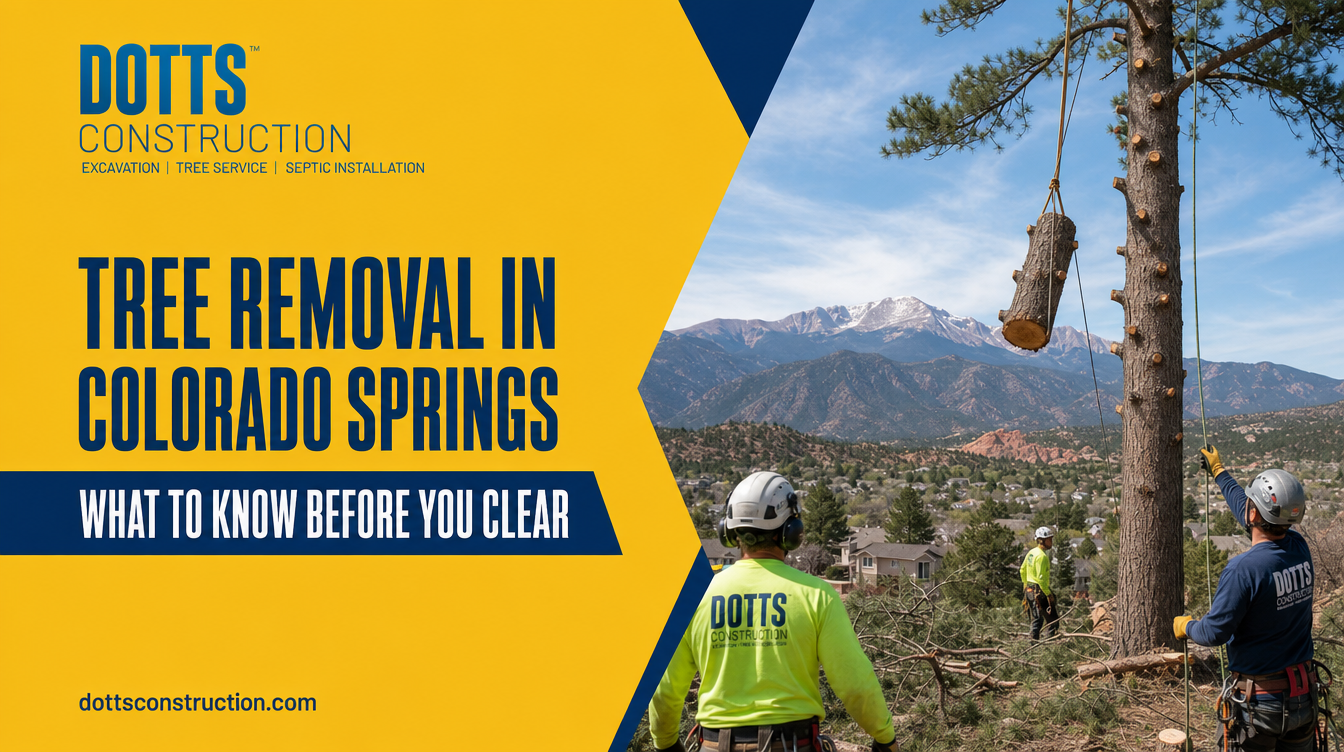
Need a Tree Removed in Colorado Springs?
What Dotts actually charges: the tree removal jobs we take on typically run $3,000 to $6,000, and can reach $10,000 for large or high-risk trees close to buildings and power lines. We focus on bigger removals and don’t quote jobs under $3,000. Every tree is different, so request a free on-site estimate or call (719) 280-4141.
Tree removal in Colorado Springs is the process of safely cutting down, grinding, and clearing trees from a property to make way for construction, improve site safety, or reclaim usable land. A professional crew handles everything from felling the trunk to stump grinding and debris hauling, leaving the ground ready for whatever comes next.
If you have a site that needs clearing before a driveway, foundation, or septic install, you need to understand exactly what tree removal involves, what it costs in the Colorado Springs area, and how to choose a crew that won't leave you with a mess or a delay.
Let's get into it.
What Is Tree Removal and When Do You Actually Need It?
Tree removal is the complete extraction of a tree from a property, including the trunk, major limbs, and typically the stump. It is not the same as tree trimming or pruning, which only removes select branches while keeping the tree alive and standing.
You need professional tree removal when:
- A tree is dead, diseased, or structurally compromised and poses a fall risk
- A tree is located where construction is planned (foundation footprint, driveway corridor, utility line path)
- Root systems are undermining existing structures, driveways, or septic fields
- Fire mitigation requirements call for thinning dense vegetation
- You are clearing raw land before breaking ground
Here's the thing: a lot of homeowners wait too long. A dead pine on the Front Range doesn't just look bad. It becomes a liability. And a tree sitting inside your planned foundation footprint doesn't move itself. The sooner you address it, the fewer surprises hit your construction timeline.
Pro Tip: If you are hiring an excavation company for land clearing ahead of construction, ask whether they handle tree removal as part of the package. Companies like Dotts Construction bundle tree removal with land clearing, grading, and site prep, which saves you from coordinating three separate contractors.
How Much Does Tree Removal Cost in Colorado Springs?
Tree removal in Colorado Springs typically costs between $300 and $2,500 per tree, depending on the size of the tree, its location on the property, and how difficult it is to access and fell safely.
Here is a general cost breakdown by tree size:
| Tree Size | Approximate Height | Estimated Cost Range |
|---|---|---|
| Small | Under 25 feet | $3,000 to $6,000 |
| Medium | 25 to 75 feet | $3,000 to $6,000 |
| Large | 75 to 100 feet | $3,000 to $6,000 |
| Very Large / Hazard | Over 100 feet | $3,000 to $6,000+ |
Factors that drive costs higher include:
- Proximity to structures, fences, or power lines (increases rigging complexity)
- Steep terrain or limited equipment access (common on Colorado Springs properties in the foothills)
- Stump grinding (usually quoted separately at $3,000 to $6,000 per stump)
- Debris hauling and disposal (some companies leave wood on-site; others haul everything away)
- Multiple trees on a single property (volume discounts are common)
When tree removal is part of a larger land clearing and site prep scope, the per-tree cost often drops significantly. If Dotts Construction is already mobilizing equipment to excavate your foundation or install a septic system, clearing a handful of trees on the same visit is far more cost-effective than scheduling a standalone tree crew.
Pro Tip: Always get a written line-item quote that separates tree removal, stump grinding, and debris removal. Vague estimates are where construction budgets go wrong.
What Is the Difference Between Tree Removal and Land Clearing?
Tree removal targets specific individual trees. Land clearing is the large-scale removal of all trees, brush, stumps, and surface vegetation from a defined area to prepare ground for construction.
Here is a comparison of both services:
| Service | Scope | Best For | Equipment Used |
|---|---|---|---|
| Tree Removal | Single or select trees | Hazard removal, specific site prep | Chainsaw, chipper, bucket truck |
| Land Clearing | All vegetation across a site | Full site prep for construction | Excavator, bulldozer, mulcher, chainsaw |
When you are preparing land for a home build, garage, driveway, or septic system in Colorado Springs, you almost always need land clearing, not just isolated tree removal. The distinction matters because the right company for the job brings excavation equipment, not just a chainsaw crew.
Dotts Construction handles both. If your property needs trees dropped, brush cleared, stumps ground, and the ground graded smooth, one mobilization handles all of it. That's what prevents the "three different contractors, three different schedules, zero coordination" problem that derails so many construction timelines.
Why Is Tree Removal in Colorado Springs Different From Other Areas?
Colorado Springs sits at roughly 6,000 feet elevation, and many surrounding properties push into the foothills at 7,000 to 9,000 feet. That geography creates site conditions that make tree removal more complex than it would be on flat suburban land in other states.
Here is what makes tree removal in Colorado Springs distinctly challenging:
- Slope and terrain: Rocky, sloped terrain limits equipment access and changes how trees can be safely felled without damaging downhill structures.
- Rocky soil and root systems: Trees growing in the rocky Front Range soils develop aggressive root structures that require more effort to fully remove or grind.
- High winds and Ponderosa pine: The area's dominant Ponderosa pines are tall, heavy, and often widowmakers when dead. They require precise felling techniques.
- Fire mitigation concerns: Colorado state agencies including Colorado State Forest Service recommend maintaining defensible space around structures. This often means removing trees within 30 to 100 feet of a home, depending on slope grade.
- Wildfire season timing: Many homeowners in El Paso County schedule tree removal and land clearing in the spring before fire season peaks, meaning crews book up quickly from March through May.
Colorado Springs tree removal crews need to understand excavation, slope management, and site prep, not just arboriculture. A company that only does tree work may leave you with stumps, uneven ground, and a site that still isn't ready for construction. That's a second contractor call you didn't plan for.
Does Colorado Springs Require a Permit for Tree Removal?
Most tree removal on private property in Colorado Springs does not require a city permit, as long as the tree is not a designated heritage or landmark tree. However, properties within certain HOA communities, fire-mitigation zones, or near public rights-of-way may have additional requirements.
Here is a practical checklist before you start:
- Check your HOA rules. Many Colorado Springs HOAs regulate tree removal and may require approval before any cutting begins.
- Confirm property boundaries. Cutting a neighbor's tree, even if it overhangs your lot, can create legal liability.
- Identify heritage trees. The City of Colorado Springs has a Heritage Tree Program. Trees meeting size and species thresholds may be protected.
- Check for utility easements. Trees near power lines may require coordination with Colorado Springs Utilities before removal.
- Wildfire mitigation grants. El Paso County and the Colorado State Forest Service offer cost-share programs for tree thinning in wildfire-prone areas. Your removal may qualify for partial reimbursement.
Note: Permit requirements change. Always confirm with the City of Colorado Springs Development Services or El Paso County Planning before you break ground. A qualified contractor should be able to walk you through this, and if they can't, that's a red flag.
What Happens to the Wood and Debris After Tree Removal?
This is one of the most overlooked parts of planning a tree removal, and it's where a lot of companies leave homeowners holding the bag.
After a tree is removed, you have several options for the material:
- Chipping: Branches and small limbs are fed through a chipper. The resulting wood chips can be left on-site as mulch or hauled away.
- Log splitting: Large trunks and limbs can be cut into firewood lengths and stacked on-site if you heat with wood.
- Full haul-away: All wood, chips, and debris are loaded and removed from the property. This is what you want if the site needs to be cleared for construction.
- Burning (where permitted): El Paso County has specific burn permit rules. Open burning of debris is sometimes allowed in rural areas outside city limits, but regulations change seasonally.
- Stump grinding: The stump is ground down 6 to 12 inches below grade, turning it into wood chips that can be raked into the surrounding soil.
For construction site prep, full haul-away is the right call. You do not want wood chips buried under a foundation or compacted into a subgrade for a driveway. Organic material left in the ground decomposes, creates voids, and causes settling.
Pro Tip: Ask your contractor explicitly: "What happens to every piece of this tree?" Get the answer in writing.
How Does Tree Removal Fit Into a Larger Excavation and Land Clearing Project?
This is the part most homeowners don't think about until they're two weeks into a project and the schedule has already slipped.
Tree removal rarely happens in isolation. On most Colorado Springs construction sites, it is one phase of a multi-step site preparation process that includes:
- Tree removal and stump grinding (clearing surface vegetation)
- Topsoil stripping and stockpiling (preserving usable organic material)
- Rough grading (establishing proper drainage slope and elevation)
- Excavation (foundation trenches, basement dig, utility corridors)
- Septic system design and installation (if outside city sewer service)
- Final grading and compaction (preparing the surface for driveway base, foundation forms, or landscaping)
When you hire a company that handles all of these phases, like Dotts Construction does with the Dotts 3M Method, the site stays on a single coordinated schedule. Equipment is already on-site. The crew knows what the finished grade needs to look like. They're not just dropping trees and leaving you to figure out the next step.
The alternative is running separate contracts for tree removal, grading, and excavation. Three different companies. Three different mobilization fees. Three different crews who have never talked to each other. That's how projects get delayed by weeks, budgets blow up, and homeowners end up frustrated.
How Do You Choose the Right Tree Removal Company in Colorado Springs?
Not every crew that owns a chainsaw should be on your property. Here is what to look for before you hire:
Credentials and insurance:
- General liability insurance (minimum $1 million; ask for the certificate)
- Workers' compensation coverage for every crew member
- ISA (International Society of Arboriculture) certification is a plus for standalone tree work
Scope of capability:
- Can they handle stump removal, not just tree felling?
- Do they offer full debris haul-away?
- If this is for construction, can they also grade the site after clearing?
Communication and reliability:
- Do they return calls and give firm written estimates?
- Do they show up when they say they will?
Let's be honest: the biggest complaint in the excavation and land clearing industry isn't price. It's contractors who don't communicate, give vague quotes, then disappear. According to multiple verified Google reviews of Colorado Springs-area contractors, the standout companies share a single trait: they showed up when they promised, communicated throughout the job, and left the site clean.
Pro Tip: Ask the company for two references from jobs that involved both tree removal and grading. That tells you whether they can coordinate the full scope, not just one piece of it.
What Is the Best Time of Year for Tree Removal in Colorado Springs?
Tree removal can be performed year-round in Colorado Springs, but late fall through early spring (October through March) is generally the best window for most homeowners. Here's why:
- Dormant trees are lighter and easier to handle. Less foliage means less crown weight and cleaner felling lines.
- Frozen or firm ground protects your yard. Heavy equipment causes less rut damage when the soil is cold and hard.
- Crews are more available. Spring and summer are peak seasons for excavation and construction in El Paso County. Booking in winter often means faster scheduling and more flexibility.
- Fire season awareness. Removing dead or hazard trees before the June to September fire season reduces risk on your property.
The exception: if a tree is an immediate safety hazard, you remove it immediately, regardless of season.
Frequently Asked Questions About Tree Removal in Colorado Springs
How long does tree removal take in Colorado Springs?
A single residential tree removal typically takes two to six hours. Large trees, difficult access, or steep terrain can extend that to a full day. Land clearing projects covering larger acreage are scoped per site and may take several days to a week depending on tree density and ground conditions.
Is stump grinding included in tree removal quotes?
Stump grinding is usually a separate line item. Always ask for it to be quoted explicitly. For construction projects, stump removal is non-negotiable because buried organic material causes ground settling that can compromise foundations and driveways.
Do I need to be home during tree removal?
You do not need to be present, but you should confirm access and any site-specific concerns before the crew arrives. Clearly mark any underground utilities, irrigation lines, or areas where equipment should not travel. Dial 811 before any ground work to have utilities marked.
What is the average cost for land clearing in Colorado Springs?
Land clearing in Colorado Springs typically runs between $1,500 and $6,000 per acre, depending on tree density, terrain, and whether stumps are ground and removed. Dense wooded parcels in the foothills will sit at the higher end of that range.
Can tree removal damage my lawn or landscaping?
Heavy equipment can cause rut damage to turf if the ground is wet or soft. A reputable contractor uses equipment appropriate for the site conditions and lays plywood or mats to protect high-traffic areas when needed. Ask specifically what steps they take to protect your property during access.
Will Dotts Construction haul away all the debris?
Yes. Dotts Construction provides complete site clearing including tree removal, stump grinding, debris haul-away, and rough grading as part of an integrated land clearing scope. You are not left managing a pile of logs and branches while your construction project waits.
How far in advance should I book tree removal in Colorado Springs?
Book at least three to six weeks in advance for spring and summer projects, when excavation and construction season peaks in El Paso County. Late fall and winter bookings often have shorter lead times. If you have an urgent hazard tree, call immediately and explain the situation.
Ready to Clear Your Site? Here's How to Move Forward With Dotts Construction
Your construction project cannot start on a site that hasn't been cleared. Every day the land sits with trees standing in your foundation footprint or your driveway corridor is another day your timeline slips.
Dotts Construction handles tree removal as part of a fully integrated site preparation service in Colorado Springs and the surrounding El Paso County area. That means tree felling, stump grinding, debris removal, rough grading, foundation excavation, and septic system installation all coordinated under one contract, on one schedule, with one crew showing up when they say they will.
No contractor drama. No three separate mobilization fees. No gaps between phases where your project sits idle.
The Dotts 3M Method ensures your site moves from wooded, rough ground to a fully prepared surface ready for construction, with clear communication and no surprises at every step.
Here's your next move: call Dotts Construction for a site assessment and written estimate. We'll walk your property, tell you exactly what needs to come out, what it will cost, and when we can start.
Request a free consultation or call (719) 280-4141
Related Guides
Need the pros? See Tree Removal Services. More reading:
About the Author
Michael Dotts brings over 15 years of hands-on experience in heavy construction and grading, with a specialty in the unique demands of building in the Rocky Mountains, where steep terrain, rocky ground, and harsh weather change the rules most flatland contractors are used to. Because Michael knows what it really takes to get the job done right in Colorado’s high country, you can count on honest, accurate quotes that won’t creep up halfway through the job.