
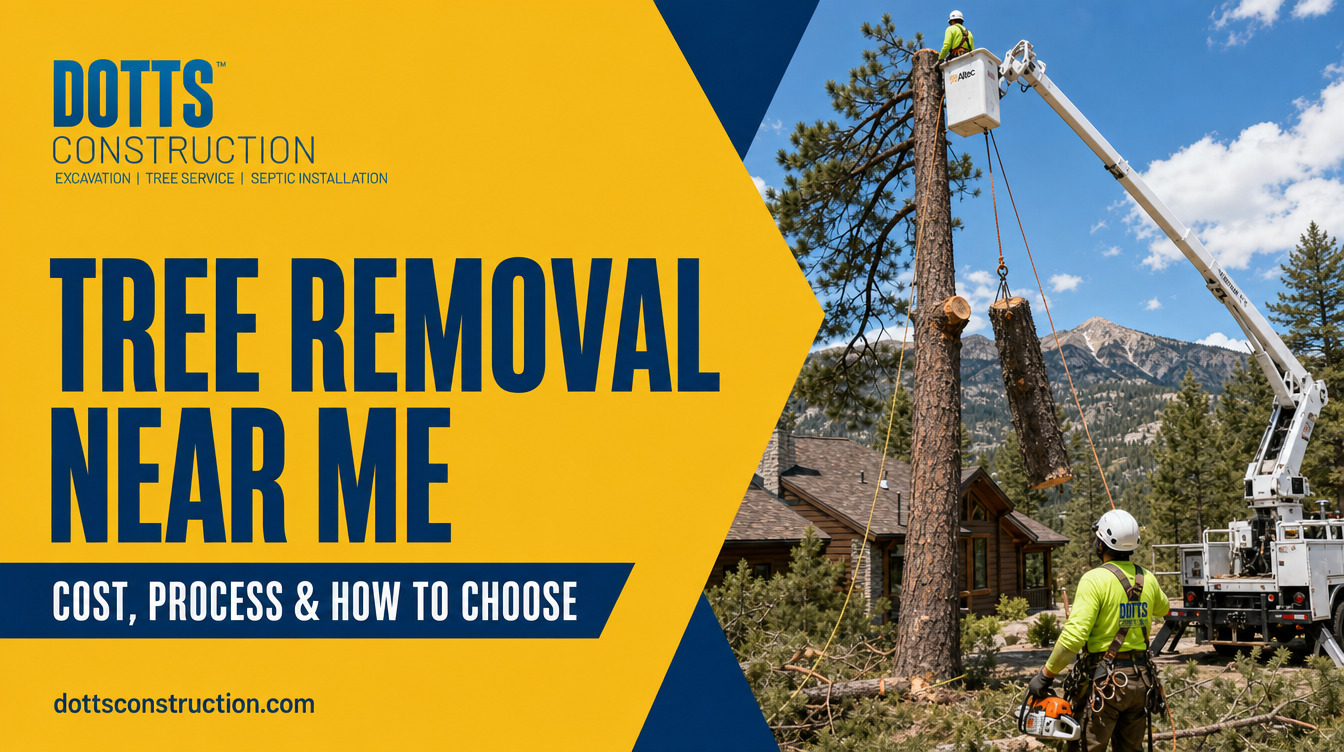
Searching for Tree Removal Near You?
What Dotts actually charges: the tree removal jobs we take on typically run $3,000 to $6,000, and can reach $10,000 for large or high-risk trees close to buildings and power lines. We focus on bigger removals and don’t quote jobs under $3,000. Every tree is different, so request a free on-site estimate or call (719) 280-4141.
Tree removal is the process of safely cutting down, extracting, and disposing of trees from a property, including the stump, root ball, and debris. If you're searching "tree removal near me," you likely need a site cleared for construction, a hazardous tree taken down before it causes damage, or overgrown land prepared for a project. Expect to pay between $300 and $2,000 per tree depending on size, location, and site conditions.
Let's be honest: most people don't think about tree removal until something forces the issue. A storm drops a limb on your fence. You finally pull the trigger on that garage or driveway project. Or you look at your lot and realize half of it is unusable because a tree line has crept in for twenty years. Whatever brought you here, this guide gives you straight answers about cost, process, risk, and how to hire a crew that actually shows up.
What Does Tree Removal Near Me Actually Include?
Tree removal is not a single service. It is a sequence of tasks, and the price you pay depends heavily on which tasks are included in the quote.
Here is what a complete tree removal job typically covers:
- Felling: Cutting the tree down using chainsaw or directional felling techniques
- Limbing and bucking: Removing branches and cutting the trunk into manageable sections
- Hauling: Loading and transporting debris off your property
- Stump grinding: Mechanically grinding the stump down to several inches below grade
- Root raking: Removing surface root systems, critical for construction-bound sites
- Site cleanup: Leaving the ground clear, level, and accessible
Pro Tip: If you're prepping land for a foundation, driveway, or septic system, root raking and stump grinding are non-negotiable. Leaving roots in the ground causes soil settling, drainage issues, and failed inspections. Any quote that doesn't include these items is incomplete for construction purposes.
When you call a company like Dotts Construction, you get a crew that understands the full picture. Tree removal is not an isolated task here. It is the first phase of a site preparation process that ends with your land ready to build on.
How Much Does Tree Removal Cost Near Me?
Tree removal costs between $200 and $2,500 per tree for most residential and light commercial projects, according to HomeAdvisor's 2026 national cost data. The average single-tree removal runs approximately $750.
Here is a breakdown by tree size:
| Tree Size | Typical Height | Estimated Cost Per Tree |
|---|---|---|
| Small | Under 30 ft | $3,000 to $6,000 |
| Medium | 30–60 ft | $3,000 to $6,000 |
| Large | 60–100 ft | $3,000 to $6,000 |
| Very Large | Over 100 ft | $3,000 to $6,000+ |
| Stump Grinding (add-on) | Any size | $3,000 to $6,000 per stump |
| Land Clearing (per acre) | Varies by density | $1,500 – $6,000 per acre |
The four biggest cost drivers are:
- Tree height and trunk diameter. Bigger trees require more labor, larger equipment, and longer haul times.
- Access difficulty. A tree 10 feet from your driveway costs less than one hemmed in by a fence, power line, or structure.
- Tree condition. Dead, diseased, or storm-damaged trees are unpredictable and require more protective measures.
- Debris disposal. Some companies haul everything off-site. Others leave it in a pile and charge extra for removal. Ask before you sign anything.
Note: Land clearing is priced per acre, not per tree, because the density of vegetation varies so much. A lightly wooded half-acre is a different job than a half-acre of dense, mature hardwoods with bramble undergrowth.
When Do You Actually Need Tree Removal vs. Tree Trimming?
This is a question people get wrong all the time. Trimming addresses living branches to manage growth, improve light, or reduce hazard from overhanging limbs. Removal takes the entire tree. Here is how to tell which one applies to your situation:
You need tree removal if:
- The tree is dead, dying, or severely diseased with no viable treatment
- The tree is located where a structure, driveway, or utility line will be built
- The root system is actively damaging a foundation, septic system, or buried line
- The trunk shows signs of hollow decay or structural instability
- Land clearing is required for a construction or grading project
You need trimming if:
- The tree is healthy but overgrown
- Branches are too close to your roofline or power lines
- You want to improve light penetration or aesthetic shape
- A certified arborist has confirmed the tree's structural health
Pro Tip: If a contractor cannot distinguish between these two scenarios when you call for a quote, that is a red flag. A professional crew assesses your tree before recommending removal. Removing a healthy tree unnecessarily is a waste of money. Trimming a structurally failed tree is a safety hazard.
What Is the Tree Removal Process Step by Step?
A professional tree removal follows a predictable sequence. Knowing the steps helps you evaluate whether the crew you hire is doing the job correctly.
- Site assessment. The crew walks the property, identifies target trees, checks for overhead utilities, underground lines, and any access constraints.
- Utility clearance. Before any cutting, buried utilities must be located. In most states this means calling 811 (the national dig-safe hotline) at least 72 hours before work begins.
- Equipment setup. Depending on tree size and access, this may include a bucket truck, chipper, skid steer, or full excavator.
- Felling or sectional removal. Smaller trees in open areas are felled in a single cut with a planned drop zone. Trees near structures are taken down in sections from the top down.
- Limbing and chipping. Branches are removed and fed into a chipper. Trunk sections are cut and staged for hauling.
- Stump grinding. A dedicated stump grinder reduces the stump to below-grade wood chips.
- Root raking (for construction sites). An excavator or skid steer removes surface roots and grinds material from the clearing zone.
- Debris removal and site cleanup. All material is hauled off-site or processed on-site if you want mulch left behind.
- Final grading (optional). If the removal is part of a larger land clearing or site prep project, the area is graded to prepare for the next construction phase.
At Dotts Construction, steps 7 through 9 are where we differentiate ourselves. Most tree services stop at step 6. We continue through full land clearing and site grading under the same project scope, which means you avoid coordinating multiple contractors and watching your schedule slip.
Why Hiring the Wrong Tree Removal Company Is a Real Risk
Here is something the tree removal industry does not advertise: unlicensed, uninsured tree crews cause thousands of dollars in property damage every year. When a limb drops on your roof, a trunk rolls into your fence, or an excavator clips a buried line, who pays for it matters enormously.
Verify these four things before any crew sets foot on your property:
- General liability insurance. Minimum $1 million per occurrence. Ask for a certificate of insurance naming you as an additional insured for the duration of the job.
- Workers' compensation coverage. If a worker is injured on your property and the company has no workers' comp, your homeowner's insurance becomes the backstop.
- State licensing. Requirements vary by state, but excavation and land clearing work often requires a contractor's license beyond the tree service itself.
- References for comparable jobs. Not just Yelp reviews. Ask for references from jobs similar in scope to yours, specifically if land clearing or construction prep is involved.
Tree removal adjacent to a construction project is not a job for the cheapest bid. We have seen sites where a low-cost tree crew left root systems intact that later undermined a freshly poured driveway. The repair cost three times what professional root raking would have.
How Does Tree Removal Fit Into Land Clearing and Site Preparation?
If your tree removal is connected to a construction project, you need to understand where it fits in the overall site preparation sequence. Tree removal is phase one of land clearing, and land clearing is phase one of site preparation.
Here is the full sequence for a construction-bound lot:
- Tree removal and land clearing: All vegetation, stumps, and surface roots removed
- Rough grading: Bulk earthmoving to establish the general elevation and drainage profile of the site
- Excavation: Digging for foundations, footings, septic systems, or underground utilities
- Compaction and subgrade prep: Preparing the soil structure to support load-bearing construction
- Fine grading: Final surface preparation before concrete, asphalt, or building placement
Dotts Construction handles all five phases under one contract. This matters because each phase affects the next. A poorly executed clearing leaves stumps and root debris that interfere with grading equipment. Improper grading creates drainage problems that compromise foundations. Disconnected contractors with no shared accountability is how construction projects fall apart.
The Dotts 3M Method (our proprietary site preparation approach) coordinates all phases from initial clearing through final grade, with documented checkpoints at each stage so you know exactly where your project stands.
Tree Removal for Septic System Installation: What You Need to Know
Tree roots and septic systems are incompatible. If you are planning a new septic system or repairing an existing one, any trees within the designated drain field area must be fully removed, including the root ball. This is non-negotiable under most state and local health codes.
Here is why this matters:
- Tree roots actively seek moisture and will infiltrate perforated drain field pipes within a few years
- Root intrusion causes drain field failure, sewage backup, and a repair bill that typically exceeds $10,000
- Most septic permits require a vegetation-free setback around the drain field, often 10 to 25 feet from tank and field lines
According to the U.S. Environmental Protection Agency's residential septic guidelines, proper site clearing around septic components is a fundamental installation requirement, not an optional upgrade.
At Dotts Construction, tree removal and septic work are coordinated under a single scope. We clear the site, design the system to code, and install it. You do not have to manage a tree crew and a septic contractor separately, which is where delays and miscommunication typically enter the picture.
How to Get a Reliable Tree Removal Quote Near You
Getting a quote is straightforward. Getting a quote that actually reflects what the job will cost is harder. Here is how to make sure you are comparing apples to apples.
When you call for a quote, ask these specific questions:
- Is stump grinding included, or is it an add-on?
- Is debris hauled off-site, or will it be left on the property?
- Does the quote include root raking if this is a construction site?
- What equipment will you use, and does your crew carry general liability insurance?
- What is your timeline, and do you guarantee the start date?
Red flags in any quote:
- Vague scope with no itemization
- No mention of insurance
- Significantly lower than every other quote with no explanation
- Cannot give you a guaranteed start date within a reasonable window
- No written contract before work begins
Pro Tip: Get three quotes minimum. Not to find the lowest price, but to identify the outlier. If two quotes are in the same range and one is dramatically lower, the low quote either excludes something or reflects a crew cutting corners on equipment, insurance, or disposal.
Frequently Asked Questions About Tree Removal Near Me
How long does tree removal take?
A single residential tree takes two to six hours for a professional crew. Larger trees or complex removals near structures can take a full day. Land clearing projects covering a quarter-acre or more typically run two to five days depending on tree density, equipment access, and debris volume.
Do I need a permit for tree removal?
Many municipalities require permits for removing trees above a certain diameter, typically 6 to 12 inches at chest height. Rules vary widely by city and county. Your contractor should pull any required permits before work begins. If they do not mention permits, ask directly.
Will tree removal damage my yard?
Some surface damage is unavoidable, especially for large trees or machinery-accessed sites. A professional crew minimizes this through equipment selection and access planning. If you are preparing for construction, minor surface damage is irrelevant because the site will be graded anyway.
What happens to the stump after removal?
Stumps are either ground down below grade with a stump grinder or fully excavated and removed if the site is being prepared for construction. Grinding leaves wood chip material in the hole, which must be removed and backfilled with compactable soil before any hardscape or structure is placed.
Can I remove a tree myself?
Small trees in open areas away from structures can be DIY-removed by experienced homeowners with the right equipment. Any tree near a structure, power line, or within a construction zone should be handled by a licensed professional. The risk of property damage or personal injury is not worth the cost savings.
How do I know if a tree is dangerous and needs emergency removal?
Signs requiring urgent attention include: large cracks in the trunk, significant lean that was not present before, fungal growth at the base indicating internal decay, hanging or attached broken branches (called "widow makers"), and visible root damage from recent construction or excavation. If you see any of these, do not wait.
Does Dotts Construction handle both tree removal and the follow-on construction work?
Yes. Dotts Construction provides tree removal and land clearing as the first phase of a complete site preparation service that includes excavation, grading, and septic system design and installation. One contract, one crew, one point of contact.
Ready to Get Your Site Cleared? Here Is Your Next Step
If you have been sitting on a property that needs trees removed before you can build, grade, or install a septic system, the wait costs you more every day. Construction schedules tighten. Material prices move. Contractor availability shrinks.
Dotts Construction is built for exactly this situation. We show up when we say we will, we communicate every step of the way, and we do not stop at felling trees. We take your site from raw land to construction-ready, handling clearing, grading, excavation, and septic all under one scope.
Here is what to do right now:
- Call or contact us to schedule a site assessment. We walk your property, assess the trees, and give you a written scope with no vague line items.
- Get your written quote within 48 hours. Line-itemized, with a guaranteed start date.
- We handle the permits, the utility locates, and the coordination. You focus on your construction project.
Request a free consultation or call (719) 280-4141
You should not have to chase a contractor for a callback or wonder whether the crew actually understood what you need. That is not how we operate.
Related Guides
Need the pros? See Tree Removal Services. More reading:
About the Author
Michael Dotts brings over 15 years of hands-on experience in heavy construction and grading, with a specialty in the unique demands of building in the Rocky Mountains, where steep terrain, rocky ground, and harsh weather change the rules most flatland contractors are used to. Because Michael knows what it really takes to get the job done right in Colorado’s high country, you can count on honest, accurate quotes that won’t creep up halfway through the job.