
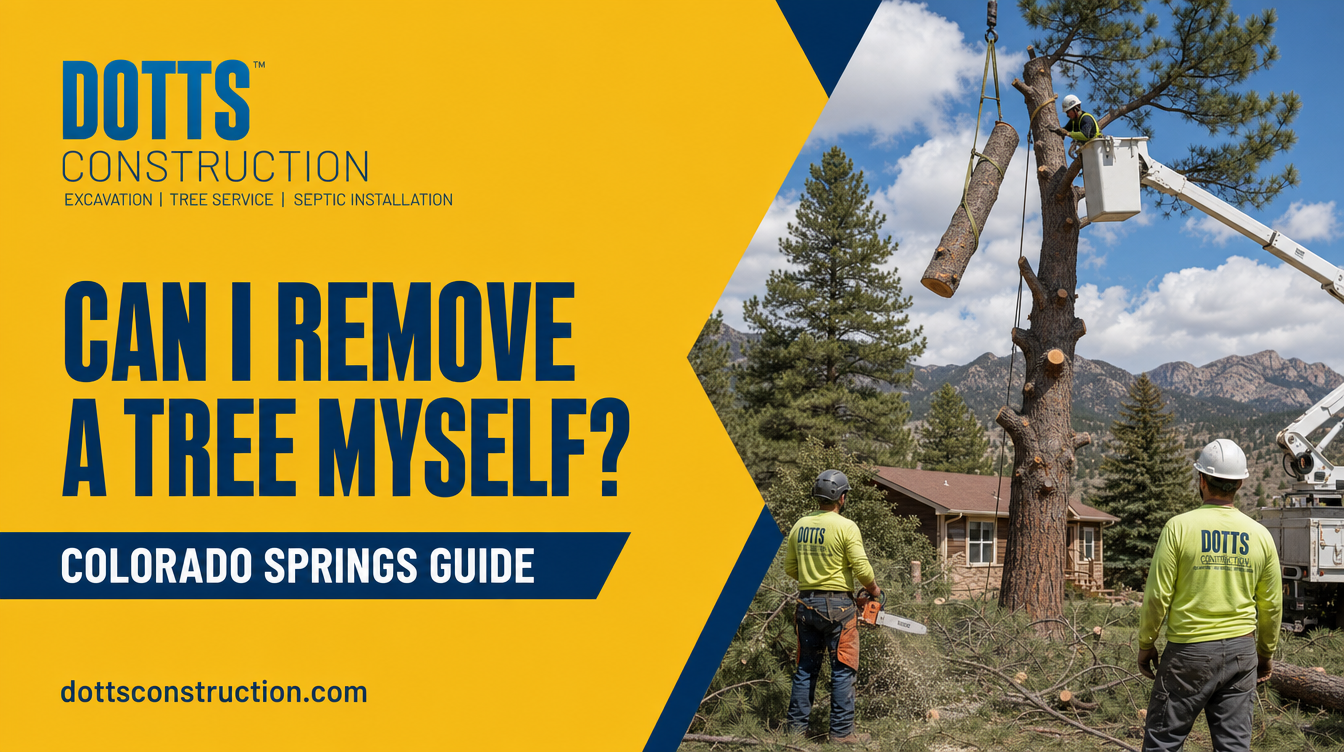
Thinking About Removing a Tree Yourself?
Yes, you can remove a small tree yourself in Colorado Springs if it is under 15 feet tall, leans away from structures, and has a clear drop zone. But for most trees on residential or rural properties, DIY removal is dangerous, legally complicated, and often more expensive to fix than hiring a professional from the start.
Why Is Tree Removal in Colorado Springs More Complicated Than It Looks?
Tree removal in Colorado Springs carries risks that most homeowners seriously underestimate.
Here's the thing: a tree looks like a single object. In reality, it is a dynamic system of weight, tension, and leverage. A 60-foot ponderosa pine can weigh more than 2,000 pounds. If you cut it wrong, it does not fall where you planned. It falls where physics sends it, and that might be through your roof, across your fence line, or onto a power line.
Colorado's Front Range terrain adds another layer of complexity. Properties in the Colorado Springs area often sit on sloped ground, near drainage easements, or close to utility corridors. The El Paso County area includes neighborhoods with overhead utility lines running directly through tree canopies, particularly in older parts of the city and in unincorporated areas to the west and north.
Related entities you need to understand before touching a single branch:
- Tree felling direction (the planned path a tree takes when cut)
- Tension wood (compressed fibers in leaning trees that cause unpredictable splits)
- Utility easements (legal rights-of-way that restrict ground disturbance)
- Root zone disturbance (removal that destabilizes surrounding soil)
- Stump grinding vs. stump removal (two different processes with different land prep implications)
What Are the Real Risks of Removing a Tree Yourself?
Let me be direct: DIY tree removal kills and seriously injures people every year. According to the U.S. Bureau of Labor Statistics Occupational Injuries report, tree trimming and removal ranks among the most dangerous trades in the country, with a fatality rate of roughly 91 per 100,000 full-time workers, far higher than most construction trades.
That statistic applies to trained professionals using proper equipment. For untrained homeowners, the risks multiply.
Here are the specific hazards you face when attempting tree removal on your own:
Physical hazards:
- Chainsaw kickback (the leading cause of chainsaw injuries, per the American Journal of Emergency Medicine, 2021 review)
- Falling limbs striking the operator during a cut
- Tree roll or bounce on impact with the ground
- Root system collapse pulling adjacent soil when a large tree falls
Property hazards:
- Crush damage to structures, fencing, and vehicles
- Root removal destabilizing nearby retaining walls or driveways
- Stump decay attracting wood-boring beetles that spread to healthy trees
- Soil erosion on sloped lots after large root systems are removed
Legal and financial hazards:
- Liability for damage to neighboring property if the tree falls across a property line
- Insurance denial if an insurer determines you attempted unlicensed work on a hazardous tree
- Permit violations if removal required prior approval
Pro Tip: Before you pick up a chainsaw, call your homeowner's insurance provider and ask one question: "If I remove a tree myself and it damages my neighbor's property, am I covered?" The answer will likely change your plans.
Does Colorado Springs Require a Permit to Remove a Tree?
The permit requirement in Colorado Springs depends on where your property is located and what type of tree you are removing.
Within City of Colorado Springs limits:
The City of Colorado Springs does not require a permit for removing trees on private residential property in most cases. However, trees located in the right-of-way (the strip of land between the sidewalk and the street) are city property. You cannot remove those without city approval through Colorado Springs Utilities or the city's Forestry Division.
In unincorporated El Paso County:
El Paso County does not have a blanket tree removal permit requirement for private property. However, land disturbance associated with tree removal, including stump grinding that disturbs more than one acre of soil, may trigger a grading or land disturbance permit under state stormwater regulations.
HOA restrictions:
Many neighborhoods in Colorado Springs, particularly in Briargate, Flying Horse, and the Powers Corridor area, have HOA covenants that require written approval before removing any tree on your lot regardless of its size or condition.
Wildfire mitigation zones:
El Paso County is part of Colorado's active wildfire mitigation program. Some properties in the wildland-urban interface (WUI) may actually be required to remove certain trees as part of defensible space compliance under Colorado Senate Bill 21-189. In those situations, removal is not optional; it is a code obligation.
| Situation | Permit Required? | Who to Contact |
|---|---|---|
| Tree on private property (city limits) | Generally no | Colorado Springs Forestry Division to confirm |
| Tree in city right-of-way | Yes | Colorado Springs Utilities |
| Tree on unincorporated county land | Usually no | El Paso County Land Use |
| HOA-governed neighborhood | HOA approval required | Your HOA management company |
| Wildfire mitigation zone | May be mandated | Colorado State Forest Service |
What Size Tree Can You Safely Remove Yourself?
If the tree is under 15 feet tall, stands upright without a significant lean, has a clear drop zone at least twice its height in every direction, and sits well away from structures, utilities, and property lines, DIY removal may be manageable.
That covers a fairly narrow category: small ornamental trees, dead saplings, or shrubby volunteer trees growing in open areas.
Beyond those conditions, the tree belongs in professional hands. Here is a practical sizing guide:
- Under 15 feet tall: Possible DIY if all conditions above are met
- 15 to 30 feet tall: High risk for DIY; one miscut and the drop zone math gets ugly fast
- Over 30 feet tall: Professional removal required; this is not a gray area
- Any size near a structure or utility line: Professional removal regardless of height
What Equipment Do You Actually Need for DIY Tree Removal?
If you have assessed your tree and determined it genuinely falls within the safe DIY category, here is what the job actually requires. Most homeowners are surprised by how much gear a proper removal demands.
Cutting equipment:
- Chainsaw (properly sized chain and bar for trunk diameter)
- Loppers and hand saw for limb removal before felling
Safety gear (non-negotiable):
- ANSI-rated chainsaw chaps
- Hard hat with face shield
- Chainsaw-resistant gloves
- Steel-toe boots
- High-visibility vest if near a road or driveway
Felling control equipment:
- Felling wedges (plastic or aluminum, not wood) to guide the fall direction
- Rope and tie-off point for directional control on leaning trees
- Clearance from all bystanders of at least 2x the tree height in all directions
Debris management:
- Chipper rental or haul-away plan for brush
- Stump grinder rental (typically $200 to $400 per day in the Colorado Springs area) or contractor hire for stump removal
The honest cost of doing this safely on your own, including equipment rental and debris disposal, often runs $300 to $700 for a small tree. Professional removal of the same tree in Colorado Springs typically runs $400 to $900. The gap is smaller than most people expect, and the professional brings liability insurance, proper equipment, and experience.
When Does Tree Removal Connect to Larger Land Clearing or Site Prep?
This is where most homeowners miss the bigger picture. Tree removal is rarely a standalone project. In most cases, the reason a tree needs to come down connects directly to a construction, grading, or land improvement goal.
We see this constantly with our clients at Dotts Construction. A homeowner needs a tree removed to:
- Clear the path for a new driveway
- Prepare a building pad for a shop, barn, or addition
- Open a lot for foundation excavation
- Allow grading work to correct drainage problems
- Access a site for septic system installation
When that is the situation, calling a separate tree removal company and then calling an excavation contractor creates two mobilizations, two sets of scheduling headaches, and two separate invoices for work that should be done in one coordinated sequence.
Handling tree removal as part of the land clearing phase of excavation work eliminates that friction. The ground gets cleared, the stumps come out, the debris gets hauled, and grading begins as a single workflow. That is how we execute it at Dotts Construction using our Dotts 3M Method: a structured approach to site preparation that sequences clearing, grading, and ground work so your construction project does not stall waiting on the next contractor to show up.
How Much Does Professional Tree Removal Cost in Colorado Springs?
Pricing for tree removal in Colorado Springs varies based on tree size, location, species, and access. Here is a realistic breakdown based on market rates in El Paso County:
| Tree Size | Estimated Cost Range |
|---|---|
| Small (under 25 feet) | $300 to $700 |
| Medium (25 to 50 feet) | $700 to $1,500 |
| Large (50 to 80 feet) | $1,500 to $3,000 |
| Very large (over 80 feet) | $3,000 to $6,000+ |
| Stump grinding (add-on) | $150 to $450 per stump |
| Emergency removal (storm damage) | 1.5x to 2x standard rate |
Factors that increase cost:
- Tree leaning toward a structure
- Limited access for equipment (narrow gates, steep slopes)
- Tree over utility lines requiring utility company coordination
- Multiple trunks or complex branching structure
- Hardwood species (heavier, harder to control than pine)
- Debris haul-away vs. leaving wood on site
Pro Tip: Always get at minimum two quotes for any tree over 30 feet. Ask each contractor whether their quote includes stump grinding, debris removal, and clean-up. These line items are where low-ball quotes hide their true costs.
What Happens After the Tree Is Removed?
Removing the tree is the beginning, not the end. What happens to the ground after removal determines whether your property looks finished or like a construction site for months.
Stump removal options:
- Stump grinding: A grinder chews the stump 8 to 12 inches below grade, leaving wood chips in the hole. The area can be backfilled and seeded. This is the most common approach.
- Full stump excavation: The entire root ball is dug out with an excavator. Required if you are building on that area or if the root system is extensive enough to cause structural interference.
- Chemical treatment: Herbicide applied to a freshly cut stump to prevent resprouting. Works on some species but is slow (months to fully kill the root system) and does not remove the physical stump.
Site restoration after removal:
- Backfill the stump void with compacted fill if it is in a high-traffic or construction zone
- Regrade the surrounding ground if root removal has created depressions
- Reseed or replant if the tree was providing erosion control on a slope
- Evaluate drainage patterns; large tree roots often channel water, and removing them can redirect surface flow
Frequently Asked Questions About Tree Removal in Colorado Springs
Do I need a permit to cut down a tree on my own property in Colorado Springs?
In most cases, no permit is required to remove a tree on private property within Colorado Springs city limits. However, trees in the city right-of-way require city approval, HOA properties require HOA sign-off, and properties in wildfire mitigation zones may have specific rules. Always verify before cutting.
What is the cheapest way to remove a tree in Colorado Springs?
The cheapest legitimate option is to hire a local company during their slower winter months (November through February), bundle multiple tree removals in a single visit to reduce mobilization costs, and agree to leave the wood on site for firewood rather than paying for haul-away. DIY is only cheaper if you already own the equipment.
Who is liable if my tree falls on my neighbor's house in Colorado Springs?
Liability depends on negligence. If you knew the tree was dead, diseased, or hazardous and did not act, you are likely liable for resulting damage. If the tree appeared healthy and fell in a storm, your neighbor's insurance typically covers their structure. Colorado follows a negligence standard, so document tree condition and get professional assessments in writing.
How long does it take to remove a large tree in Colorado Springs?
A large tree (50 to 80 feet) typically takes a professional crew 4 to 8 hours to remove, including limbing, felling, bucking the trunk, and initial cleanup. Stump grinding adds 1 to 2 hours. Complex removals near structures or utilities can take a full day or extend into a second visit.
Can I burn the wood from a removed tree in Colorado Springs?
You can burn wood from removed trees in a fire pit or outdoor fireplace during periods when the city or county has not issued a fire ban. Colorado Springs and El Paso County frequently issue Stage 1 or Stage 2 fire bans during dry summer months, during which all open burning is prohibited. Check the El Paso County Sheriff's Office website before burning.
Will removing a large tree affect my soil and drainage?
Yes. Large tree root systems act as soil anchors and water management systems. Removing a mature tree can increase surface runoff, create soil depressions as roots decay, and occasionally alter how groundwater moves through the area. On sloped properties, this deserves serious attention before removal.
Is stump grinding included in tree removal quotes in Colorado Springs?
Rarely. Most tree removal companies in the Colorado Springs area quote the felling and removal of the above-ground tree separately from stump grinding. Always ask explicitly whether stump grinding is included, and get the stump grinding price in writing before signing anything.
Ready to Clear Your Property the Right Way? Here Is Your Next Step.
If you have a tree that needs to come down, or a full lot that needs to be cleared and graded for a driveway, foundation, or construction project in the Colorado Springs area, waiting does not make the problem easier or cheaper.
At Dotts Construction, we handle tree removal as part of a complete site preparation process. That means the trees come down, the stumps come out, the ground gets graded, and your site is ready for whatever comes next, whether that is a foundation, a driveway, a septic system, or all three. No juggling three different contractors. No stalling while you wait for the next crew to show up.
We built our Dotts 3M Method specifically to eliminate the scheduling chaos and communication breakdowns that derail construction projects before they start. You get a clear timeline, direct communication at every phase, and a finished site that your next contractor can actually work with.
Call Dotts Construction today or request a site assessment online. We will walk the property with you, assess what needs to come out, and give you a clear plan for what the ground looks like when we are done.
Request a free consultation or call (719) 280-4141
Related Guides
Need the pros? See Tree Removal Services. More reading:
About the Author
Michael Dotts brings over 15 years of hands-on experience in heavy construction and grading, with a specialty in the unique demands of building in the Rocky Mountains, where steep terrain, rocky ground, and harsh weather change the rules most flatland contractors are used to. Because Michael knows what it really takes to get the job done right in Colorado’s high country, you can count on honest, accurate quotes that won’t creep up halfway through the job.