
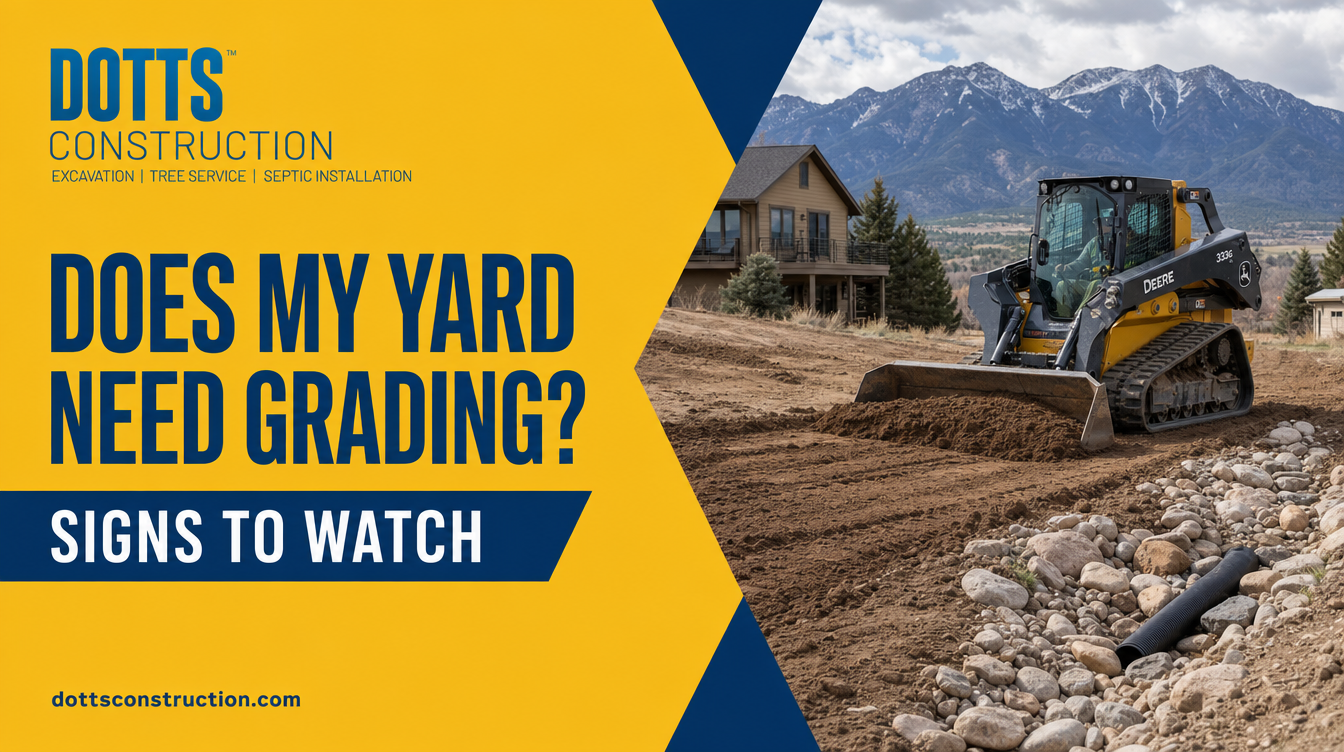
Not Sure If Your Yard Needs Grading?
Your yard needs grading if water pools near your foundation, soggy spots refuse to dry out after rain, or soil slopes toward your home instead of away from it. These are not cosmetic issues. They are early warnings of foundation damage, erosion, and failed drainage that get worse and more expensive the longer you wait.
What Is Yard Grading and Why Does It Matter?
Yard grading is the process of reshaping the slope and elevation of your soil so water drains away from structures, roads, and any areas where standing water causes damage. It is one of the most critical site preparation steps in construction and one of the most overlooked by homeowners.
Here is the thing: your yard is not just aesthetically important. It is a drainage system. When that system fails, the consequences run deep. The U.S. Army Corps of Engineers estimates that improper site drainage accounts for a significant share of residential foundation failures each year, particularly in regions with heavy seasonal rainfall.
Land grading and drainage issues share one root cause: water going where it should not. Proper grading is the fix that redirects it.
Related entities you will encounter throughout this post: slope gradient, surface runoff, foundation drainage, erosion control, swale design, compaction, and topsoil settlement.
What Are the Warning Signs That Your Yard Has Land Grading and Drainage Issues?
You do not need to be a contractor to read your yard. These are the signs that tell you grading is off and drainage is failing.
1. Water Pools Near Your Foundation After Rain
If you see standing water within 6 feet of your home's foundation after a moderate rain, your grade is sloping toward the house instead of away from it. This is the single most urgent grading warning sign.
Water that pools against a foundation will eventually find a way in. Over time, it saturates the soil, creates hydrostatic pressure against basement or crawlspace walls, and causes cracks that let moisture infiltrate.
2. Soggy or Permanently Wet Spots in the Yard
Some spots in your yard never seem to dry out, even days after it stops raining. This tells you one of two things: the soil is compacted and cannot absorb water, or the land surface is low (a depression) and has nowhere to drain.
Both conditions are grading problems. A proper grading contractor will reshape the low area and, in some cases, install a French drain or swale to carry water away from the depression.
3. Erosion Channels or Bare Soil Patches
When water moves fast across uneven ground, it carves paths. You will see this as small gullies, bare soil strips, or exposed root systems where topsoil has washed away. Erosion is not just a landscaping problem. It signals that surface runoff is uncontrolled, which means your grading is not directing water to an appropriate outlet.
Pro Tip: Check your yard 30 to 60 minutes after a moderate rain. Walk the perimeter of your home and look for flow patterns in the soil. Water always reveals the true grade of your land.
4. Water Stains or Moisture Inside Your Basement or Crawlspace
If you are seeing water stains on basement walls, efflorescence (white mineral deposits on concrete), or musty smells in your crawlspace, water is finding its way in from the outside. Grading is almost always a contributing factor.
According to the National Association of Home Builders, approximately 60% of homes built with basements will experience some form of below-grade water intrusion during their lifetime, and improper exterior grading is one of the top causes.
5. Doors and Windows That Stick or Shift
This one surprises homeowners. When water repeatedly saturates soil around a foundation, it causes differential settlement: the soil under one part of the foundation compresses unevenly, shifting the structure. This shows up as doors or windows that no longer close properly, cracks in drywall near corners, or gaps along floor baseboards.
If you are seeing these signs, a grading assessment should happen before a structural engineer visit. Fix the water source first.
6. Driveways or Patios with Standing Water
Paved surfaces are part of your drainage system. If water pools on your driveway, patio, or walkway after rain, the sub-grade (the graded soil beneath the pavement) was not sloped correctly during installation. This leads to pavement cracking, heaving, and edge erosion.
How Much Slope Does Your Yard Actually Need?
This is where most homeowners get vague answers from the internet. Here is the specific number: the soil around your home's foundation should slope at a minimum of 6 inches of drop over the first 10 feet away from the house. That is a 5% grade.
The International Residential Code (IRC), Section R401.3, mandates this slope for drainage away from foundations in residential construction. If your yard does not meet this spec, it does not meet code.
Beyond the foundation zone, the general rule is:
- Lawn areas: 1% to 2% slope minimum (1 to 2 inches of drop per 10 feet)
- Paved surfaces: 1% to 2% slope minimum for drainage
- Swales (drainage channels): 2% slope minimum to maintain flow velocity
If you want to measure your own grade, drive two stakes into the ground 10 feet apart (one at the foundation, one 10 feet out), run a string line level between them, and measure how far the string sits above ground at the far stake. That measurement is your slope drop.
Pro Tip: A simple line level from any hardware store costs under $5 and tells you everything you need to know about your existing grade.
What Is the Difference Between Grading Problems and Drainage Problems?
People use these terms interchangeably, but they are related, not identical.
| Issue Type | Root Cause | Primary Fix |
|---|---|---|
| Grading problem | Soil is sloped incorrectly (toward structure or flat) | Re-grade the soil surface |
| Drainage problem | Water has nowhere to flow even with correct slope | Install drain system (French drain, swale, catch basin) |
| Both | Incorrect slope AND inadequate drainage outlet | Re-grade + drainage infrastructure |
| Compaction problem | Soil cannot absorb water (hardpan layer below surface) | Aeration, sub-surface drain, or re-grading with amended fill |
| Subsurface problem | Underground water table or pipe failure | Drain tile, sump pump, or pipe repair |
Most residential land grading and drainage issues involve a combination of grading and drainage. The slope is off, and there is no proper outlet even if you fixed the slope. A qualified excavation contractor assesses both before recommending a solution.
Can You Grade Your Own Yard or Do You Need a Professional?
Let's be honest about this.
Minor grading, like adding topsoil to a low spot near a downspout or reshaping a small swale, is a reasonable DIY project for a homeowner with a wheelbarrow and a few weekends. For areas under 500 square feet and slope corrections under 3 inches, you can likely handle it yourself.
But here is where it gets real: any grading within 6 feet of a foundation, any project requiring equipment like a skid steer or motor grader, or any drainage work tied to a septic system requires a professional. Mistakes in these zones can trigger foundation movement, failed septic fields, and erosion that costs 10 to 20 times more to fix than the original grading would have cost.
Dotts Construction works with homeowners and contractors at exactly this intersection: site prep that needs to be done right the first time so the rest of the project does not get derailed.
What Happens During a Professional Yard Grading Assessment?
Knowing what to expect makes it easier to move forward. Here is the general process a qualified grading contractor follows:
- Site walk: Visual inspection of drainage patterns, existing slopes, foundation clearance, and any visible erosion or pooling.
- Grade measurement: Using laser levels or manual string-and-level methods, the contractor maps your existing slope percentages across the property.
- Soil assessment: Identifying soil type (clay, sandy loam, hardpan) because soil composition determines how water moves through and across it.
- Drainage outlet identification: Where will the water go once it leaves the problem area? A drain without an outlet just moves the problem.
- Written scope of work: A clear estimate showing what will be cut, filled, or installed, with equipment required and timeline.
At Dotts Construction, we call this approach the Dotts 3M Method: Measure, Map, and Move. We assess before we touch a single shovel of dirt, because guessing on grade is how properties get wrecked.
How Does Land Grading Connect to Septic System Performance?
If your property has a septic system, grading is not optional. It is code.
Septic drain fields depend entirely on correct slope and soil saturation levels to function. When grading is off, surface water infiltrates the drain field, saturates the leach lines, and causes the system to back up. According to the EPA's OnSite Wastewater Treatment Systems Manual, soil saturation from poor surface drainage is one of the leading causes of premature septic system failure in residential properties.
When Dotts Construction installs or repairs a septic system, grading around the drain field is always part of the scope. You cannot spec a septic system correctly without also controlling how surface water moves across the site.
Pro Tip: If you are seeing wet areas over your drain field or noticing odors after rain, the problem may not be the septic system itself but the grading around it. Have a site drainage assessment before you assume the tank or field needs replacement.
What Does Yard Grading Cost?
Pricing depends on the scope, equipment required, and soil conditions. Here are real-world ranges based on typical residential projects:
- Minor re-grading (topsoil fill, hand work): $500 to $1,500
- Foundation perimeter grading (small excavator or skid steer): $1,500 to $4,000
- Full yard re-grade with drainage outlet: $3,000 to $8,000
- Re-grade plus French drain or swale installation: $5,000 to $15,000+
- Large lot or access road grading: Priced per acre or linear foot
The cost of doing nothing is always higher than the cost of fixing it early. Foundation waterproofing repairs average $5,000 to $15,000 according to HomeAdvisor's 2026 Cost Guide. Structural foundation repair runs $10,000 to $40,000 or more. A $3,000 grading project eliminates both risks.
Frequently Asked Questions About Land Grading and Drainage Issues
How do I know if my yard needs grading or just better drainage?
If water collects because the ground slopes toward a structure or has depressions, it is a grading issue. If water moves correctly but has no outlet, it is a drainage issue. Most yards need both addressed together. A site assessment from a grading contractor will tell you which problem you have before any work begins.
How long does yard grading take?
A typical residential re-grading project around a home's foundation takes one to three days. Larger lots, access roads, or combined grading-and-drainage projects can take one to two weeks. Timeline depends heavily on soil conditions and equipment access to the site.
Will yard grading kill my existing lawn or landscaping?
Some disruption is unavoidable. A skilled grading contractor will preserve as much existing turf as possible, but areas requiring significant cut or fill will need reseeding or sodding after the work is complete. Plan for lawn restoration as part of your total project budget.
Can poor grading void my home's warranty or affect my insurance?
Yes. Many home builder warranties require that homeowners maintain proper slope away from the foundation. If you modify grading incorrectly and water damage results, your insurer may deny the claim. Improper drainage is a property maintenance issue, not a covered event in most standard policies.
What is a swale and when do I need one?
A swale is a shallow, vegetated drainage channel that moves surface water across a property to a designated outlet (street, pond, or storm drain). You need a swale when re-grading alone cannot handle the volume of water moving through a low area or when a neighboring property's runoff is entering your site.
Does grading affect my septic system?
Yes, directly. Septic drain fields require specific soil saturation conditions to function. Poor grading that allows surface water to pool over a drain field will cause it to fail prematurely. Grading around a septic system must comply with local health department codes and EPA onsite wastewater guidelines.
How often does yard grading need to be redone?
Properly installed grading on stable soil is a one-time fix that lasts decades. However, soil settles over time, especially after construction, heavy tree removal, or significant rainfall events. Inspect your foundation grading every three to five years, or after any major site disturbance, and add fill where settlement has created low spots.
Ready to Find Out If Your Yard Has a Grading Problem? Here Is What to Do Next.
Do not wait for a wet basement or a cracked foundation to force the issue. Land grading and drainage problems follow a predictable pattern: slow at first, expensive fast.
If you are seeing pooling water, soggy spots, or erosion anywhere on your property, the right move is a professional site assessment before the next rain season hits.
Dotts Construction provides grading assessments, foundation excavation, septic system design and install, and full land clearing services. We show up when we say we will, we walk you through every step of the scope, and we do not leave you with surprises on the back end.
Call us or request an estimate today and we will tell you exactly what your site needs and what it will cost, before we touch a single yard of dirt.
Request a free consultation or call (719) 280-4141
Related Guides
Need the pros? See Site Preparation & Grading. More reading:
About the Author
Michael Dotts brings over 15 years of hands-on experience in heavy construction and grading, with a specialty in the unique demands of building in the Rocky Mountains, where steep terrain, rocky ground, and harsh weather change the rules most flatland contractors are used to. Because Michael knows what it really takes to get the job done right in Colorado’s high country, you can count on honest, accurate quotes that won’t creep up halfway through the job.