
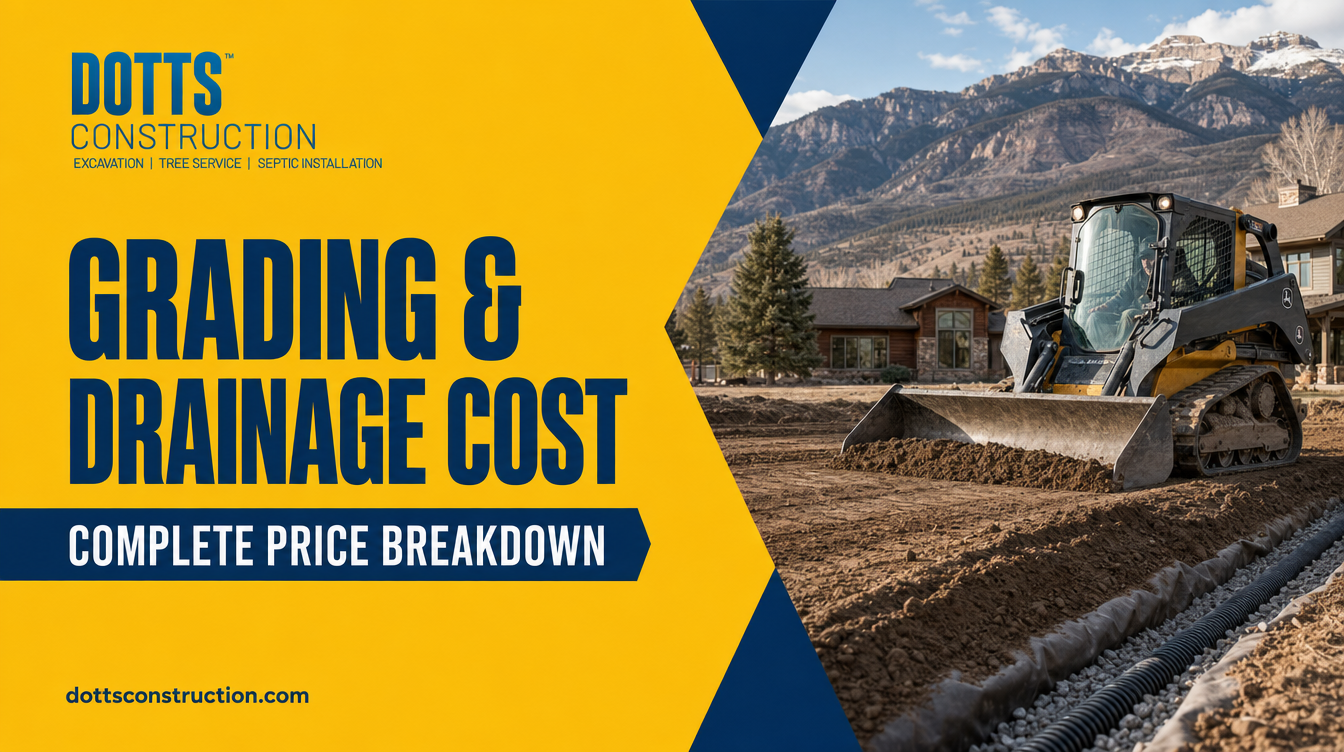
Budgeting for Grading and Drainage?
What Dotts actually charges: grading and drainage projects start at $3,000 and go up from there based on the size of the area, slope, haul-off, and the drainage work involved. We don’t take on small sub-$3,000 jobs. Every property is different, so request a free on-site estimate or call (719) 280-4141.
Land grading and drainage projects cost between $1,000 and $6,400 for most homes. Simple foundation fixes start around $500, while full yard leveling with a complete drainage system can reach $15,000 or more. The final price depends on your yard size, slope severity, soil conditions, and which drainage solution your property actually needs.
If you're trying to budget a construction project or finally fix that soggy yard, you're in the right place. We've broken down every major cost factor so you know exactly what you're paying for before anyone shows up with a machine.
What Is Land Grading and Why Does It Affect Drainage?
Land grading is the process of reshaping or leveling the ground on your property to control how water flows across and away from it. When your yard is properly graded, rainwater drains away from your foundation, driveway, and structures instead of pooling against them.
Poor grading causes water to collect in low spots, seep into basements, erode topsoil, and undermine foundations. Left uncorrected, drainage problems caused by bad grading can cost far more to repair than the original grading project would have.
Here's the connection that surprises most homeowners: most drainage problems are actually grading problems. The ground is simply sloped the wrong way, or it's flat when it should pitch away from the house. Fix the grade, and you often fix the drainage.
Related entities that come into play here include: swales, French drains, catch basins, slope gradient, compaction, and topsoil redistribution.
How Much Does Grading and Drainage Cost by Project Type?
Costs vary significantly based on what kind of work your property needs. Below are the most common project types and their typical price ranges.
Yard Grading Only (No Drainage System)
| Project Scope | Typical Cost Range |
|---|---|
| Minor regrading near foundation | $3,000 to $8,000 |
| Spot grading (one low area) | $3,000 to $8,000 |
| Full yard regrading (average lot) | $1,000 – $4,000 |
| Large or heavily sloped lot | $3,000 – $10,000+ |
Yard grading alone without drainage installation is the most affordable option. It works well when your ground is mostly flat but pitched slightly toward the house.
Grading Plus Drainage System Installation
| Drainage System Type | Typical Cost Range |
|---|---|
| Surface swale (grass channel) | $3,000 to $8,000 |
| French drain (trench + perforated pipe) | $1,000 – $6,000 |
| Catch basin with piped outlet | $1,500 – $5,000 |
| Full drainage system (multiple components) | $5,000 – $15,000 |
| Retaining wall with drainage | $4,000 – $20,000+ |
When grading alone can't redirect enough water, a drainage system channels it to a safe outlet point. French drains are the most common solution for residential properties.
Foundation Excavation and Grading
If you're preparing a site for a new home, garage, or commercial building, foundation excavation and grading is a separate service category. According to the National Association of Home Builders (NAHB), site preparation including grading typically accounts for 4–8% of total new construction cost.
For a standard residential lot, expect to pay:
- Foundation excavation: $1,500 – $6,000 depending on soil type and depth
- Rough grading after excavation: $1,000 – $5,000
- Final grading before landscaping: $3,000 to $8,000
At Dotts Construction, we handle all three phases as part of our excavation and site prep services so you're not chasing three separate contractors.
What Factors Drive the Price of Grading and Drainage Work?
The single biggest cost driver in any grading and drainage project is the volume of material that needs to be moved. Every other factor feeds into that number.
Here are the specific variables that will directly affect your quote:
1. Lot Size
Larger yards need more machine time, more labor hours, and sometimes more material. A 5,000 square foot lot and a 20,000 square foot lot are not even in the same price category.
2. Slope and Elevation Change
Severe slopes are harder to work. Steep grades require cut-and-fill techniques where material from high points is moved to low points, which takes longer and uses more equipment.
3. Soil Type
Rocky soil, heavy clay, or extremely compact ground slows excavation and wears down equipment faster. Sandy or loamy soil is faster and cheaper to grade. If your contractor hits rock, expect additional charges.
4. Drainage System Complexity
A simple surface swale costs very little. A catch basin connected to buried pipe that ties into a municipal storm drain is a multi-day project with permit requirements.
5. Access and Site Conditions
Can a full-size excavator get to your yard? Tight access forces contractors to use smaller, slower equipment or do more work by hand. Overgrown vegetation, existing structures, and buried utilities add time and risk.
6. Permits
Some drainage projects require permits, especially when tying into municipal systems or when significant soil disturbance is involved. Permit costs vary by municipality but typically run $3,000 to $8,000.
7. Geographic Location
Labor costs vary by region. Urban and suburban markets tend to run 15–25% higher than rural areas for the same scope of work.
Pro Tip: Get at least three written quotes that itemize labor, equipment time, materials, and permit costs separately. A single lump-sum number tells you almost nothing about what you're actually paying for.
How Much Does a French Drain Cost?
A French drain costs between $1,000 and $6,000 for most residential installations, with the average falling around $2,500. French drains are the most commonly recommended drainage solution for yards with chronic wet spots, soggy lawns, or water pooling near foundations.
A French drain works by routing water through a perforated pipe buried in a gravel-filled trench. Water enters the pipe through the perforations and flows to a discharge point, usually at the edge of the property or into a storm drain.
Cost variables for French drains:
- Trench length: Most residential installations run 50 – 200 linear feet. Expect to pay $3,000 to $8,000 per linear foot installed.
- Depth: Deeper trenches cost more to dig. Foundation-level French drains (3 – 6 feet deep) cost more than surface drains (12 – 24 inches deep).
- Discharge point: Daylighting to a slope is free. Connecting to a municipal system requires a permit and additional pipe.
- Landscape restoration: After the trench is filled and graded, you may need sod, seed, or mulch to restore the surface.
What Does Driveway Grading Cost?
Driveway grading costs between $500 and $4,000 depending on driveway length, surface type, and how much regrading is needed.
Gravel driveways settle and develop ruts over time. A simple re-grading to restore crown and slope typically costs $3,000 to $8,000 for a standard residential driveway. Adding new gravel runs another $3,000 to $8,000 depending on length and depth.
For new driveway construction that requires site clearing, excavation, and base preparation:
- Gravel driveway base prep: $1,500 – $4,000
- Asphalt or concrete base grading: $2,000 – $6,000
Road grading for private driveways and access roads on rural properties often runs $1,500 – $5,000 per mile for basic grading work, according to data compiled by HomeAdvisor's 2026 contractor cost database.
How Does Grading Affect Your Septic System?
This is the connection most homeowners miss entirely.
Improper grading around a septic system is one of the leading causes of premature septic failure. The drain field (also called a leach field) requires specific slope conditions to function correctly. If surface water is allowed to pool over or run toward the drain field, it saturates the soil and prevents proper effluent filtration.
According to the U.S. Environmental Protection Agency (EPA) guidance on onsite wastewater treatment systems, drain field areas should maintain positive slope away from the field and be protected from surface runoff intrusion.
This is why at Dotts Construction, we treat septic system design and grading as a single integrated project rather than two separate jobs. When we install a new septic system or repair an existing one, site grading around the drain field is part of the scope. Coordinating these two scopes upfront prevents the much more expensive problem of replacing a drain field that was drowned out by poor surface drainage.
Pro Tip: If you're adding a septic system to a property that already has drainage issues, address the grading before or during septic installation. Fixing grading after a drain field is installed is significantly more expensive and risks damaging the system.
Grading vs. Drainage: Which Do You Actually Need?
| Situation | Primary Solution | Estimated Cost |
|---|---|---|
| Water pools away from house in low yard spots | French drain or swale | $1,000 – $4,000 |
| Water runs toward foundation | Regrading + possible French drain | $1,500 – $5,000 |
| Basement or crawl space takes on water | Exterior regrading + drainage | $2,000 – $8,000 |
| Driveway develops ruts and poor drainage | Driveway regrading | $3,000 to $8,000 |
| Building site prep for new construction | Full site grading + erosion control | $2,000 – $15,000 |
| Septic system failing due to saturated soil | Site regrading + system evaluation | $1,500 – $10,000+ |
The honest answer is that many properties need both grading and a drainage system working together. Grading redirects water across the surface. Drainage systems capture and remove water that grading alone can't handle.
A reputable excavation contractor will assess both before recommending either.
How Does the Dotts 3M Method Change the Outcome?
Most excavation companies show up, move dirt, and leave. Problems get missed. Sites don't drain correctly. Construction projects get delayed because the site work wasn't done to spec.
The Dotts 3M Method is our three-phase approach to every grading and drainage project:
- Map: We assess the full site before any equipment moves. We evaluate slope gradients, soil type, drainage patterns, water entry points, and construction goals. This is where problems get identified instead of discovered mid-project.
- Move: We execute the grading and drainage scope using the right equipment for the terrain. Every cut, fill, and drainage structure is aligned to the plan from Phase 1.
- Mark: We confirm drainage performance before we leave. Proper slope, correct drainage tie-ins, and a clean site. No loose ends.
Here's something we see constantly: homeowners get a grading quote from a crew that doesn't ask a single question about what they're building or why the drainage is failing. They just grade to a flat surface and walk away. Then the same problem comes back in 18 months, or worse, the foundation prep is wrong and the building project stalls.
We've fixed other crews' grading mistakes enough times that we built the 3M Method specifically to prevent them from happening on our own jobs.
What Should You Watch Out For When Hiring a Grading Contractor?
Let's be honest about what separates a good excavation contractor from a bad one. It's not the equipment. It's not even the experience. It's the communication.
Watch for these red flags:
- Vague estimates with no line items. If a contractor can't tell you what you're paying for, they don't have a clear plan.
- No site walk before the quote. Grading and drainage work cannot be properly quoted without seeing the property. Phone quotes are guesses.
- No mention of permits. Some drainage projects require them. A contractor who doesn't bring it up either doesn't know or doesn't care.
- No discussion of what you're building next. Site grading for a foundation is different from grading for a driveway. If the contractor doesn't ask what's going in on the site, the grade won't be right.
What a good contractor looks like: they return your call, they explain the scope in plain language, they give you a written quote broken into materials and labor, and they show up when they said they would.
Our clients describe the experience this way: "On time, on budget, no surprises." That's not a slogan. That's the baseline expectation we hold ourselves to on every project.
How to Estimate Your Own Grading and Drainage Budget
Use this quick framework before calling any contractor:
Step 1: Measure your problem area.
Walk the perimeter of the area with drainage issues. Rough square footage gives contractors a useful starting point.
Step 2: Identify the water source.
Where is the water coming from? Rain runoff from a roof? A neighbor's yard? Natural low spot? Knowing the source helps determine the right solution.
Step 3: Identify the discharge point.
Where will the water go when you redirect it? A municipal storm drain, a drainage ditch, a low area at the property edge? No drainage solution works without a valid discharge point.
Step 4: Apply the rough estimate ranges.
Use the tables in this post as your baseline. Build in a 15–20% contingency for soil surprises, permit fees, or scope additions.
Step 5: Get three quotes and compare line items, not just totals.
The lowest total number is meaningless if the contractor skipped half the scope.
Frequently Asked Questions About Grading and Drainage Costs
How much does basic yard grading cost?
Basic yard grading costs between $1,000 and $4,000 for an average residential lot. Smaller spot-grading near a foundation can run as low as $500. Larger properties with significant slope changes or soil problems will exceed $4,000. Get an itemized quote based on an actual site visit before budgeting.
Is drainage covered by homeowners insurance?
Homeowners insurance generally does not cover grading and drainage work. Most policies exclude gradual water damage and do not pay for the landscaping corrections needed to prevent it. Sudden flooding from a storm event may have limited coverage depending on your policy. Check with your insurer for specifics.
How long does grading and drainage work take?
Most residential grading and drainage projects take 1 to 3 days with the right equipment. Larger lots, complex drainage systems, or rocky soil can push projects to a full week. Site prep for new construction with foundation excavation typically runs 3 to 7 days depending on scope.
Do I need a permit for land grading?
Permit requirements for grading vary by municipality. Projects that involve significant soil disturbance (typically over 500 – 1,000 square feet), slopes near waterways, or connections to municipal storm drains usually require permits. Your contractor should know local requirements and pull permits as part of their scope.
What is the cheapest way to fix yard drainage?
The cheapest drainage fix is regrading the surface slope to direct water away from problem areas. Surface swales (shallow grass-lined channels) are the next most affordable option, often costing under $2,000. French drains and catch basins are more expensive but necessary when surface grading alone cannot move enough water.
How much does it cost to regrade a driveway?
Regrading an existing gravel driveway costs $3,000 to $8,000 for a standard residential driveway. Adding a fresh gravel base layer runs an additional $3,000 to $8,000. New driveway construction requiring full base excavation and grading ranges from $1,500 to $6,000 depending on length and surface material.
Can bad grading cause foundation problems?
Yes. Improper grading that allows water to pool against a foundation is a leading cause of basement water intrusion, foundation wall cracking, and long-term structural damage. The International Residential Code (IRC) requires a minimum 6-inch drop in grade within the first 10 feet from a foundation wall to direct water away from the structure.
Ready to Price Your Grading or Drainage Project? Here's Your Next Step.
You now have the full picture on what land grading and drainage actually cost, what drives those costs, and what warning signs to watch for when hiring a contractor.
The next step is a site assessment. No online calculator and no phone estimate will replace a contractor walking your property, understanding your drainage problem from source to discharge point, and building a scope that actually solves it.
Dotts Construction serves homeowners and builders who are done dealing with contractors who overpromise and underdeliver. We handle excavation and grading, foundation site prep, driveway and road grading, septic system design and installation, and land clearing. One crew. One point of contact. One standard: on time, on budget, no surprises.
Get your free site assessment and written estimate from Dotts Construction today.
Request a free consultation or call (719) 280-4141
Related Guides
Need the pros? See Site Preparation & Grading. More reading:
About the Author
Michael Dotts brings over 15 years of hands-on experience in heavy construction and grading, with a specialty in the unique demands of building in the Rocky Mountains, where steep terrain, rocky ground, and harsh weather change the rules most flatland contractors are used to. Because Michael knows what it really takes to get the job done right in Colorado’s high country, you can count on honest, accurate quotes that won’t creep up halfway through the job.