
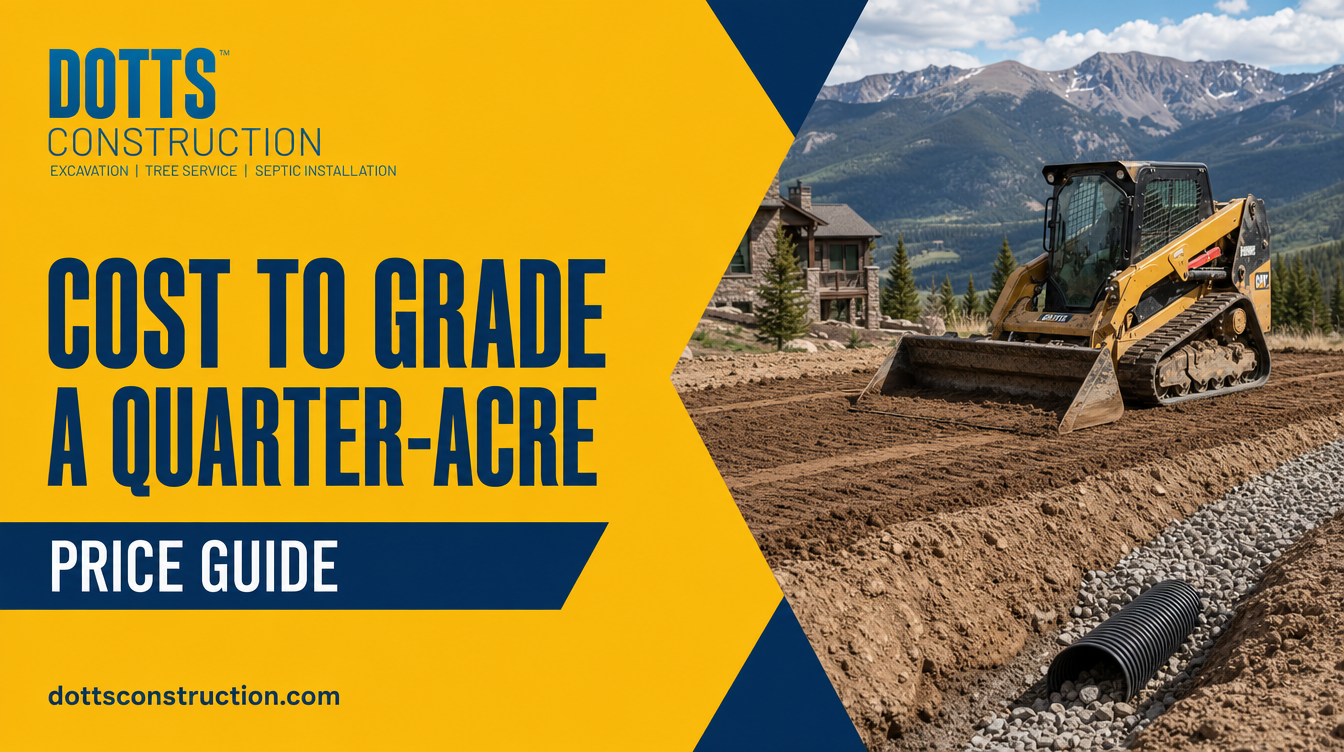
Grading a Quarter-Acre Lot?
What Dotts actually charges: grading and drainage projects start at $3,000 and go up from there based on the size of the area, slope, haul-off, and the drainage work involved. We don’t take on small sub-$3,000 jobs. Every property is different, so request a free on-site estimate or call (719) 280-4141.
Grading a 1/4-acre lot (10,890 square feet) typically costs between $3,950 and $11,250, with a national average around $7,500. Your exact price depends on slope steepness, soil type, and how much reshaping the land needs. Light smoothing runs as low as $1,000. Steep, rocky terrain can push well past $11,250.
If you're searching for a grading contractor near me, you already know the hardest part isn't the dirt work. It's finding someone who shows up when they promise, tells you what things cost before they start, and doesn't leave your project stuck in the mud. That's what we're going to solve for you today.
What Is Land Grading and Why Does Your Project Depend on It?
Land grading is the process of reshaping, leveling, or sloping the soil on a property to prepare it for construction, drainage, or landscaping. It is not optional. Every foundation, driveway, septic system, and drainage solution starts with properly graded ground.
Here's the thing: if the grade is wrong, everything built on top of it is wrong. Water pools against your foundation. Driveways crack and heave. Septic systems fail county inspections. A few hundred dollars saved on a cheap grading job turns into tens of thousands in repairs.
Related entities at work in any grading project:
- Topographic survey
- Cut-and-fill earthwork
- Soil composition (clay, sand, loam)
- Drainage slope and runoff management
- Erosion control
- Foundation excavation
- Compaction testing
Grading is the first domino. Get it right, and every trade that follows you onto the site has a clean, solid start. Get it wrong, and your whole construction timeline collapses.
How Much Does It Cost to Grade a 1/4 Acre? (Full Price Breakdown)
The cost to grade a 1/4-acre lot ranges from $1,000 to $11,250+, and where you fall in that range depends almost entirely on three factors: your current terrain, your soil composition, and the final use of the land.
Contractors typically charge $0.40 to $2.00 per square foot for labor and equipment on a standard grading job. At 10,890 square feet, that puts a 1/4-acre project between roughly $4,400 and $21,780 before any additional costs are factored in. Most residential projects land well below the upper end of that range.
Here's how the three main complexity tiers break down:
Light / Fine Grading: $1,000 to $3,000
This applies to lots that are already relatively flat and just need the top 1 to 3 inches of soil smoothed and leveled. Common uses: sod installation, minor driveway prep, or basic landscaping. Equipment time is short. Labor is minimal.
Moderate / Drainage Grading: $3,950 to $7,000
This is the most common residential grading scenario. It involves standard cut-and-fill earthwork, where soil is cut from high spots and moved to fill low areas. This is what you need when you're fixing drainage around a home foundation, creating a level building pad, or correcting minor erosion damage.
Extensive / Steep Slope Grading: $7,000 to $11,250+
This tier applies to sharp hillsides, heavily eroded lots, or properties with dense clay or embedded rock. These jobs require larger, more specialized equipment and more operator hours. If your site has significant elevation changes (typically more than 4 to 6 feet across the lot), plan for this range.
Pro Tip: The single fastest way to lower your grading cost is to schedule the work before land clearing. If trees and brush are removed and the stumps are ground flush first, your grading crew can work faster and with lighter equipment.
What Additional Costs Should You Budget For?
Rarely does a 1/4-acre grading project cost exactly what the base estimate says. Here are the additional line items that come up most often, and what you should expect to pay.
Land Clearing: $1,200 to $5,000
If your quarter-acre has trees, heavy brush, stumps, or construction debris, it must be cleared before grading can begin. The price varies based on tree density and size. A lightly wooded lot might run $1,200. Dense hardwood coverage can push $5,000 or more.
Fill Dirt and Topsoil: $3,000 to $8,000 per cubic yard
When your lot has low spots or you need to raise a building pad, you need fill material brought in. Basic fill dirt runs $3,000 to $8,000 per cubic yard. Nutrient-rich topsoil for landscaping or growing surfaces costs $3,000 to $8,000 per cubic yard. The volume needed depends on how much elevation change you're creating.
Topographic Survey: $3,000 to $8,000
A professional survey maps your property lines and existing elevation grades. Many grading contractors require this before they can produce an accurate bid. It's also legally necessary in most jurisdictions before you pull a permit.
Grading Permit: $3,000 to $8,000
Local municipalities commonly require permits when you're altering drainage patterns or disturbing more than a set amount of soil (often 1,000 square feet or 1 acre, depending on the county). Never skip this. Unpermitted grading work can trigger fines and force you to undo the work.
Retaining Walls: $3,500 to $10,000+
If your site has a steep slope and the grading creates a sharp elevation drop, you may need a retaining wall to hold the newly graded soil in place. Timber walls are cheaper. Concrete block or stone walls cost significantly more but last far longer.
What Drives the Price Up? (And What You Can Control)
Most homeowners and property owners are surprised by how much these five variables swing the final cost:
- Slope and elevation change. The steeper the terrain, the more dirt moves, the more equipment hours required, and the higher the risk of erosion control complications.
- Soil type. Sandy, loamy soil is a contractor's dream. Dense clay soil is harder to cut and compact correctly. Rocky soil or buried boulders require breaking equipment and dramatically increase labor time.
- Accessibility. If heavy equipment can't easily enter your property, smaller machinery must be used, which takes longer. Narrow driveways, overhead lines, and existing structures all create access constraints.
- Volume of material hauled away. If you have excess cut material that can't be used as fill on-site, it must be loaded and hauled to a disposal facility. That's an additional cost per load.
- Season and market conditions. Grading in winter (in freeze-thaw climates) or during peak construction season typically costs more due to demand and ground condition complications.
What you can control: schedule early in the year, clear the site before your grading contractor arrives, and have your survey done ahead of the first site visit. These three steps alone can reduce your estimate by 10 to 20 percent.
Cost Comparison by Terrain Type for a 1/4-Acre Lot
| Terrain Type | Average Price Range | Primary Cost Drivers |
|---|---|---|
| Flat / Near-Flat | $1,000 to $3,000 | Minor smoothing, short equipment run time |
| Rolling / Mild Slope | $3,950 to $7,000 | Drainage correction, cut-and-fill balancing |
| Steep Hill | $7,000 to $11,250+ | Heavy excavation, potential retaining structures |
| Rocky or Dense Clay | $8,000 to $14,000+ | Rock breaking, specialized equipment, extended hours |
| Wooded / Pre-Clearing Required | Add $1,200 to $5,000 | Tree removal, stump grinding, debris hauling |
How Does Grading Differ from Excavation and Land Clearing?
These three services are closely related but they are not interchangeable. Knowing the difference saves you from calling the wrong contractor or misreading a quote.
Land clearing removes surface vegetation: trees, brush, stumps, and debris. It exposes raw soil but does not shape it.
Excavation removes large volumes of soil or rock to create a specific void. Foundation holes, utility trenches, and septic tank pits are excavation work. The goal is to go down.
Grading reshapes the existing ground surface to achieve a target elevation and slope. The goal is to move soil horizontally and create a stable, draining, level (or precisely sloped) surface.
In practice, these three services often happen in sequence on the same project: clear, then excavate, then grade. Many full-service excavation and grading contractors handle all three, which is more efficient and typically cheaper than hiring separate crews.
At Dotts Construction, we handle land clearing, excavation, and grading as a complete package. That means one point of contact, one mobilization cost, and a site that's ready for the next phase without handoff delays.
What Is the Dotts 3M Method and Why Does It Matter for Your Site?
Most grading companies show up, move dirt, and leave. That's not a process. That's a best guess.
The Dotts 3M Method is our structured site preparation approach built around three phases: Measure, Move, and Mitigate. Every grading project we take on follows this sequence.
Measure: We start with a thorough site evaluation and topographic review before a single machine rolls. We assess existing slope, soil composition, drainage flow patterns, and any constraints from structures, utilities, or property lines. This is where we catch problems that would cost you money later.
Move: This is the active grading phase: cut-and-fill earthwork, subgrade preparation, and slope establishment. We do not start moving material until we know exactly where it needs to end up and why.
Mitigate: After grading, we address drainage, erosion control, and compaction. A graded surface that isn't protected and compacted correctly will shift, settle unevenly, and cause problems for whatever gets built on top of it.
The result: a site that's genuinely ready for your foundation, driveway, or septic system, not just "good enough for now."
How Do You Find a Trustworthy Grading Contractor Near You?
This is where most homeowners get burned. They search "grading contractor near me," call three companies, get three wildly different quotes, and have no idea who to trust.
Here's what to look for when evaluating any excavation or grading company:
1. They visit the site before quoting.
Any contractor who quotes a grading job without walking the property is guessing. Slope, soil, and access conditions can only be assessed in person. If they won't come to the site before giving you a number, they won't give you an accurate number.
2. The quote is itemized.
"Grading, all-in, $6,500" tells you nothing. A trustworthy contractor breaks down equipment hours, material costs, haul-away fees, and any subcontracted work. If the quote isn't itemized, the surprises will be.
3. They communicate before, during, and after.
The reviews that matter aren't just "great job." Look for reviews that mention on-time arrival, clean job sites, and contractors who answer the phone. One of the most common complaints in excavation is that contractors go silent after the deposit clears.
4. They're licensed and insured for your state.
Grading and excavation require heavy equipment operating near your property and potentially your neighbors'. Verify general liability insurance and any required contractor licensing in your state before signing anything.
5. They understand what comes next.
A good grading contractor asks about your next phase. Are you pouring a foundation? Installing a septic system? Paving a driveway? The grade requirements are different for each. A contractor who doesn't ask doesn't understand the full scope.
Pro Tip: Ask for three references from projects completed in the last 12 months on properties similar in size and terrain to yours. Then call them. Ask specifically about whether the final cost matched the original quote and whether the contractor communicated well when problems came up.
Grading for Specific Projects: What Changes?
The end use of your graded land changes how the work is done. Here's what to know for the four most common grading applications.
Foundation Grading
Foundation grading requires precise elevation control and proper drainage slope away from the structure (typically 6 inches of drop over the first 10 feet per International Residential Code Section R401.3). Subgrade compaction testing is often required before the concrete pour.
Driveway Grading
Driveway surfaces need a stable, compacted subbase with a consistent cross-slope (usually 2 to 5 percent) to shed water. Improper driveway grading is the leading cause of premature asphalt and gravel surface failure.
Septic System Grading
Septic system installation (including drain field layout) requires precise grading to meet county health department specifications. At Dotts Construction, we handle septic system design and installation alongside site grading, so both are engineered to work together from the start.
Drainage Correction
If your goal is to fix standing water or redirect runoff, grading is often paired with French drains, swales, or dry creek beds. Drainage grading is highly site-specific and requires understanding where water currently goes and where it needs to go instead.
Frequently Asked Questions About Grading a 1/4 Acre
How long does it take to grade a 1/4-acre lot?
A standard 1/4-acre grading project takes one to three days for most residential sites. Flat lots with easy access can be completed in a single day. Steep terrain, rocky soil, or sites requiring significant cut-and-fill work may take three to five days depending on equipment and crew size.
Can I grade my own land without a contractor?
You can rent a skid steer or small bulldozer and attempt DIY grading on flat terrain. However, achieving correct drainage slopes, proper compaction, and a grade that meets building code or septic design requirements almost always requires a licensed contractor with survey equipment. Mistakes are expensive to fix.
Do I need a permit to grade my 1/4-acre lot?
In most counties, yes. Grading permits are required when you disturb a certain threshold of soil or alter drainage patterns. Permit costs run $3,000 to $8,000. Check with your local planning or building department before any earthwork begins.
What is the best time of year to grade land?
Late spring through early fall is ideal in most climates. Soil is workable but not waterlogged. Avoid grading on saturated ground: equipment sinks, soil compacts poorly, and erosion control becomes much harder. In the Southeast and Southwest, winter grading is often feasible.
How do I know if my lot needs grading before building?
If your lot has visible slope changes, standing water after rain, or uneven terrain, it needs grading before construction. Any foundation or septic installation also requires a graded and compacted subgrade that meets design specifications, regardless of how the lot looks visually.
What is cut-and-fill grading?
Cut-and-fill is the standard grading method where soil is "cut" (removed) from high spots and "filled" into low areas on the same site. When the volume of cut material matches the fill needed, no soil has to be hauled away, which reduces cost. A well-planned cut-and-fill design is one of the biggest cost control levers in grading.
Does grading affect my property's drainage permanently?
Yes. Grading permanently changes how water flows across your property. This is why proper engineering matters. Poor grading can direct water toward neighboring properties (a legal liability), against your foundation, or into utility easements. Correct grading directs all runoff away from structures and toward appropriate drainage outlets.
Ready to Get a Real Quote from a Grading Contractor Near You?
Here's the bottom line: grading a 1/4-acre lot costs $3,950 to $11,250 for most residential projects, with your final number determined by slope, soil, and what you're building next. The cost ranges in this post give you a solid planning baseline, but they are not a substitute for a site visit.
At Dotts Construction, we built our reputation on one simple commitment: we show up when we say we will, we tell you what it costs before we start, and we don't leave until your site is ready for the next phase. No vague estimates. No contractor drama. Just ground that's prepared to the spec your project needs.
Whether you need grading for a foundation, a new driveway, a septic system installation, or full land clearing and site prep, we're ready to walk your property and give you a real number.
Call Dotts Construction today or request your on-site estimate online.
Request a free consultation or call (719) 280-4141
Related Guides
Need the pros? See Site Preparation & Grading. More reading:
About the Author
Michael Dotts brings over 15 years of hands-on experience in heavy construction and grading, with a specialty in the unique demands of building in the Rocky Mountains, where steep terrain, rocky ground, and harsh weather change the rules most flatland contractors are used to. Because Michael knows what it really takes to get the job done right in Colorado’s high country, you can count on honest, accurate quotes that won’t creep up halfway through the job.