
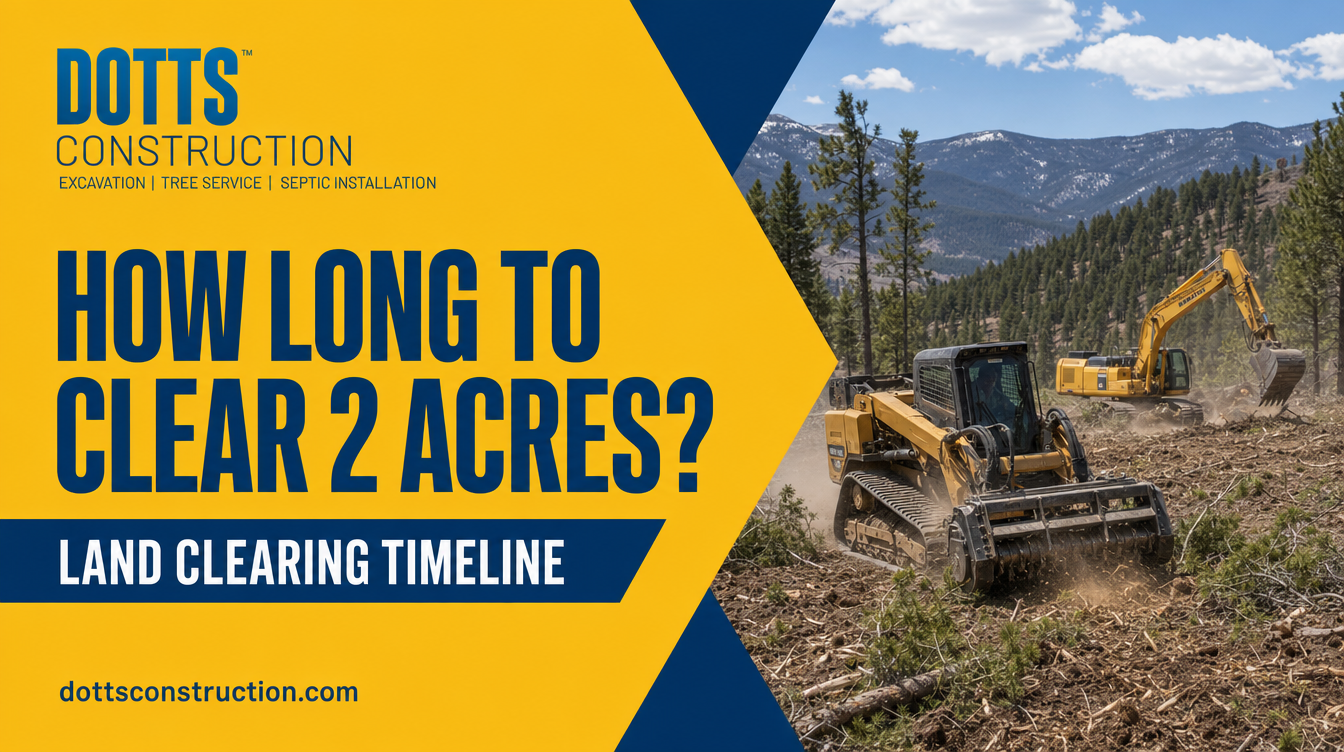
Clearing a 2-Acre Lot?
Clearing 2 acres of land with professional equipment takes 1 to 7 days in most conditions. Light brush and small trees can be cleared in a single day using a forestry mulcher. Dense hardwood forest with large stumps and rough terrain can stretch to two weeks. Hiring a professional crew is the single biggest factor that controls the timeline.
Here's the thing: most homeowners and property owners go into a land clearing project with no real idea of what to expect. They get vague estimates, unclear timelines, and then find themselves stuck waiting while their entire construction project sits on hold. This guide gives you the exact numbers you need so you can plan accurately and avoid delays.
At Dotts Construction, we use what we call the Dotts 3M Method to assess, plan, and execute land clearing projects efficiently. Whether you're preparing a 2-acre plot for a foundation, a driveway, or a septic system installation, understanding your clearing timeline before you break ground saves money and protects your construction schedule.
What Is Land Clearing and What Does It Actually Involve?
Land clearing is the process of removing trees, stumps, brush, rocks, and debris from a plot of land to prepare it for construction, agriculture, or development. It is not simply cutting down trees. A complete clearing project includes:
- Tree felling and removal
- Stump grinding or full stump extraction
- Root raking and soil preparation
- Brush and debris disposal (mulching, hauling, or burning)
- Rough grading to level the cleared surface
Each of those steps adds time to the project. When you get a timeline from a contractor, make sure you know which of those steps are included. A quote that only covers tree removal is not a complete land clearing quote.
How Long Does It Take to Clear 2 Acres: Timelines by Method
The clearing method is the most powerful variable in your timeline. Professional crews using the right machine can complete work in hours that would take a DIY crew weeks.
How Fast Does Forestry Mulching Clear 2 Acres?
Forestry mulching is the fastest land clearing method available. A high-horsepower forestry mulcher or mulching attachment on a skid steer can clear 1 to 3 acres per day on moderate terrain with brush and small trees. That puts a 2-acre clearing job at roughly 1 to 2 days.
Forestry mulching grinds vegetation directly into mulch that stays on the ground as a natural ground cover. There is no debris hauling, no burning, and no secondary cleanup. The result: you compress a multi-step process into a single machine pass.
Best for: Brush removal, overgrown fields, saplings, light tree cover, and sites where you need fast turnaround before construction begins.
Estimated time for 2 acres: 1 to 2 days
How Long Does Bulldozing and Excavating Take on 2 Acres?
Bulldozing and excavating is slower but more thorough. A dozer pushes trees over (roots and all), and an excavator follows behind to pull stumps and rake debris into piles for hauling or burning. According to the American Society of Civil Engineers site preparation guidelines, a dozer/excavator combination typically clears 0.5 to 1 acre per day when full stump removal is required.
For 2 acres, that translates to 2 to 4 days minimum in moderate conditions.
Best for: Sites where the land will be graded for a foundation, driveway, or septic system. Full root removal prevents future settling issues.
Estimated time for 2 acres: 2 to 5 days
How Long Does DIY Land Clearing Take on 2 Acres?
Let's be honest: DIY clearing on 2 acres is a major undertaking that most people underestimate by a factor of three or four. With a chainsaw, a rented chipper, and manual labor, clearing 2 acres of moderate vegetation can take 3 to 6 weeks of full-time work. Heavy tree cover with large stumps can stretch to 2 months or longer.
Renting a skid steer or mini excavator helps, but without professional operator experience, productivity drops significantly and equipment damage risk goes up.
Our professional recommendation at Dotts Construction: For any site that will have a foundation, septic system, or permanent driveway installed, DIY clearing is not worth the risk. Improper stump removal and incomplete root raking can cause soil settling problems that cost far more to fix than hiring a professional crew in the first place.
How Does Vegetation Density Affect the Clearing Timeline?
Vegetation type and density may be the second most important variable after equipment choice. Here is a practical breakdown based on our field experience:
| Vegetation Type | Description | Estimated Time for 2 Acres (Professional) |
|---|---|---|
| Light brush / overgrown field | Weeds, tall grass, shrubs under 2 inches diameter | 4 to 8 hours (1 day or less) |
| Moderate brush and saplings | Mixed brush, saplings up to 4 inches diameter, scattered small trees | 1 to 3 days |
| Mixed forest (small to medium trees) | Trees 6 to 14 inches diameter, moderate understory | 3 to 5 days |
| Heavy hardwood forest | Mature hardwoods over 14 inches diameter, dense canopy, deep root systems | 5 to 14 days |
Heavy hardwood forest is not just harder to cut; it is harder to haul. Mature oak, maple, or hickory produces dense, heavy debris that takes significantly longer to chip, haul, or burn than softwood or brush. Budget extra time and cost if your 2-acre plot is covered in mature hardwoods.
How Does Terrain and Soil Type Change the Timeline?
Flat, accessible land with sandy or loamy soil clears fastest. Rough terrain multiplies your timeline and cost.
Here is what adds time in the field:
- Steep slopes: Equipment moves more slowly and operators must be more careful. A 15-degree slope can add 30 to 50 percent more time to a clearing job.
- Rocky soil or large embedded boulders: Rock removal requires specialized equipment and adds significant time. A single large boulder can take hours to break up or extract.
- Wet or saturated soil: Heavy equipment can get stuck, rut the land badly, and cause safety issues. Wet conditions may delay or pause the project entirely.
- Limited equipment access: If your lot has a narrow entry point or is landlocked by neighboring properties, getting equipment in and out takes longer and limits the size of machines a crew can use.
Pro Tip: Before requesting a quote for land clearing, walk the full perimeter of your 2-acre plot and note any slopes, rock outcroppings, wet areas, or access restrictions. Sharing this upfront saves everyone time and prevents surprises after work begins.
What Role Does Debris Disposal Play in the Total Timeline?
Debris disposal is consistently the most underestimated part of a land clearing project. Cutting trees and mulching brush is only half the job. What you do with the material afterward determines how long crews stay on site.
The three main disposal methods and their time impact:
1. On-site mulching: Fastest option. The mulcher grinds material directly into the ground. Adds zero extra time. Best for brush and small trees.
2. On-site burning (where permitted): Material is piled and burned in controlled burns. Adds 1 to 3 days depending on debris volume and local burn restrictions. Requires permits in most counties.
3. Hauling offsite: Debris is loaded into trucks and transported to a disposal facility. Hauling adds 1 to 3 days for a 2-acre project depending on debris volume and haul distance. This method also adds cost per truckload.
Dotts Construction approach: We evaluate disposal options during our initial site assessment as part of the Dotts 3M Method so there are no scheduling surprises. Debris disposal is planned before the first machine arrives, not figured out after the fact.
How Does the Dotts 3M Method Speed Up Land Clearing Projects?
Most land clearing delays happen not because of the clearing itself but because of poor planning before equipment hits the ground. The Dotts 3M Method (Measure, Map, Mobilize) was built specifically to compress timelines and eliminate the "figure it out as we go" approach that causes most contractor delays.
Here is how it works in practice:
Measure: We assess the site before the job starts. Vegetation density, terrain, soil type, access points, and debris volume are all documented so we can right-size the equipment and crew.
Map: We establish a clear sequence of operations including clearing zones, equipment staging areas, and debris disposal logistics before work begins. No improvisation on day one.
Mobilize: We show up with the right equipment for the job and the crew size to finish on the estimated timeline. We do not send a single operator with a skid steer when the job needs a dozer and excavator combo.
The result is a site that is ready for foundations, driveways, and septic system installations without the contractor drama that derails construction schedules.
What Permits Do You Need Before Clearing 2 Acres of Land?
Skipping permits is one of the most common and costly mistakes property owners make before clearing land. Depending on your county and state, clearing 2 acres may require one or more of the following:
- Land disturbance permit: Required in many counties for disturbing more than 1 acre of land. The EPA's National Pollutant Discharge Elimination System (NPDES) program requires a Stormwater Pollution Prevention Plan (SWPPP) for land disturbances of 1 acre or more.
- Tree removal permit: Some municipalities require permits to remove trees above a certain size or species classification.
- Burn permit: Required in most states before conducting open burns of cleared debris.
- Wetland disturbance clearance: If any portion of your 2-acre plot touches a wetland or waterway, Army Corps of Engineers Section 404 permits may apply.
Pro Tip: Pull your county GIS parcel map and check for wetland delineations, flood zones, and existing easements before starting any clearing work. A professional land clearing company should be able to walk you through local permit requirements as part of the initial consultation.
How Does Land Clearing Connect to Site Preparation for Construction?
Land clearing is almost never the final step. For most construction projects, clearing is the first phase of a multi-step site preparation process that includes:
- Land clearing (trees, brush, stumps removed)
- Rough grading (land leveled, low spots filled, drainage slope established)
- Foundation excavation (cut for basement, crawl space, or slab depending on design)
- Driveway and road grading (base material installed, compacted, graded to drain)
- Septic system design and installation (soil testing, system layout, installation to county code)
Land clearing that is done wrong creates problems in every step that follows. Stumps left in the ground cause future settling. Poor grading leads to drainage issues that flood foundations. That is why Dotts Construction handles land clearing, excavation, grading, and septic system installation as integrated services rather than disconnected jobs. You get a site that is genuinely ready for construction, not just "cleared" in the loosest sense.
Land Clearing Cost: What Does Clearing 2 Acres Actually Cost?
According to HomeAdvisor's 2026 national cost database, professional land clearing costs range from $1,500 to $3,000 per acre for moderate vegetation, putting a 2-acre clearing project in the $3,000 to $6,000 range under typical conditions. Heavy wooded land with large hardwoods and stump removal can run $4,000 to $8,000 or more per acre.
Key cost drivers:
- Tree size and density: Large hardwoods cost significantly more to remove than brush or saplings.
- Stump removal method: Grinding stumps costs less than full excavation. Full root ball extraction costs the most but is required for sites with foundations.
- Debris disposal: On-site mulching is cheapest. Hauling offsite adds $200 to $600 or more per truckload.
- Terrain difficulty: Rocky soil, steep slopes, and limited access all increase equipment time and therefore cost.
- Permit fees: Local land disturbance permits can add $150 to $500 to project costs.
Note: These figures are national averages and will vary by region. Request an itemized quote that separates clearing, stump removal, and debris disposal so you can compare contractors accurately.
Frequently Asked Questions About Clearing 2 Acres of Land
Can 2 acres of land be cleared in one day?
Yes. With a high-powered forestry mulcher and light to moderate vegetation, a professional crew can clear 2 acres in a single day. Dense hardwood forest with large stumps requires 5 to 14 days. The vegetation density and equipment type determine whether a one-day clearing is realistic for your specific site.
Is forestry mulching better than bulldozing for land clearing?
Forestry mulching is faster and leaves organic matter on the ground to prevent erosion, making it ideal for brush removal and overgrown fields. Bulldozing removes root systems completely, which is required for foundation and septic system sites. The right method depends on what you plan to build after clearing.
Do I need a permit to clear 2 acres of land?
In most states, clearing 2 acres triggers a land disturbance permit requirement under the EPA's NPDES stormwater program, which covers sites disturbing 1 acre or more. Local tree removal permits and burn permits may also apply. Always check county and state regulations before starting any clearing work.
How much does it cost to clear 2 acres of wooded land?
Clearing 2 acres of moderately wooded land costs $3,000 to $6,000 on average according to HomeAdvisor's 2026 national data. Heavy hardwood forest with full stump removal can run $8,000 to $16,000 or more. Terrain difficulty, debris disposal method, and access restrictions all affect the final price.
What happens if stumps are not fully removed during land clearing?
Stumps left in the ground decompose over time, leaving voids in the soil that cause settling and structural problems in driveways, foundations, and septic drain fields. For construction-ready sites, full stump removal or stump grinding below grade is essential. Skipping this step creates expensive repair work after construction.
How do I prepare my 2-acre lot for a septic system after clearing?
After clearing, the site needs rough grading to establish proper drainage slopes, followed by a percolation (perc) test to assess soil absorption rates. A licensed septic designer then lays out the system to county code and spec. Dotts Construction handles clearing, grading, and full septic design and installation as a single integrated service.
What is the difference between land clearing and grading?
Land clearing removes surface vegetation, trees, and stumps. Grading reshapes the cleared land by moving soil to establish proper elevation, drainage slopes, and a level building pad. Most construction projects require both in sequence. Clearing always comes first, followed by rough and finish grading before any foundation or septic work begins.
Ready to Clear Your Land? Here Is What to Do Next
If you have a 2-acre site that needs to go from raw ground to construction-ready, the fastest path is getting an accurate site assessment before you commit to a timeline or budget.
At Dotts Construction, we transform rough ground into meticulously prepared land ready for foundations, driveways, and construction projects. We handle land clearing, excavation, road and driveway grading, and septic system design and installation to code and spec.
Here is the specific next step: Request a site assessment with the Dotts 3M Method. We walk your property, document vegetation density, terrain conditions, and access points, and give you a written timeline and itemized quote. No vague estimates. No phone tag. No surprises after work begins.
Request a free consultation or call (719) 280-4141
You should not let land clearing uncertainty hold your construction project hostage. One call gets you a real plan.
Related Guides
Need the pros? See Land Clearing Services. More reading:
About the Author
Michael Dotts brings over 15 years of hands-on experience in heavy construction and grading, with a specialty in the unique demands of building in the Rocky Mountains, where steep terrain, rocky ground, and harsh weather change the rules most flatland contractors are used to. Because Michael knows what it really takes to get the job done right in Colorado’s high country, you can count on honest, accurate quotes that won’t creep up halfway through the job.