
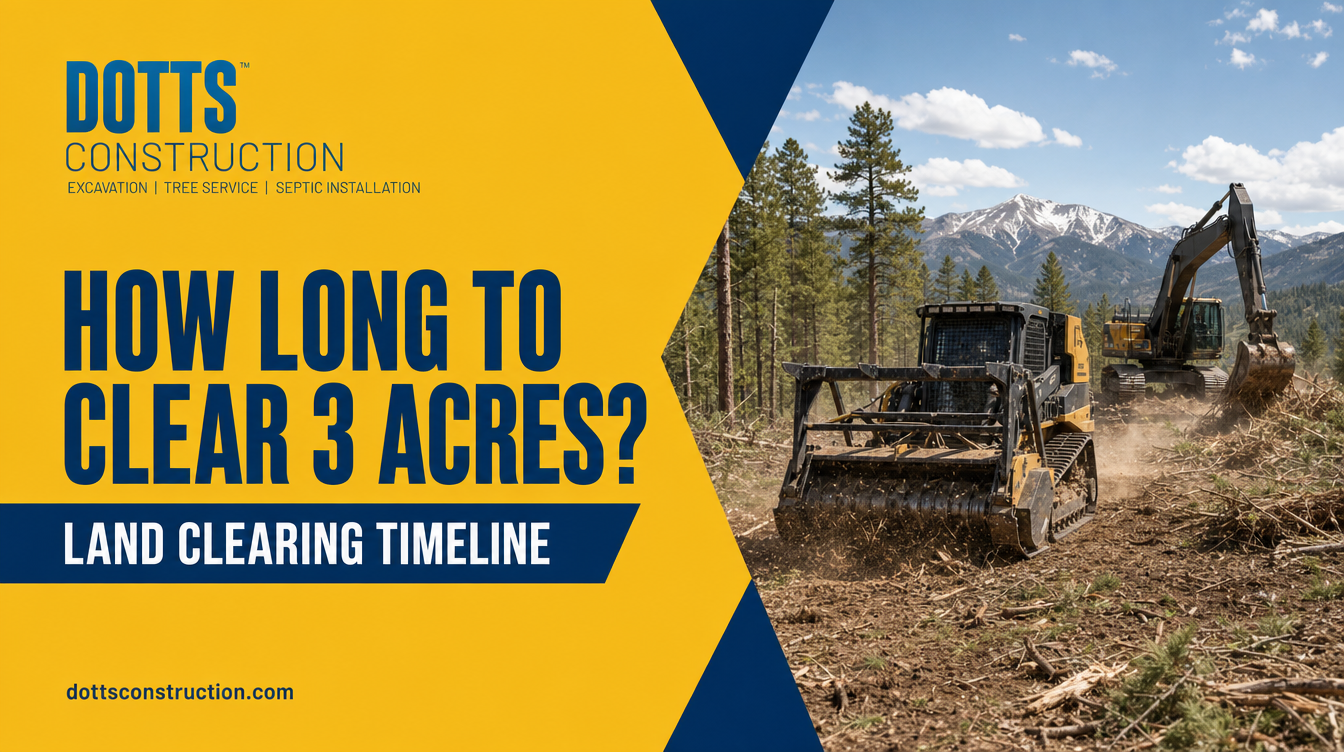
Clearing 3 Acres of Land?
Clearing 3 acres of land typically takes 3 days to 4 weeks. Light brush and small trees can be cleared in 3 to 6 days. Moderately wooded lots take 1 to 2 weeks. A heavy, mature forest can take 2 to 4 weeks. The single biggest variable is whether you use professional-grade equipment or manual labor.
If you are preparing a homesite or building lot, that timeline is only the beginning of the story. What happens after the trees come down, including stump removal, grubbing, grading, and final site prep, determines whether your project stays on schedule or grinds to a halt before a single foundation is poured.
At Dotts Construction, we have worked through enough lot clearing for homesite projects to know that most delays do not come from the land itself. They come from contractors who underestimate the work, overpromise on timelines, and disappear when complications show up. This post gives you the honest breakdown so you can plan confidently.
What Is Lot Clearing for a Homesite, and What Does It Actually Include?
Lot clearing for a homesite is the process of removing all vegetation, debris, stumps, and surface obstructions from a parcel of land so it can be graded and prepared for construction. It is not just cutting down trees.
A true lot clearing scope for a buildable homesite includes:
- Tree felling and removal (or mulching via forestry mulcher)
- Stump grinding or full stump and root grubbing
- Brush and debris clearing
- Rough grading to establish a workable surface grade
- Topsoil stripping where required by building codes or engineering specs
- Rock removal if surface or subsurface rocks are present
The distinction between "cleared" and "construction-ready" matters enormously. A parcel can look cleared to the eye and still be completely unbuildable because of root systems, soft subgrade, or improper drainage. A homesite is not truly ready until it passes inspection and supports safe foundation work.
How Long Does Each Phase of Clearing 3 Acres Take?
Here is a realistic phase-by-phase breakdown for a standard 3-acre lot clearing project targeting homesite construction:
Phase 1: Vegetation and Tree Removal
| Vegetation Type | Estimated Time for 3 Acres |
|---|---|
| Light brush, small saplings, scrub | 3 to 6 days |
| Moderate woods, mixed hardwood and pine | 1 to 2 weeks |
| Dense, mature hardwood forest | 2 to 4 weeks |
A skilled operator running a forestry mulcher can process 1 to 2 acres per day in moderately wooded conditions. An excavator with a hydraulic thumb and a dedicated brush crew can clear 2 to 3 acres per day on a lighter lot. Manual crews using chainsaws and hand tools average 0.1 to 0.5 acres per day, meaning a lightly wooded 3-acre lot could still take 6 to 30 days with manual labor alone.
Pro Tip: Forestry mulching eliminates the haul-away step by grinding debris in place, which shaves days off your timeline. But it is not always the right call. If you need clean topsoil or plan to regrade significantly, full removal and grading may serve the project better long-term.
Phase 2: Stump and Root Removal
Stumps and roots are where timelines quietly fall apart.
- Stump grinding: Faster, leaves roots in place, 1 to 3 days for a 3-acre lot depending on stump count
- Full grubbing (stump and root ball excavation): Slower, adds 3 to 7 days, but required for foundation zones and septic field areas
If your homesite plan requires a foundation excavation or a septic system design and installation, grubbing is not optional. Roots left in the ground decompose over time, creating voids that compromise both structural integrity and drain field performance.
Phase 3: Rough Grading
Once vegetation and stumps are cleared, the excavator returns to establish grade. For a 3-acre homesite with reasonable slope:
- Simple flat grading: 1 to 2 days
- Moderate cut-and-fill work: 2 to 5 days
- Complex grading with drainage swales, driveway cuts, and foundation pad leveling: 1 to 2 weeks
Grading is where the Dotts 3M Method earns its results. Our process maps the finished grade to your foundation plan and driveway layout before a single blade hits the ground, so we are not regrading the same dirt twice.
What Factors Have the Biggest Impact on Your Clearing Timeline?
Equipment vs. Manual Labor: The Real Difference
This is the most consequential decision in your timeline.
| Method | Daily Clearing Rate | Best For |
|---|---|---|
| Forestry mulcher (tracked) | 1 to 2 acres per day | Dense brush, small trees, light canopy |
| Excavator with hydraulic thumb | 2 to 3 acres per day (skilled operator) | Medium to large trees, grubbing, grading |
| Chainsaw and hand crew | 0.1 to 0.5 acres per day | Selective clearing, no heavy equipment access |
| Combination (mulcher + excavator) | 2 to 4 acres per day | Full-service lot clearing and site prep |
According to operator consensus in professional excavation contractor forums, a skilled excavator operator can clear 2 to 3 acres of moderately wooded land in a single day. An inexperienced operator doing the same work may need a full week or longer. Operator skill is not a soft factor. It directly controls your timeline and the quality of the finished grade.
How Does Terrain Affect Clearing Time?
Flat, dry, accessible land clears fast. Everything else adds time:
- Slope over 15%: Slows equipment movement, increases soil erosion risk, may require erosion controls before grading
- Rocky subsoil: Adds rock breaking or removal steps, can double grading time
- Wet or clay-heavy soil: Limits equipment access windows, may require waiting for dry conditions
- Irregular shape or tight access: Restricts equipment turning radius, slows coverage rate
Note: Wet clay soils are a hidden timeline killer. If your property has heavy clay content, your contractor needs to schedule clearing around dry weather windows or risk getting equipment stuck and compacting subsoil that takes months to recover.
Does Your End Goal Change the Timeline?
Absolutely. The finish line looks very different depending on your project:
- Simple brush clearing for pasture or privacy: Fastest. Mulch in place, you are done.
- Clearing for a gravel driveway or road: Adds 1 to 3 days for base prep and compaction.
- Clearing for a home foundation: Adds stump grubbing, precise grade work, and often a soil bearing test before the foundation crew shows up.
- Clearing for a septic system installation: Requires locating and preserving the drain field area, coordinating with a licensed septic designer, and often a soil perc test. This can add 1 to 3 weeks to the overall project timeline when permit review is included.
What Slows Down a Lot Clearing Project Nobody Warns You About?
Here is the honest list of what actually stalls homesite clearing projects:
- Permit delays. Some counties require a land disturbance permit or tree removal permit before work begins. Permit review can take 1 to 6 weeks depending on jurisdiction.
- Utility locates. Before any excavation, underground utilities must be located and marked. In most states this is a legal requirement. Call 811 at least 3 business days before work starts.
- Unexpected buried debris. Old foundations, buried trash pits, and concrete pads from previous structures show up regularly on rural lots. Each find adds hours or days of unexpected work.
- Weather. A week of rain on a clay-heavy site can push a 1-week project into a 3-week project.
- Contractor communication gaps. This one costs more time than most people expect. When the crew shows up, the plan is unclear, and decisions have to wait for a call-back, half a day is gone. This is precisely why Dotts Construction communicates every step before the equipment arrives.
How Does Lot Clearing for a Homesite Differ from General Land Clearing?
This distinction matters because it directly affects what your contractor needs to do and how long it takes.
| Factor | General Land Clearing | Homesite Lot Clearing |
|---|---|---|
| Primary goal | Remove vegetation | Create a buildable, code-compliant site |
| Root/stump treatment | Grind or leave in place | Full grubbing required in foundation zones |
| Grading standard | Rough grade acceptable | Precise grade to engineering specs |
| Drainage planning | Minimal | Required for foundation and septic performance |
| Permit involvement | Sometimes | Almost always |
| Coordination with other trades | Rarely | Always (foundation, septic, utilities) |
Lot clearing for a homesite is a construction operation, not a landscaping operation. The difference in rigor is significant. A contractor who clears pasture land may not have the experience or equipment precision needed to prepare a buildable pad that will pass a foundation inspection.
How Much Does It Cost to Clear 3 Acres for a Homesite?
Clearing costs vary widely, but here are the realistic ranges based on regional contractor data:
- Light brush clearing, 3 acres: $1,500 to $5,000
- Moderate woodland clearing, 3 acres: $5,000 to $15,000
- Heavy mature forest clearing, 3 acres: $15,000 to $30,000+
- Full homesite prep (clearing, grubbing, rough grade, fine grade): $20,000 to $50,000+ depending on complexity
, the average all-in cost for a 3-acre moderately wooded lot was $X including grading and septic area prep."]
The biggest cost surprises come from:
- Rock removal (billed separately, often by the hour or ton)
- Debris hauling when mulching is not an option
- Regrading after an initial contractor does substandard work
Getting a detailed written scope before you sign is not optional. Vague estimates like "clear and grade" have cost homeowners tens of thousands in scope disputes.
What Equipment Is Used to Clear a 3-Acre Lot?
Understanding the equipment tells you whether your contractor is set up to do the job efficiently:
- Forestry mulcher (tracked or skid-steer mounted): Grinds trees and brush into mulch in a single pass. Best for light to medium vegetation. Eliminates haul-away cost.
- Excavator with hydraulic thumb: The workhorse for grubbing stumps, moving large timber, and precision grading. A skilled operator on a mid-size excavator is the single most productive tool on a homesite clearing project.
- Bulldozer: Used for large-scale push clearing and rough grading on bigger lots. On a 3-acre homesite, an excavator typically offers more precision.
- Skid-steer loader: Cleanup tool for moving debris piles, grading tight areas, and finish work.
- Stump grinder: Standalone machine for grinding stumps when full grubbing is not required.
A professional lot clearing contractor running a full homesite project should have, at minimum, an excavator and a mulcher or separate stump grinder on site. If a contractor shows up with only chainsaws and a skid-steer, ask specific questions about their grubbing and grading plan.
FAQ: Lot Clearing for a House or Homesite
How long does it take to clear 3 acres of land for a house?
Clearing 3 acres for a house takes 1 to 3 weeks for a moderately wooded lot when using professional equipment. Add another 3 to 7 days for full stump grubbing in foundation and septic zones, plus 1 to 5 days for rough and finish grading. Total site prep from raw land to buildable pad typically runs 2 to 5 weeks.
Do I need a permit to clear 3 acres of land?
Most counties require a land disturbance permit for clearing projects over 1 acre. Some jurisdictions also require tree removal permits and soil erosion control plans before work begins. Permit timelines range from 3 business days to 6 weeks. Contact your local planning or zoning office before scheduling clearing work.
Can I clear 3 acres of land myself?
You can clear 3 acres yourself using a rented skid-steer, chainsaw, and stump grinder, but expect the project to take 4 to 8 weeks at a manual pace. DIY clearing is generally not cost-effective for homesite prep because the grading precision and root grubbing required for a buildable pad demands professional equipment and an experienced operator.
What is the difference between forestry mulching and traditional clearing?
Forestry mulching grinds trees and brush into wood chips in a single pass, eliminating the haul-away step and leaving a natural ground cover. Traditional clearing fells trees, removes logs, and hauls or burns debris. Mulching is faster and cheaper for vegetation removal, but may not be appropriate if deep root grubbing or precise grading is required for your homesite.
Does lot clearing include stump removal?
Not automatically. Many clearing contractors price stump grinding or grubbing separately. For a homesite, confirm whether your quote includes full root grubbing in the foundation footprint and septic drain field area. Leaving roots in these zones creates structural and drainage risks that can compromise your entire build.
How long does it take to get a lot cleared and ready for a foundation?
From the first day of clearing to a foundation-ready pad, most 3-acre homesite projects take 3 to 6 weeks. This includes clearing, grubbing, rough grading, fine grading, soil testing if required, and final inspection. Weather, permit timelines, and soil conditions are the primary variables that extend this range.
What happens after lot clearing before construction can start?
After clearing and grading, most homesite projects require: a soil bearing test or geotechnical report for the foundation design, utility trench routing and installation, septic system design and permitting if not connected to municipal sewer, and driveway rough-in. Each step has its own lead time, so coordinating these concurrently with your clearing schedule saves weeks.
Ready to Clear Your Lot? Here Is Your Exact Next Step.
If you are planning a homesite on a 3-acre parcel, the worst thing you can do is call a dozen contractors, collect vague estimates, and try to compare them against each other. They will not be comparing the same scope.
The right first step is an on-site evaluation where someone who understands foundation excavation, septic system design, and lot clearing for homesite construction walks your property, identifies what is actually in the ground, and gives you a written scope with a real timeline.
At Dotts Construction, that is exactly what we do. Our Dotts 3M Method maps every phase of your site prep before equipment rolls, so your project does not stall when the first stump comes out bigger than expected or the soil bearing test surprises everyone.
We do not overpromise. We do not disappear. We show up when we say we will, communicate every step, and hand you a site that is ready to build on.
Call Dotts Construction today or request your on-site evaluation below.
Request a free consultation or call (719) 280-4141
Related Guides
Need the pros? See Land Clearing Services. More reading:
About the Author
Michael Dotts brings over 15 years of hands-on experience in heavy construction and grading, with a specialty in the unique demands of building in the Rocky Mountains, where steep terrain, rocky ground, and harsh weather change the rules most flatland contractors are used to. Because Michael knows what it really takes to get the job done right in Colorado’s high country, you can count on honest, accurate quotes that won’t creep up halfway through the job.