
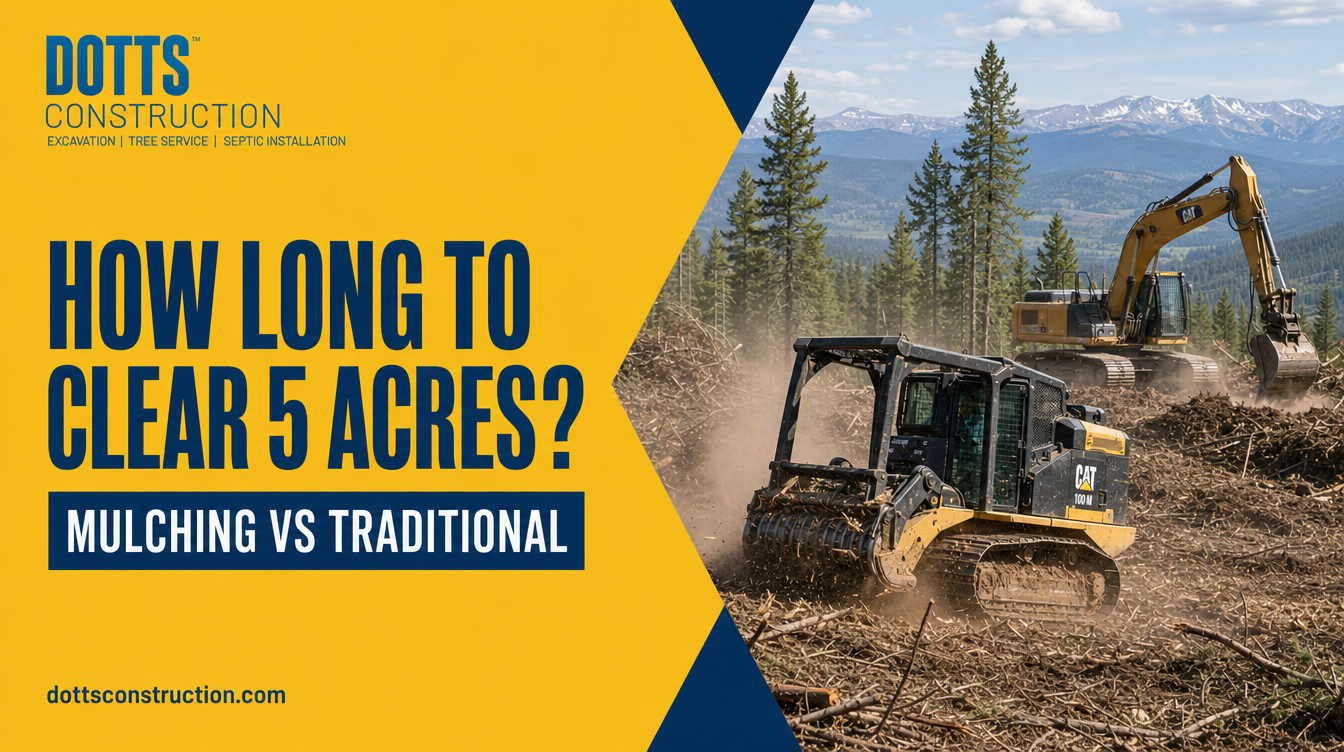
Clearing 5 Acres of Land?
Clearing 5 acres of land takes 1 to 3 days for professional crews using heavy equipment on lightly wooded sites. Dense timber with stumps can stretch that to 1 to 2 weeks. The single biggest variable is not the size of your land. It is the method you choose and what is growing on it right now.
This guide breaks down real timelines, the honest tradeoffs between forestry mulching and traditional land clearing, and what Dotts Construction has learned getting raw ground ready for foundations, driveways, and septic systems.
What Is the Difference Between Forestry Mulching and Land Clearing?
Forestry mulching is a single-machine process. A specialized mulching head (mounted on a skid steer, track loader, or dedicated mulcher) grinds trees, brush, and stumps directly into a layer of wood chips that stays on-site as ground cover. No hauling. No burning. No separate stump grinding pass.
Traditional land clearing is a multi-step process: bulldozers or excavators push trees down, a separate crew handles stump grubbing or grinding, and then a third phase hauls or burns the debris. Each phase adds time and cost.
Here is why the distinction matters when you are planning a 5-acre project:
- Forestry mulching completes in one mobilization. Traditional clearing often requires two or three separate crews and equipment deployments.
- Traditional clearing leaves bare, disturbed soil that erodes fast. Mulching leaves a protective layer that holds moisture and suppresses weeds.
- If your site is destined for a foundation, driveway, or septic system, traditional clearing with grubbing is often required because buried root masses and mulch layers can compromise compaction. Your contractor should tell you this upfront.
Pro Tip: Forestry mulching is the right tool for pasture reclamation, fence line clearing, and lot prep where you do not need to excavate or compact the ground afterward. For building pads and septic fields, you likely need traditional clearing with full stump removal.
How Long Does It Actually Take to Clear 5 Acres by Vegetation Type?
The timeline is almost never about acreage alone. A professional crew can mulch 5 acres of light brush in a single day. That same crew hits dense hardwood timber and the clock resets entirely.
Light Brush, Grass, and Scrub (Under 4 Inches Diameter)
Timeline: 4 to 8 hours (same-day completion)
A commercial forestry mulcher or brush hog cuts through light vegetation fast. One operator, one machine. Dotts Construction regularly knocks out light brush sites before lunch. If your land has been growing up for 3 to 5 years with saplings and briars, expect a half-day to full day of work.
Medium Woods and Mixed Understory (4 to 12 Inch Trees)
Timeline: 2 to 4 days
This is the most common scenario for rural homeowners clearing land for a new build or driveway. Mixed hardwoods with a developed understory take sustained machine time. An excavator or dedicated mulcher processes roughly 1 to 2 acres per day in this density.
Stump handling makes or breaks the timeline here. If you grind stumps flush, add a half day per acre. If you pull them entirely for a construction-ready subgrade, plan for the longer end of this range.
Heavy Timber and Large-Diameter Trees (Over 12 Inches)
Timeline: 1 to 2 weeks
Old-growth timber or mature hardwood stands require a different approach. Chainsaw crews fall trees first. An excavator pushes and piles debris. A grinder runs continuously. Haul trucks cycle in and out. Each phase is dependent on the previous one finishing.
On top of that, if your county requires a timber harvesting permit or a land disturbance permit for sites over a certain acreage, that paperwork has to clear before a single machine rolls. Permits alone can add 2 to 6 weeks of waiting time to your project start date.
Forestry Mulching vs. Traditional Land Clearing: Which Is Faster for 5 Acres?
The honest answer depends on what you are doing with the land afterward. Here is a direct comparison:
| Factor | Forestry Mulching | Traditional Land Clearing |
|---|---|---|
| Typical timeline (5 acres, medium density) | 1 to 3 days | 3 to 10 days |
| Equipment mobilizations | 1 | 2 to 4 |
| Debris handling | Mulch stays on-site | Haul away, burn, or chip |
| Stump treatment | Ground flush or mulched | Pulled or ground separately |
| Erosion control after clearing | Built in (mulch layer) | Requires seeding or silt fence |
| Cost for 5 acres (rough average) | $3,000 to $7,000 | $5,000 to $15,000+ |
| Best use case | Pasture, trails, lots without excavation | Foundation pads, septic fields, driveways |
| Soil disturbance | Minimal | High |
Forestry mulching is faster and cheaper in most cases. The catch is that mulched ground is not compaction-ready. If Dotts Construction is following up with grading, foundation excavation, or septic installation, we coordinate the clearing method to match what comes next. Skipping that conversation early is how homeowners end up redoing work they already paid for.
What Are the Biggest Factors That Slow Down a Land Clearing Project?
Stump Removal Takes Longer Than Most People Expect
Grinding stumps flush to grade takes roughly 20 to 30 minutes per stump on average. Full stump grubbing with an excavator takes longer but leaves a cleaner subgrade for construction. On a heavily wooded 5-acre site, you could be looking at 100 to 300 stumps. That math adds up fast.
Debris Hauling Can Double Your Timeline
Burning debris requires a burn permit in most counties and depends on dry weather windows. Chipping takes time and specialized equipment. Hauling requires dump trucks making multiple runs to an approved disposal site. Any one of these constraints can extend your project by days.
Terrain Conditions Matter More Than People Realize
Flat, dry ground with good machine access is a completely different job than a site with:
- Slopes over 15 degrees (machines slow down significantly)
- Wet or clay-heavy soil (tracked equipment sinks, work stops)
- Rocky subsurface (mulchers and excavators take damage, progress slows)
- Limited access points (machines have to navigate carefully instead of working)
Dotts Construction uses the Dotts 3M Method to assess each site before quoting: Map, Measure, and Mobilize. We walk the property, identify terrain constraints, flag utility easements, and plan the machine sequence before we ever load a trailer. That prep work is why our timelines hold.
Permitting and Environmental Approvals Add Weeks Before Work Starts
This is the hidden timeline killer almost every homeowner misses. Depending on your state and county:
- Wetland setbacks may require a delineation survey before clearing
- Erosion and sediment control plans may be required for disturbed areas over 1 acre
- Some counties require a grading permit before any land disturbance
- HOAs and deed restrictions can add another layer of approval
Build permit lead time into your project schedule from day one. The physical clearing is often the fastest part of the whole process.
DIY vs. Hiring Professionals: What Does the Timeline Really Look Like?
Let's be honest about DIY land clearing at scale. Renting a skid steer or brush cutter and attacking 5 acres solo is a significant undertaking that most people underestimate.
DIY Timeline Reality
- Renting a tracked skid steer with a mulching head costs $800 to $1,500 per day depending on your market.
- Learning curve on machinery you have never operated costs you 30 to 50% of your first day.
- Equipment breakdowns happen. Replacement parts and service calls are your problem when you rent.
- Physical fatigue from operating heavy machinery 8 hours a day is real and compounds across days.
Realistically, a capable DIYer tackling 5 acres of medium density brush and small trees should budget 2 to 4 weekends before the site is genuinely clear. That is 8 to 16 days of active work stretched over a month or more.
Professional Crew Timeline
A Dotts Construction crew with the right equipment combination processes 1 to 3 acres per day on medium density ground. Five acres of comparable density is a 2 to 3 day job, start to finish, including cleanup.
The math that surprises people: when you factor in equipment rental days, fuel, any repairs, your own labor hours at your actual hourly rate, and the inevitable do-overs from learning on the job, professional clearing often costs less on a total-project basis.
Pro Tip: Get your contractor to commit to a written scope that specifies acres per day expected, what constitutes completion, and what the plan is if they encounter conditions not visible in the site walk. Vague scopes are how projects drag on indefinitely.
How Does the Dotts 3M Method Affect Your Clearing Timeline?
Most excavation and clearing contractors show up, look around, and start quoting numbers from memory. The Dotts 3M Method is the opposite approach.
Map: We pull site data and walk every corner of the property. We identify tree density zones, access points, soil conditions visible at the surface, and any structures, utilities, or easements within the clearing area.
Measure: We calculate actual vegetation load, not estimated acreage. A 5-acre site with mature timber along the north edge and light scrub everywhere else is not a uniform 5-acre job. It is two different jobs that require different equipment and different time allocations.
Mobilize: We sequence equipment and crew based on the first two steps. The mulcher goes first on accessible light zones while the excavator is staged for the timber section. No crew is sitting idle waiting on another machine to finish.
The result is a realistic timeline you can actually build your construction schedule around. When Dotts Construction says your site will be cleared and graded in 4 days, that number came from a system, not a guess.
What Comes After Land Clearing on a Construction Site?
Clearing the land is the first step, not the final one. Here is what typically follows on a site headed toward construction:
- Grading and Grubbing: Establishing the rough grade, pulling remaining root masses, and shaping the site to drain properly.
- Foundation Excavation: Digging footings, basements, or crawl space perimeters to the engineer-specified depth.
- Driveway Base Work: Cutting and compacting the driveway corridor, installing culverts where needed.
- Septic System Installation: Soil percolation testing, system design per county code, and installation of the tank and field lines.
- Final Grading: Establishing finished grades that drain away from the structure and match the approved site plan.
Each phase connects to the next. This is why the clearing method you choose on day one matters through the entire project. Dotts Construction handles all of it under one roof, which means the crew that cleared your site already knows your terrain before the excavator arrives.
Frequently Asked Questions About Land Clearing and Forestry Mulching
How long does it take to clear 5 acres with a forestry mulcher?
A dedicated commercial forestry mulcher clears 5 acres of light to medium brush in 1 to 3 days. Heavy timber with large-diameter trees slows that rate to 1 acre per day or less. Terrain, moisture, and machine access all affect daily output.
Is forestry mulching better than clear-cutting for residential land prep?
Forestry mulching is faster and leaves topsoil intact, which is better for erosion control and future seeding. Traditional clear-cutting is better when you need a compacted, grubbed subgrade for a foundation or septic field where buried organic matter would cause settling issues.
What is the cheapest way to clear 5 acres of land?
Forestry mulching is typically the most cost-efficient method for land that does not need to be excavated afterward, averaging $3,000 to $7,000 for 5 acres. Traditional clearing with haul-away costs more because of the additional equipment, labor phases, and disposal fees involved.
Do I need a permit to clear 5 acres of land?
Most states and counties require some form of land disturbance permit for clearing projects over 1 acre. Wetlands, floodplains, and protected tree ordinances can add additional approval layers. Contact your local planning or zoning office before scheduling any clearing work.
How many trees can a forestry mulcher process per hour?
A commercial forestry mulcher processes trees up to 8 to 12 inches in diameter at a rate of roughly 20 to 40 trees per hour under good conditions. Larger trees require multiple passes or pre-felling by a chainsaw crew before the mulcher engages.
What is the difference between stump grinding and stump grubbing?
Stump grinding uses a rotating drum to chip the stump down to a few inches below grade, leaving roots in the ground. Stump grubbing uses an excavator to pull the entire root ball out of the ground. Grubbing is required for construction subgrades; grinding is sufficient for replanting or lawn establishment.
How do I prepare my land for a septic system after clearing?
After clearing, a licensed engineer or sanitarian performs a soil evaluation and percolation test to determine the appropriate septic system type. The site is then rough-graded to establish proper drainage before the tank and field lines are installed to county code. Dotts Construction handles the full process from clearing through installation.
Ready to Get Your 5 Acres Cleared on a Real Schedule?
Here is what we see happen constantly: a homeowner calls a clearing crew, gets a vague estimate, waits three weeks for them to show up, and then watches the project drag out while their construction start date slides further away. The whole build is on hold because the site work was not treated like the critical path item it actually is.
That is not how Dotts Construction operates. We show up when we say we will. We communicate every step through the process. And we get your ground ready for foundations, driveways, and septic systems without the contractor drama that derails projects.
Whether your 5 acres needs a quick forestry mulching pass or a full excavation and grading sequence, we can tell you exactly what your timeline looks like after one site visit.
Call Dotts Construction or book your site evaluation today and get a timeline you can actually build around.
Request a free consultation or call (719) 280-4141
Related Guides
Need the pros? See Land Clearing Services. More reading:
About the Author
Michael Dotts brings over 15 years of hands-on experience in heavy construction and grading, with a specialty in the unique demands of building in the Rocky Mountains, where steep terrain, rocky ground, and harsh weather change the rules most flatland contractors are used to. Because Michael knows what it really takes to get the job done right in Colorado’s high country, you can count on honest, accurate quotes that won’t creep up halfway through the job.