
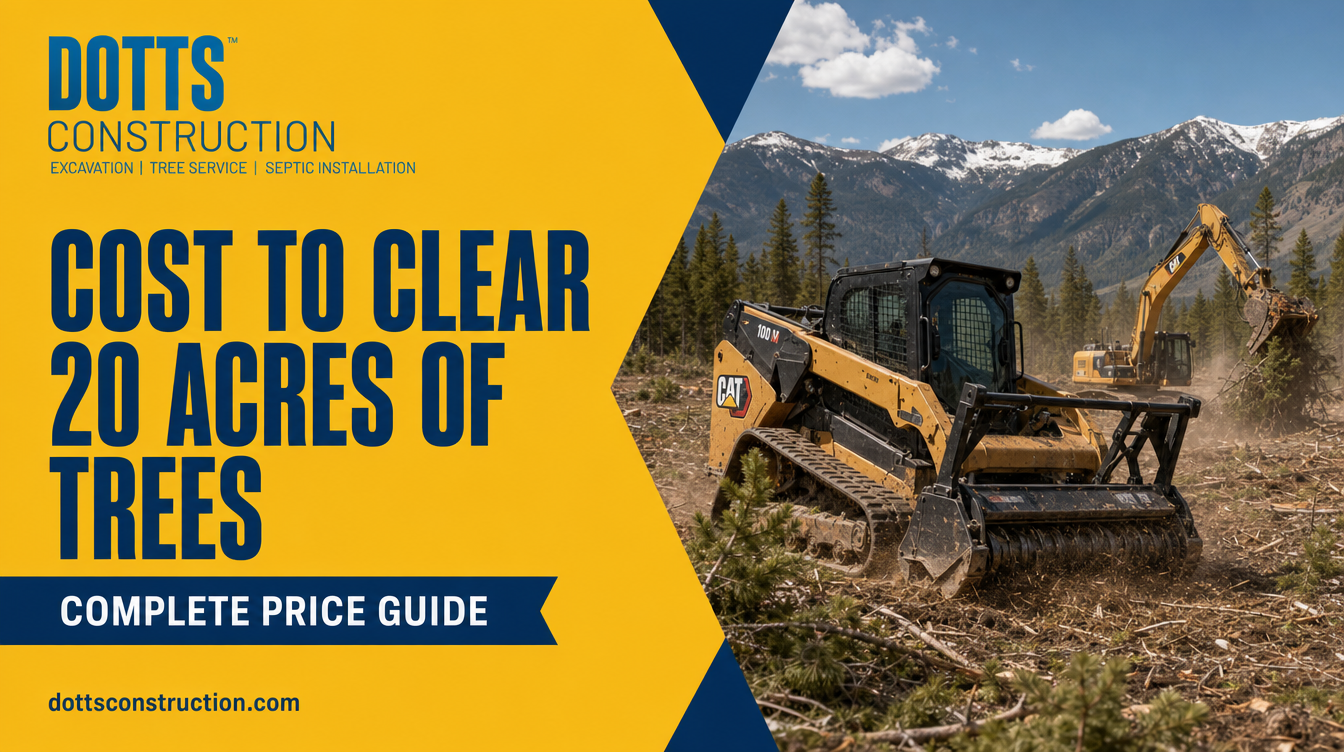
Clearing 20 Acres of Trees?
Before the numbers: every job is different. The ranges below are realistic starting points, but your real cost depends on access, terrain, volume, and the specific conditions of your Colorado property. For an accurate figure, request a free on-site estimate or call (719) 280-4141.
Clearing 20 acres of trees typically costs between $24,000 and $100,000+, with most standard wooded projects landing in the $40,000 to $70,000 range. Your final number depends almost entirely on how dense the trees are, which clearing method your contractor uses, and what happens to all the debris once the trees come down.
Here's everything you need to know before you call a single contractor.
Why Does 20-Acre Lot Clearing Cost So Much Less Per Acre Than Small Jobs?
Large acreage projects unlock volume pricing. When a contractor mobilizes heavy equipment to a site, the biggest cost is getting the machines there. On a 1-acre job, you absorb 100% of that mobilization cost. On a 20-acre job, that same cost is spread across 20 acres of productive work.
As a result, per-acre rates for 20-acre land clearing typically run $1,200 to $5,000 per acre, compared to $3,000 to $8,000 per acre on smaller residential lots.
The three forces controlling your total:
- Tree density: Sparse brush clears fast. Mature hardwood canopy with deep root systems takes four times as long.
- Clearing method: Forestry mulching leaves debris on-site. Excavator clearing requires hauling or burning, both of which add significant cost.
- Post-clearing scope: A rough-cleared lot is different from a graded, construction-ready homesite. If you need grade work after clearing, that is a separate line item.
Pro Tip: Call your contractor and ask specifically: "Does your quote include stump removal, debris disposal, and rough grading, or just felling and pushing?" Those three items can add $20,000 to $40,000 to a 20-acre project if they are not included in the base price.
What Does It Cost Per Acre to Clear 20 Acres by Tree Density?
Tree density is the single biggest variable in lot clearing for a house or homesite. Here is what you should expect based on what is actually growing on your land.
Lightly Wooded or Sparse Brush: $24,000 to $40,000 Total
At $1,200 to $2,000 per acre, this is the most favorable scenario. Light coverage means:
- Open canopy with scattered saplings
- Mostly brush, scrub, and small diameter trees (under 6 inches)
- Equipment can move fast without constant repositioning
- Minimal stump mass to deal with
If your land looks like an overgrown pasture or recently logged property with regrowth, budget closer to the low end.
Moderately Wooded Mixed Forest: $40,000 to $70,000 Total
At $2,000 to $3,500 per acre, this is the most common scenario for homesite and homestead clearing projects. Moderate coverage includes:
- Mixed canopy of hardwoods and softwoods, 6 to 18 inch diameter trees
- Steady understory brush
- Normal root systems that can still be mulched or pushed without extraordinary effort
Most wooded residential parcels in the Mid-Atlantic, Southeast, and Midwest fall into this tier.
Heavily Forested Mature Timber: $70,000 to $100,000+ Total
At $3,500 to $5,000+ per acre, dense mature timber is the most expensive and most labor-intensive scenario. This category includes:
- Large-diameter hardwoods (oak, walnut, hickory, poplar) over 18 inches
- Deep, extensive root systems that require full grubbing if you are building
- High debris volume that must be burned, chipped, or hauled
- Possible logging value that can offset costs (more on this below)
Which Clearing Method Should You Use for a 20-Acre Homesite?
The method your contractor uses is not a style preference. It determines whether stumps stay in the ground, whether debris leaves the property, and whether the site is buildable when they are done.
Forestry Mulching: $1,200 to $3,500 Per Acre
Forestry mulching is usually the most cost-efficient method for large acreage land clearing. A tracked mulching machine grinds trees, brush, and stumps down to ground level in a single pass, leaving a thick layer of wood chip mulch on the soil surface.
What you get:
- No debris hauling cost (debris stays on-site as mulch)
- Faster mobilization and operation than traditional bulldozing
- Erosion control from the mulch layer
- Lower per-acre cost on large projects
What you do not get:
- Complete stump removal. Stumps are ground down but root balls stay underground.
- If you are pouring a foundation, digging a septic system, or laying a road base directly through that area, the underground root mass is a problem. You will need additional excavation to grub those roots out.
Forestry mulching is ideal for: Clearing land for agriculture, pasture, recreational use, or rough access roads where you do not need every square foot of cleared area to be foundation-ready.
Bulldozer and Excavator Clearing: $2,000 to $5,000 Per Acre
If you are preparing a homesite for a house foundation, this is typically the required method. Heavy excavators and bulldozers push trees over and rip the stump and root ball out of the ground completely, leaving a cleared surface where nothing organic remains underground.
What you get:
- Complete stump and root ball removal
- A site that is immediately ready for foundation excavation, septic design, and utility installation
- The ability to pile, burn, or haul all debris
What you must plan for:
- Debris management cost: All those trees, stumps, and root balls have to go somewhere. Burning on-site requires local permits and dry conditions. Hauling to a transfer station adds $500 to $2,000 per acre depending on haul distance.
Pro Tip: At Dotts Construction, our Dotts 3M Method sequences clearing, rough grading, and site prep in one coordinated workflow. That means you are not calling three separate contractors or paying three separate mobilization fees.
Hybrid Approach: Selective Logging + Mulching
If your 20 acres contains mature hardwood timber (oak, walnut, cherry, black walnut), contact a commercial timber buyer before you hire a clearing contractor. Mature hardwood stands in good condition have real market value.
A timber company may:
- Clear the canopy trees for free in exchange for the logs
- Pay you for timber rights (offsetting your clearing cost by thousands of dollars)
- Leave you with a partially cleared site where only the smaller brush, stumps, and debris remain
At that point, follow-up forestry mulching on the remaining material drops your total project cost significantly.
What Additional Costs Can Push a 20-Acre Clearing Project Over Budget?
Lot clearing for a homesite is rarely a single-line invoice. Here are the hidden cost drivers that contractors often quote separately.
Complete Stump Grubbing: $500 to $1,500 Per Acre
If you used forestry mulching, or if your excavator clearing left partial root mass underground, grubbing removes all underground organic material. This is non-negotiable if you are placing a foundation, installing a septic system, or building a road base. Decomposing root mass underground causes settling, voids, and structural problems.
Site Grading: $1,000 to $5,000 Per Acre
Clearing leaves the ground rough, uneven, and littered with low stumps, depressions, and pushed soil. Grading is a separate scope of work that levels and prepares the cleared surface for construction. If you are building a house, installing a driveway, or planning a detention pond, grading is required.
On a 20-acre lot, expect grading to add $20,000 to $100,000 depending on terrain complexity, cut-and-fill volume, and how precisely level the finished surface needs to be.
Terrain Surcharges: 20% to 50% Cost Premium
Steep slopes and rocky soil slow equipment movement and cause accelerated wear on cutting heads and tracks. Contractors in hilly or rocky regions routinely add terrain surcharges. If your parcel has grades steeper than 15 to 20 degrees, get that disclosed before you accept a quote.
Permitting: $200 to $2,000+
Most counties require tree removal or land clearing permits above a certain acreage threshold. Burning permits (if you plan to burn debris on-site) are a separate requirement. Your contractor should handle permitting, but verify it is included in the scope.
Erosion and Sediment Control: $500 to $3,000
Many jurisdictions require silt fencing, straw wattles, or sediment basins on cleared land above a certain disturbed area. If your project triggers a land disturbance permit, expect erosion control to be a line item.
How Do Clearing Costs Compare by Method for a 20-Acre Homesite?
| Tree Density | Est. Cost Per Acre | Est. Total for 20 Acres | Best Clearing Method | Stump Status |
|---|---|---|---|---|
| Light (sparse brush & saplings) | $1,200 to $2,000 | $24,000 to $40,000 | Skid steer or forestry mulching | Stumps ground down, roots remain |
| Medium (mixed hardwood & softwood) | $2,000 to $3,500 | $40,000 to $70,000 | Forestry mulching or bulldozer | Depends on method chosen |
| Heavy (dense mature timber) | $3,500 to $5,000+ | $70,000 to $100,000+ | Excavator + logging + haul off | Full root ball removal required |
| Heavy + site grading included | $5,000 to $8,000+ | $100,000 to $160,000+ | Full-service excavation & grade | Fully construction-ready surface |
Lot clearing for a house or homesite almost always requires the full-service approach. A partially cleared lot with stumps in the ground and uneven terrain is not a buildable surface. Factor grading into your budget from day one.
Can You Recoup Any of the Cost by Selling Timber?
Yes, and this is one of the most underused cost-reduction strategies in large-scale land clearing.
If your 20 acres contains mature hardwood timber, you may be able to offset $5,000 to $30,000 or more of your clearing cost by selling timber rights before clearing begins. Mature black walnut, white oak, cherry, and poplar are actively purchased by sawmills and timber buyers.
Steps to pursue a timber offset:
- Contact a licensed consulting forester or timber buyer for a free timber cruise (a formal inventory and valuation of your standing timber).
- Get a timber sale contract in writing before any machinery touches the site.
- Coordinate the logging schedule so the timber crew clears canopy trees first, then your land clearing contractor follows with mulching and stump work on the residual debris.
Note: Timber buyers are not land clearing contractors. They remove merchantable logs, but they leave tops, limbs, stumps, and small-diameter debris behind. You still need a contractor to finish the job.
What Should You Ask a Lot Clearing Contractor Before Signing Anything?
Getting three quotes is standard advice. Getting the right quotes is what actually matters. Here are the questions that separate professional contractors from the ones who will leave you with a rough-cleared disaster and disappear.
Ask every contractor:
- "Is stump removal included, or just tree felling and pushing?"
- "What is your debris disposal plan, and is hauling included in this price?"
- "Does your quote include grading, or just clearing?"
- "Are permits, erosion control, and sediment fencing included?"
- "How do you handle unexpected terrain or underground obstacles like ledge rock?"
- "What is your payment schedule, and do you require a large deposit upfront?"
The contractors who answer these questions clearly, in writing, before the first shovel moves are the ones worth hiring. The ones who get vague when you press for specifics are the ones who will surprise you with change orders after the equipment is already on-site.
Every homeowner we have worked with who had a bad prior experience with a contractor said the same thing: they did not communicate clearly before the project started. At Dotts Construction, we build the scope in writing before we build the site.
How Long Does It Take to Clear 20 Acres of Trees?
Timeline depends on tree density and method, but here are realistic expectations:
- Lightly wooded, forestry mulching only: 3 to 5 working days for a 20-acre parcel
- Moderately wooded, bulldozer clearing with debris burn: 5 to 10 working days
- Heavily forested, full excavator clearing with hauling: 10 to 20+ working days
- Full clearing plus site grading: Add 5 to 15 additional working days depending on cut-and-fill volume
Weather, equipment availability, and permit lead times all affect your actual project timeline. In wet seasons, soft soil conditions can delay heavy equipment operation or cause ruts that require additional grading.
Frequently Asked Questions About 20-Acre Lot Clearing Costs
How much does it cost to clear 20 acres for a house?
Clearing 20 acres for a house typically costs $40,000 to $100,000+ when you include the clearing, full stump removal, and rough grading needed to create a buildable homesite. A cleared-but-not-graded lot that still has stumps in the ground is not ready for a foundation and will require additional work before construction begins.
Is forestry mulching good enough for a house foundation?
Forestry mulching alone is not sufficient for a house foundation. Mulching grinds stumps to ground level but leaves root balls underground. Decomposing roots create voids and settlement risk under concrete. Foundation areas need full stump grubbing and excavation to remove all organic material below the footprint.
Can I clear 20 acres myself to save money?
You can rent forestry equipment, but clearing 20 acres is not a DIY project for most homeowners. The machinery is dangerous without training, the equipment rental alone runs $2,000 to $5,000 per week, and errors in stump removal or grading create expensive problems during construction. The per-acre savings rarely justify the risk.
What permits do I need to clear 20 acres?
Permit requirements vary by county and state, but most jurisdictions require a land disturbance permit for clearing projects above 1 acre. Burning permits are separate and not available in all counties. Your contractor should pull permits as part of the project scope. Always verify before clearing begins.
How do I know if my timber is worth selling before clearing?
Contact a licensed consulting forester for a free timber cruise before any clearing work starts. If your 20 acres contains mature hardwood species (oak, walnut, cherry, poplar), the timber may be worth $5,000 to $30,000+ in log value, which can significantly reduce your net clearing cost.
Does lot clearing cost include grading?
No, not automatically. Most clearing quotes cover felling, pushing, and debris management only. Site grading is typically a separate scope of work priced per acre or by cut-and-fill volume. Always ask your contractor to specify whether grading is included before you accept a quote.
What happens to the topsoil when land is cleared?
Heavy equipment operators push cleared debris into piles but also disturb and mix the topsoil layer. If your project requires a finished grade with a preserved topsoil cap (important for future landscaping or septic drain fields), your contractor needs to strip, stockpile, and replace topsoil as a deliberate step in the grading plan.
Ready to Get a Real Number for Your 20-Acre Clearing Project?
A rough estimate from a website is a starting point. A real number comes from a contractor who has walked your land, assessed your tree density, and scoped the full project from clearing through grading.
At Dotts Construction, we use the Dotts 3M Method to sequence your site prep so clearing, grading, and construction readiness happen in one coordinated plan. No three-contractor juggling act. No mystery change orders after we are on-site. No phone calls that go unreturned.
We prepare rough ground into meticulously ready homesites for foundations, driveways, septic systems, and full construction projects. We show up when we say we will, communicate every step of the process, and deliver a site that does not derail your build schedule.
Get a site assessment and quote for your 20-acre clearing project:
Request a free consultation or call (719) 280-4141
Related Guides
Need the pros? See Land Clearing Services. More reading:
About the Author
Michael Dotts brings over 15 years of hands-on experience in heavy construction and grading, with a specialty in the unique demands of building in the Rocky Mountains, where steep terrain, rocky ground, and harsh weather change the rules most flatland contractors are used to. Because Michael knows what it really takes to get the job done right in Colorado’s high country, you can count on honest, accurate quotes that won’t creep up halfway through the job.