
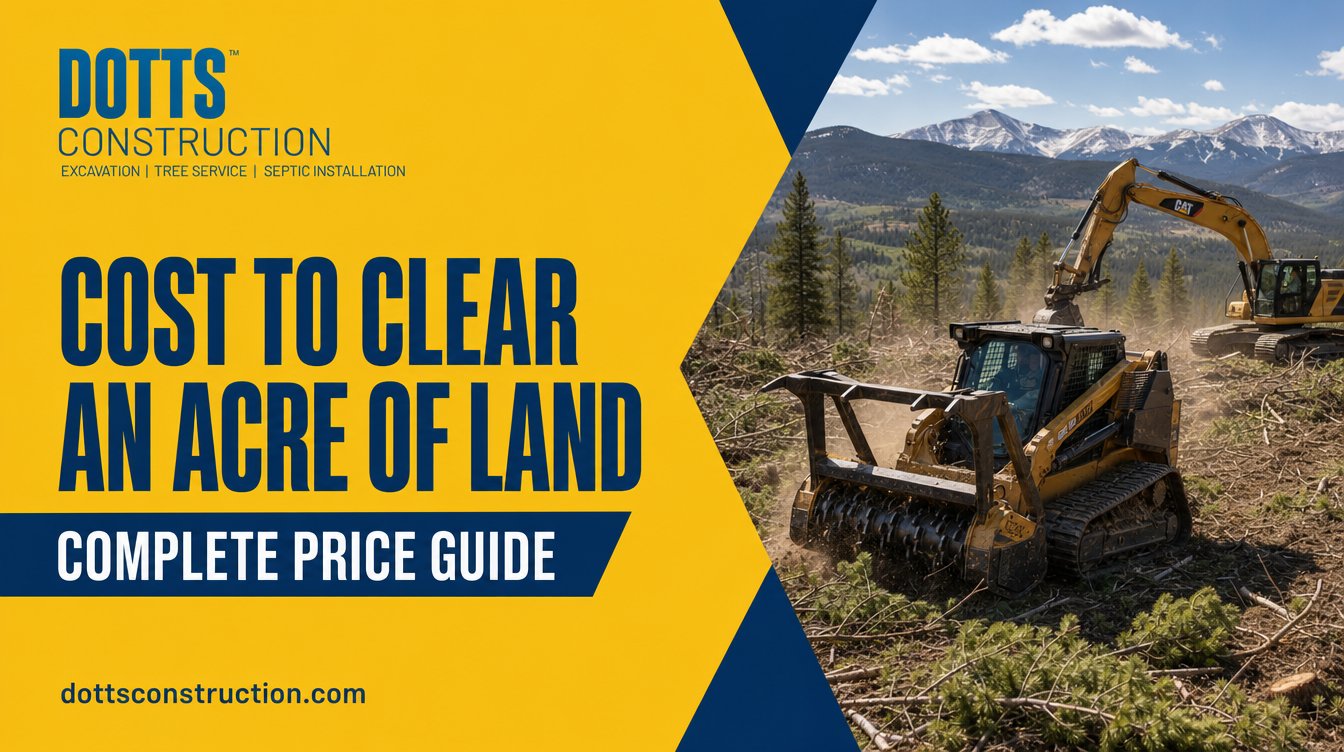
What Does It Cost to Clear an Acre?
Before the numbers: every job is different. The ranges below are realistic starting points, but your real cost depends on access, terrain, volume, and the specific conditions of your Colorado property. For an accurate figure, request a free on-site estimate or call (719) 280-4141.
Clearing one acre of land costs between $1,200 and $12,000, depending on vegetation density, terrain, and whether the site needs to be construction-ready. Most property owners pay $2,000 to $5,500 for a standard acre. Densely forested lots with large hardwoods and heavy root systems push costs toward the top of that range, and sometimes beyond it.
That range is wide because "land clearing" covers a lot of ground, literally. Cutting down tall grass is not the same job as pulling out mature oak root balls so a foundation can go in. The two cost completely different amounts and require completely different equipment.
Here at Dotts Construction, we walk property owners through realistic numbers before we ever fire up a machine. This guide gives you the same no-fluff breakdown we give our clients, including cost tables, method comparisons, and the add-ons that catch people off guard.
What Is the Average Cost to Clear an Acre of Land?
The national average cost to clear an acre of land is $3,000 to $5,500 for a lightly to moderately wooded lot. Light brush and open fields fall at the low end around $1,200 to $2,500. Dense forest with large trees and deep root systems runs $6,000 to $12,000 or more per acre.
According to cost data tracked by Angi and HomeAdvisor across thousands of completed projects, the single biggest cost driver is vegetation density, not lot size. A half-acre of old-growth hardwood often costs more to clear than a full acre of scrub brush.
Here is a fast-reference table broken down by what you are actually dealing with on your property:
| Vegetation Type | Cost Range (Per Acre) | Typical Timeline | Best Method |
|---|---|---|---|
| Pasture / Light Grass & Brush | $1,200 – $2,500 | 1 – 2 Days | Forestry Mulching |
| Thick Undergrowth & Small Trees | $2,500 – $4,000 | 2 – 3 Days | Skid Steer & Brush Cutter |
| Heavily Wooded (No Pad Prep) | $4,000 – $6,000 | 3 – 5 Days | Bulldozer Push & Pile |
| Construction-Ready (Pad Prep) | $6,000 – $12,000 | 5 – 10 Days | Excavator, Stump Out & Grading |
Pro Tip: If you are clearing land to build on it, always get a quote for the full scope: clearing, stump removal, grading, and drainage. Quoting only the clearing phase and then receiving separate invoices for everything else is how budgets blow past the original estimate by 40%.
How Does Vegetation Type Change the Price of Land Clearing?
Vegetation is the biggest variable in any land clearing services quote, and it is the one most homeowners underestimate.
Light brush and grass ($1,200 to $2,500 per acre) covers open fields, tall weeds, and scattered saplings under 3 inches in diameter. A forestry mulcher or skid steer can move through this kind of terrain fast, which keeps labor hours and fuel costs low.
Medium brush and small trees ($2,500 to $4,000 per acre) means thicker growth with trees up to 12 inches in diameter. This work takes longer, consumes more fuel, and often requires a second pass to handle stumps and root masses.
Heavy brush and mixed forest ($4,000 to $6,000 per acre) is densely packed woods where equipment must stop and start constantly to deal with obstacles. Logs must be either chipped on-site or hauled off, both of which add cost.
Dense forest with large trees ($6,000 to $12,000+ per acre) is the most labor-intensive clearing scenario. Large hardwoods like oak, hickory, and poplar require heavy iron to pull roots completely out of the ground. If those roots stay in the earth and you build over them, they rot and cause foundation settlement. Complete root ball extraction is not optional on a construction pad; it is a structural requirement.
What Are the Three Main Land Clearing Methods and What Do They Cost?
The method your contractor uses determines both price and result. These three options cover the vast majority of residential and light commercial land clearing projects.
1. Forestry Mulching ($1,500 to $3,500 per day)
A forestry mulcher is a single machine that grinds trees, brush, and stumps down to wood chips on the spot. It is fast, it eliminates haul-off fees, and it preserves topsoil structure better than any other method.
The drawback: mulching leaves stumps ground flush with the ground surface, not removed below grade. For pasture reclamation, fire break clearing, or lot beautification, that is fine. For a foundation pad or drilled pier system, it is not sufficient.
Best for: Acreage management, fence line clearing, rural properties not intended for near-term construction.
2. Bulldozer Clearing ($2,000 to $5,500 per acre)
A bulldozer pushes trees over, roots and all, and piles them for burning or haul-off. It is the most efficient bulk-clearing method when speed is the priority.
The trade-off is significant topsoil disruption. A dozer push strips and buries the organic layer of your soil, which matters for drainage, compaction, and future landscaping. After a dozer clear, grading is almost always required before the site is usable.
Best for: Large raw acreage where speed matters more than precision and topsoil quality.
3. Excavator Clearing ($2,500 to $8,000 per acre)
An excavator is the most precise and thorough land clearing tool for building sites. It pulls root balls completely out of the ground, handles heavy timber, and gives the operator exact control over what stays and what goes.
This method costs more in labor and fuel, but it produces a site that is genuinely ready for a foundation, driveway, or septic system installation. When we use the Dotts 3M Method to prepare a construction site, excavator work is almost always part of the clearing phase because the result eliminates soil surprises after the build begins.
Best for: Residential building lots, foundation pad preparation, septic system site preparation.
What Add-On Costs Should You Budget for When Clearing Land to Build?
Here is where a lot of homeowners get blindsided. The base clearing quote gets the trees and brush off the ground. It does not automatically get the site ready for construction. Budget for these line items separately.
Stump Removal: $150 to $500 per stump
Stump grinding leaves wood debris in the soil. Full stump and root extraction, which is what construction sites require, costs more per stump but eliminates the subsidence risk that buried organic material creates over time.
Land Grading and Leveling: $1,000 to $5,000 per acre
After clearing, raw ground is almost never level enough for a building pad or driveway. Rough grading establishes slope and drainage. Finish grading creates the precise elevations your foundation or driveway requires. These are often billed as separate scopes even by the same contractor.
Debris Disposal and Haul-Off: $300 to $1,200
If logs, brush, and roots have to leave the property, someone pays for the trucking and tipping fees. Burning on-site (where local ordinances allow it) or chipping and spreading as mulch are the two ways to avoid this line item entirely.
Permits and Surveys: $200 to $500
Most counties require a land disturbance permit before clearing begins on lots above a certain size or near waterways. Some areas also require erosion control plans. Check with your local planning office before you sign a contract.
Soil Compaction Testing: $300 to $800
If you are building, your foundation engineer may require compaction testing after clearing and grading to verify the subgrade can support the structure. This is not always required, but skipping it when the engineer asks for it is never a good idea.
How Do Terrain and Soil Conditions Affect Land Clearing Costs?
Flat, dry ground is the cheapest to clear. Every deviation from that baseline adds time and cost.
Slope: Steep grades slow equipment down, increase fuel burn, and require more skilled operators. Sites with grades above 15 to 20 percent may require specialized tracked equipment instead of wheeled machines, which adds a daily rental premium.
Wet and Saturated Soil: Soft, waterlogged ground does not support heavy equipment without ground protection mats or tracked machines. Working in wet conditions increases both time and risk of equipment getting stuck. Some contractors will simply delay the job, which delays your project.
Rocky Subsurface: Ledge rock or significant boulder fields require blasting or specialized rock-breaking attachments. This can add $2,000 to $8,000 or more to a project depending on the extent of the rock.
Proximity to Water: Clearing near streams, ponds, or wetlands triggers state and federal environmental regulations in most states. Buffer zones, silt fences, and permit fees apply. Violating these rules can result in project shutdowns and fines.
, approximately X% of lots we evaluate require at least one add-on service beyond the base clearing quote."]
Should You Hire a Separate Land Clearing Company or a Full-Service Excavation Contractor?
This is a question we hear often, and the honest answer is: a full-service excavation contractor almost always delivers better results for construction projects than a clearing-only company.
Here is why. Clearing-only companies specialize in getting vegetation off the ground fast. That is their entire focus. They are not thinking about drainage patterns, subgrade compaction, or how the cleared lot needs to be graded before your foundation contractor shows up. When their trucks leave, you are left coordinating a second contractor, a third contractor, and possibly a fourth, each of whom has no accountability for what the previous crew left behind.
A full-service contractor handles land clearing, tree removal, grading, foundation excavation, driveway construction, and septic system installation under one contract. When something unexpected comes up during clearing, they handle it immediately instead of leaving it for the next crew to discover (and charge you extra for).
The VOC data backs this up. Homeowners who report the smoothest construction projects consistently describe their site work contractor in terms like "on time, on budget, no surprises" and "cleaned up at the end of each day." That outcome requires a contractor thinking about the whole project, not just today's clearing hours.
Dotts Construction operates as a full-service excavation and site preparation company for exactly this reason. Our Dotts 3M Method sequences clearing, grading, and site preparation into a coordinated process so your project does not stop at the clearing phase waiting for handoffs.
How Can You Get an Accurate Land Clearing Quote?
Getting a quote that actually reflects your final cost requires giving your contractor the right information upfront. Here is how to walk into that conversation prepared.
- Know your acreage. If you do not have a survey, pull your property's parcel map from the county GIS portal. Most are free and give you approximate dimensions.
- Identify your vegetation density. Walk the lot and note the average tree diameter and spacing. Photos help enormously. A contractor who sees photos before the site visit gives a more accurate initial estimate.
- Know your end goal. "I want to build a house on it" is a completely different scope than "I want it cleaned up so I can see the property." Tell the contractor what you are building, not just what you want removed.
- Ask about all phases in one quote. Request a quote that includes clearing, stump removal, grading, and any debris disposal. A line-item quote lets you compare contractors on equal terms.
- Ask who pulls the permits. Some contractors handle permitting; others expect the property owner to manage it. Clarify this before signing.
Note: Never sign a contract that only quotes the clearing phase for a construction project. Insist on a full scope of work or at minimum a written estimate range for each subsequent phase.
FAQ: Land Clearing Services Costs
How long does it take to clear one acre of land?
Most one-acre land clearing projects take one to five days depending on vegetation density and the clearing method used. Light brush clears in one to two days. Dense, heavily wooded acres with large tree removal and stump extraction take three to five days or longer when construction-grade site prep is included.
Is land clearing cheaper in the winter?
In many regions, yes. Contractors often have lighter scheduling in late fall and winter, and frozen or firm ground can actually improve equipment access. However, wet, muddy winter conditions work the opposite way. Ask your local contractor about their seasonal pricing and site access policies.
Can I clear my own land to save money?
For light brush and small trees on a small lot, DIY clearing with a rented brush cutter or small skid steer is realistic. For anything involving trees over six inches in diameter, uneven terrain, or site prep for construction, professional land clearing services are strongly recommended. Equipment damage, injury risk, and subgrade preparation errors are costly to fix.
Does land clearing include stump removal?
Not automatically. Most land clearing quotes cover cutting and removing above-ground vegetation. Stump grinding or full root ball extraction is usually a separate line item priced per stump or as an add-on per acre. Always ask specifically whether stumps are included and to what depth.
Do I need a permit to clear my land?
It depends on your county and state. Many jurisdictions require a land disturbance permit for clearing above a certain acreage threshold, especially near waterways or wetlands. Clearing without required permits can result in stop-work orders, fines, and remediation requirements. Your contractor should know the local rules, but verify with your county planning office independently.
How much does it cost to clear land and put in a driveway?
Clearing an acre and constructing a gravel driveway typically runs $5,000 to $15,000 combined, depending on driveway length, terrain, clearing complexity, and gravel depth required. A full-service excavation contractor can quote the clearing and driveway installation together, which often produces better coordination and pricing than two separate contracts.
What happens to the trees and debris after clearing?
Options include on-site burning (where permitted), chipping and spreading as mulch, log salvage (some timber has resale value), and full haul-off to a landfill or composting facility. Your contractor should outline all options and their associated costs before clearing begins. Leaving material on-site as mulch is the most cost-effective disposal method when the site plan allows it.
Ready to Get Your Property Cleared? Here Is What to Do Next.
Land clearing services are not a commodity. The contractor who shows up prepared, communicates every step, and delivers a site that is actually ready for what you are building next is worth every dollar of the difference between the cheapest bid and the right bid.
At Dotts Construction, we transform rough ground into meticulously prepared land ready for foundations, driveways, and construction projects using the Dotts 3M Method. That means no hand-off gaps, no vague estimates, and no stopping mid-project to figure out what the clearing crew left behind.
If you have land that needs to be cleared and a construction project waiting on the other side of it, we want to talk.
Call us or request your site visit estimate today: Request a free consultation or call (719) 280-4141
We will walk the property with you, give you a straight answer on what the work involves, and tell you exactly what it will cost before we start the machine.
Related Guides
Need the pros? See Land Clearing Services. More reading:
About the Author
Michael Dotts brings over 15 years of hands-on experience in heavy construction and grading, with a specialty in the unique demands of building in the Rocky Mountains, where steep terrain, rocky ground, and harsh weather change the rules most flatland contractors are used to. Because Michael knows what it really takes to get the job done right in Colorado’s high country, you can count on honest, accurate quotes that won’t creep up halfway through the job.