
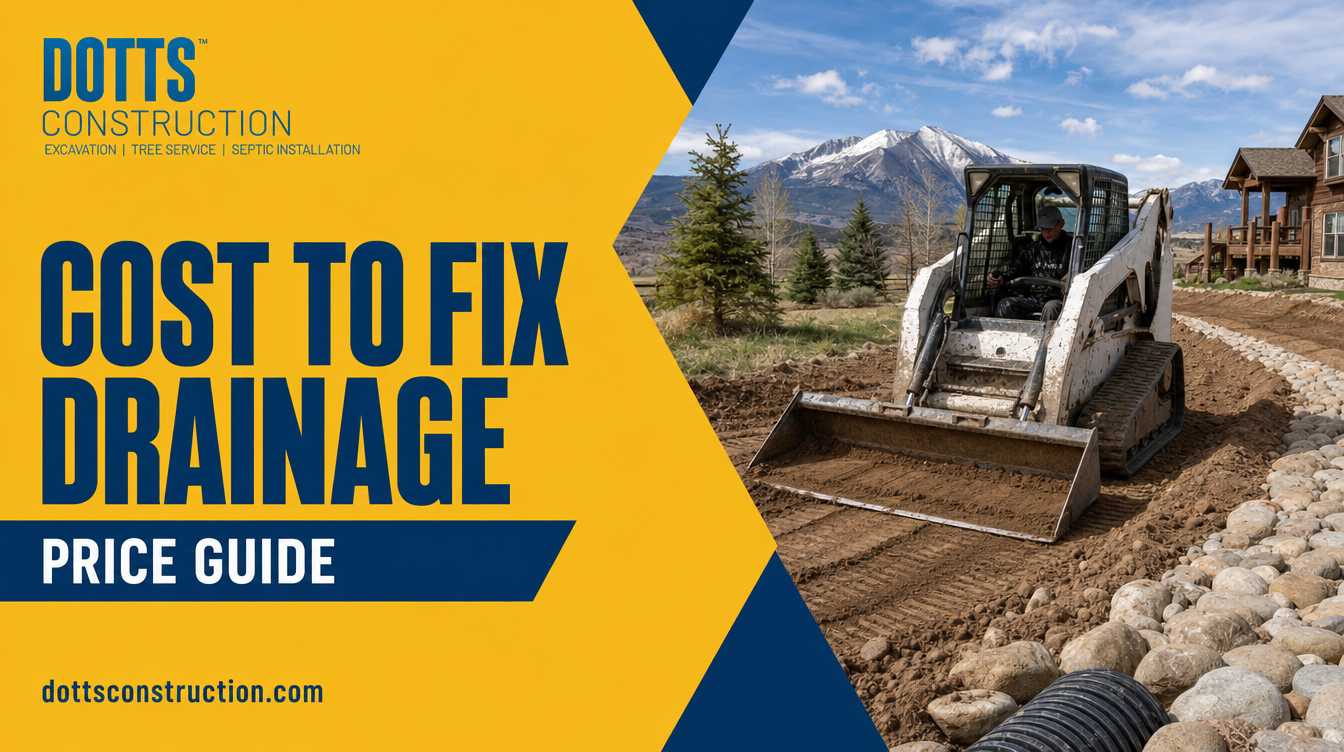
Dealing With Drainage Problems?
What Dotts actually charges: grading and drainage projects start at $3,000 and go up from there based on the size of the area, slope, haul-off, and the drainage work involved. We don’t take on small sub-$3,000 jobs. Every property is different, so request a free on-site estimate or call (719) 280-4141.
Fixing drainage costs between $150 and $10,000+ depending on the problem. A simple pipe cleaning runs $3,000 to $8,000. Replacing a damaged pipe section costs $3,000 to $8,000. Repairing serious land grading and drainage issues that redirect water away from a foundation can cost $1,000 to $6,000 or more.
Here's the thing: most homeowners only see the symptom. Standing water in the yard. A soggy driveway edge. Water pooling near the foundation. What they don't see is the underlying cause, and that's where the real cost lives.
This guide breaks down every type of drainage fix, what drives the price, and how to know which solution your property actually needs.
What Are the Most Common Land Grading and Drainage Issues?
Before you can fix a drainage problem, you need to know what kind you have. Not all drainage issues are created equal, and the fix for one type can make another type worse if misapplied.
The most common drainage problems on residential and construction sites include:
- Negative grading: The ground slopes toward your house instead of away from it. Water follows gravity directly to your foundation.
- Clogged or collapsed drainage pipes: Existing drainage infrastructure that no longer functions. Often the first thing to inspect before assuming larger work is needed.
- Compacted soil: Water cannot absorb into clay-heavy or compacted soil. It pools on the surface instead.
- Low spots in the yard: Natural or construction-related depressions that collect water after every rain.
- Improper site preparation: Construction that left the site without a planned drainage path. This is one of the most expensive problems to fix after the fact.
- Septic system interference: A failing or undersized septic system can cause ground saturation that mimics drainage failure.
The majority of serious drainage problems trace back to inadequate land grading done during original site preparation. Getting the slope wrong by even a few degrees can send thousands of gallons of water toward a foundation every year.
How Much Does Drainage Pipe Repair or Cleaning Cost?
If your drainage system is clogged or blocked, professional cleaning typically costs $3,000 to $8,000. This covers hydro-jetting, snaking, or flushing a drain line.
If a pipe section needs to be replaced or repaired, costs jump to $3,000 to $8,000 depending on:
- Pipe material: PVC is cheaper to replace than cast iron or corrugated metal.
- Depth of the pipe: Deeper pipes require more excavation, which adds equipment and labor costs.
- Length of the damaged section: A 5-foot section costs far less than a 40-foot run.
- Access: Pipes running under a driveway, deck, or landscaped area cost more to reach.
Pro Tip: Before any excavation happens, have the line camera-inspected. A drain camera inspection costs $3,000 to $8,000 and tells you exactly where the damage is, whether it's a root intrusion, a crack, a belly in the line, or a full collapse. This prevents digging in the wrong spot.
What Does It Cost to Fix Yard Drainage and Standing Water?
Standing water in a yard usually points to one of three problems: soil compaction, low spots, or negative grading. The fix depends on which one you're dealing with.
| Drainage Problem | Typical Cost Range | Notes |
|---|---|---|
| Soil aeration and amendment | $3,000 to $8,000 | Improves absorption without grading |
| Surface grading (small yard) | $3,000 to $8,000 | Moves soil to redirect water flow |
| French drain installation | $1,000 to $5,000 | Perforated pipe buried in gravel trench |
| Catch basin installation | $1,500 to $4,000 | Collects surface water and channels it away |
| Dry creek bed installation | $700 to $3,500 | Aesthetic and functional; directs runoff |
| Full regrading (large lot) | $1,000 to $6,000+ | Requires excavation equipment |
A French drain is the most commonly recommended fix for chronic yard drainage issues. According to the University of Minnesota Extension's residential drainage guidelines, a properly installed French drain should slope at least 1 inch per 8 feet to maintain effective water movement.
The cost of a French drain varies most by length and depth. A simple 50-foot trench through a residential yard costs far less than a 200-foot installation that navigates tree roots, existing utilities, and hardscape.
How Much Does Land Grading Cost to Fix Drainage Near a Foundation?
Land grading to correct foundation drainage is one of the most important investments a property owner can make. The International Residential Code (IRC) requires a minimum 6-inch drop within the first 10 feet away from a foundation wall for proper drainage. Many existing homes don't meet this standard.
Cost factors for foundation grading include:
- Property size: A small suburban lot is far cheaper to regrade than a rural acre.
- Soil type: Rocky or clay-heavy soil requires more equipment hours.
- Existing landscaping: Removal and replacement of plants, sod, or hardscape adds cost.
- Equipment access: Tight side yards that limit equipment movement increase labor time.
Typical cost ranges for grading to fix foundation drainage:
- Minor regrading (1 to 3 cubic yards of fill): $3,000 to $8,000
- Moderate regrading with fill delivery: $1,500 to $4,000
- Major grading project with excavation equipment: $3,000 to $10,000+
We've seen properties where the original site prep was done wrong, and the homeowner spent years fighting water intrusion in their basement before finally calling a grading crew. The cumulative cost of water damage, mold remediation, and repeated band-aid fixes was far higher than a one-time proper grading job would have been.
What Factors Drive Up the Cost of Fixing Drainage Issues?
Not every drainage project is the same. Here are the variables that push costs from the low end to the high end of any range:
1. Soil composition
Clay soil doesn't drain. Sandy soil drains too fast. Either extreme complicates drainage solutions and often requires imported fill material or engineered drainage structures.
2. Site accessibility
A flat, open lot with easy equipment access is the cheapest environment to work in. A property with steep slopes, dense trees, existing utilities, or tight access corridors adds significant time and equipment cost.
3. Scale of the problem
A single low spot costs far less to address than a property-wide grading issue. The larger the affected area, the more material, labor, and equipment hours required.
4. Permits
Some grading and drainage work requires a local permit, especially near wetlands, waterways, or in flood zones. Permit costs vary by municipality but typically run $3,000 to $8,000. Some jurisdictions require a licensed engineer to stamp the drainage plan.
5. Existing infrastructure conflicts
Utilities buried in the path of drainage work require hand-digging or re-routing. Always call 811 (the national call-before-you-dig number) before any excavation.
6. Combination problems
The most expensive drainage fixes involve multiple overlapping issues: a clogged pipe that caused soil saturation, which caused settling, which created negative grading, which directed water to the foundation. Each layer adds cost.
When Is a Drainage Problem Actually a Septic System Problem?
This one gets missed more often than it should. Saturated ground that looks like a drainage failure can actually be a failing septic system.
Signs your drainage issue may be septic-related:
- Wet or soggy ground directly over the drainfield, even in dry weather
- Sewage odors outdoors near the yard
- Slow drains inside the house without obvious blockage
- Unusually green or lush grass over the drainfield area
If any of these are present alongside your drainage concerns, the septic system needs to be evaluated before any grading or drainage work begins. Installing a French drain or regrading the yard around a failing drainfield can permanently damage the septic system and violate local health codes.
A septic inspection typically costs $3,000 to $8,000. A full septic system replacement, if needed, runs $5,000 to $25,000 depending on system type, soil conditions, and local regulations.
Land Grading vs. French Drains: Which Fix Is Right for Your Property?
The two most common solutions to serious drainage problems are land regrading and French drain installation. They solve different problems. Applying the wrong one wastes money.
| Factor | Land Regrading | French Drain |
|---|---|---|
| Best for | Negative slope toward foundation; poor site-wide drainage | Specific wet areas; surface water collection points |
| Permanence | Highly permanent when done correctly | Requires periodic maintenance (10 to 15 years) |
| Cost range | $500 to $10,000+ | $1,000 to $5,000 |
| Equipment required | Excavator or skid steer | Trenching machine or mini-excavator |
| Disruption to yard | High (full resodding often needed) | Moderate (trench line only) |
| Addresses root cause | Yes (corrects slope) | Partially (collects and redirects, doesn't prevent) |
Pro Tip: In many situations, the correct answer is both. Regrade the site to establish positive drainage away from structures, then install a French drain at the low point to handle overflow. A drainage professional can evaluate your specific site and tell you which combination makes sense.
How Do You Know If Your Property Needs Professional Grading?
Here are clear indicators that simple DIY drainage fixes won't solve your problem:
- Water consistently pools within 10 feet of your foundation after rain
- Your driveway or gravel road develops ruts or washout channels every season
- A new construction project is stalled because the site won't drain
- You've installed surface drainage fixes that haven't worked
- You're planning a foundation, septic system, or major structural addition
Any construction project that involves a foundation or septic system requires proper site grading before work begins. This isn't optional. A foundation poured on an improperly graded site will fight water intrusion from day one. A septic system installed without proper drainage planning will fail prematurely and may violate health codes.
What Should You Do Next If You Have Drainage Issues?
Start by documenting the problem. Take photos and video of standing water, wet areas, and water flow patterns during and after rain. Note how long water sits before absorbing or draining. This documentation helps any contractor give you an accurate assessment.
Then, get a professional site evaluation before committing to any solution. A qualified excavation and grading contractor can walk your property, identify the source of the problem, and recommend the right fix in the right order. This is especially important before any construction project begins.
At Dotts Construction, we use our Dotts 3M Method to evaluate site drainage issues at every scale, from a single wet corner of a yard to full construction site preparation. We show up when we say we will, communicate every step of the way, and don't start digging until we know exactly what we're dealing with. No vague estimates. No surprises mid-project.
Whether you're dealing with an existing drainage problem or preparing a raw site for a foundation, driveway, or septic system, we'll tell you exactly what needs to happen and what it will cost before any work begins.
Ready to get your drainage issue diagnosed and fixed the right way? Call Dotts Construction for a site evaluation today. Request a free consultation or call (719) 280-4141
Frequently Asked Questions About Fixing Drainage Issues
How much does it cost to fix a yard that won't drain?
Fixing a yard with drainage problems typically costs $500 to $5,000 depending on the cause. Simple regrading of a small area runs $3,000 to $8,000. French drain installation costs $1,000 to $5,000. Larger properties or more complex problems with multiple contributing factors will cost more.
Can I fix drainage issues myself?
Minor issues like adding topsoil to a small low spot or redirecting a downspout can be DIY projects. However, any problem involving foundation drainage, large-scale grading, buried pipe installation, or proximity to a septic system requires a licensed contractor with the right equipment. Bad DIY drainage work often makes the underlying problem worse.
How long does it take to fix a drainage problem?
Simple pipe cleaning takes a few hours. French drain installation on a residential lot typically takes one to two days. Full site regrading for a construction project can take two to five days depending on the scope. Timeline expands when permits are required or when weather delays excavation.
Does fixing drainage increase home value?
Yes. According to the National Association of Realtors, water intrusion and drainage problems are among the top issues flagged in home inspections that reduce sale prices or kill deals. Correcting drainage issues before listing can recover two to three times the remediation cost in improved sale price and fewer inspection contingencies.
What is the best drainage solution for a wet basement?
Interior waterproofing and sump pump systems address symptoms but don't fix the cause. The best long-term solution for a wet basement is exterior regrading to establish positive slope away from the foundation, combined with proper gutter and downspout extensions. Interior solutions should be a last resort after exterior grading is addressed.
How do I know if I have a grading problem or a pipe problem?
If water sits in one specific spot and doesn't spread, it's often a pipe or soil absorption issue. If water migrates toward your house or consistently collects in multiple areas after rain, negative grading is the likely cause. A contractor with a level and a drainage camera can diagnose the difference in one site visit.
What happens if you ignore drainage issues before building?
Ignoring land grading and drainage issues before pouring a foundation or installing a septic system is one of the most expensive mistakes in construction. Water intrusion, structural settling, and septic failure are the predictable outcomes. Remediation after a structure is built costs three to ten times more than proper site preparation would have cost before construction began.
Related Guides
Need the pros? See Site Preparation & Grading. More reading:
About the Author
Michael Dotts brings over 15 years of hands-on experience in heavy construction and grading, with a specialty in the unique demands of building in the Rocky Mountains, where steep terrain, rocky ground, and harsh weather change the rules most flatland contractors are used to. Because Michael knows what it really takes to get the job done right in Colorado’s high country, you can count on honest, accurate quotes that won’t creep up halfway through the job.