
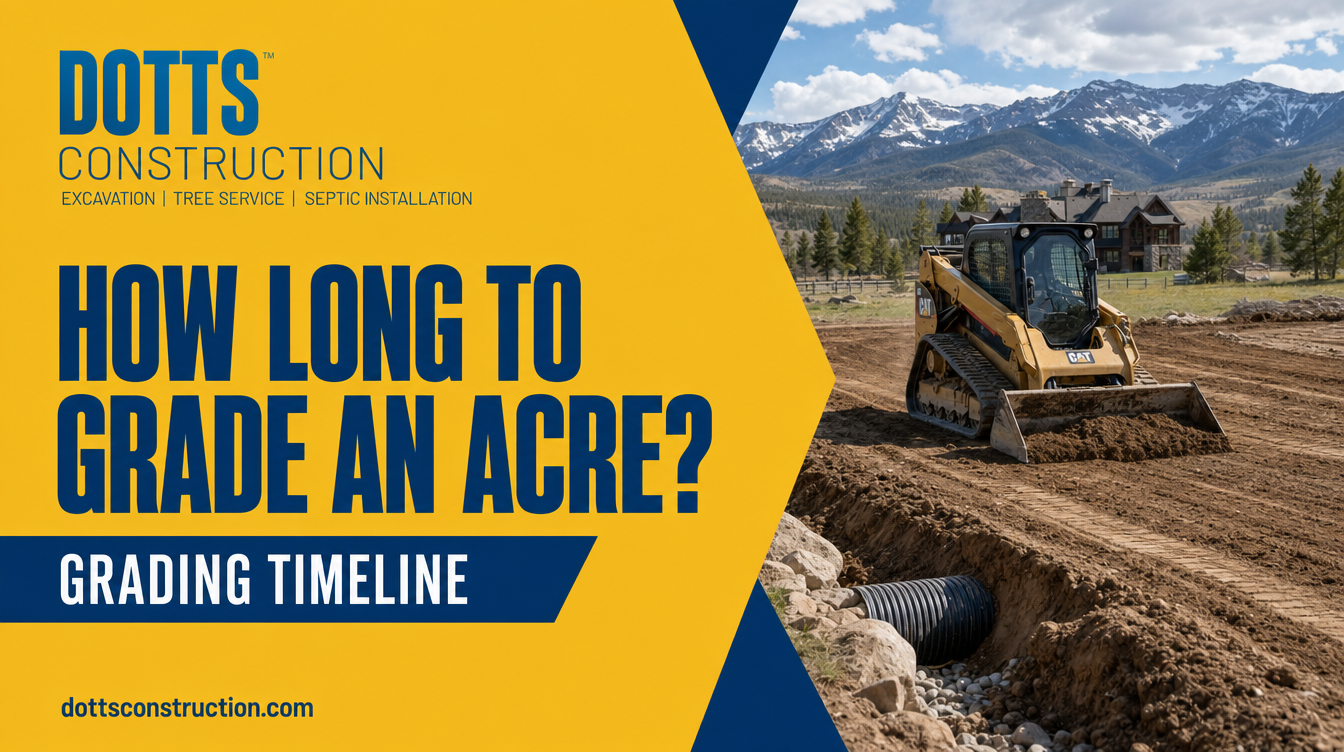
Grading an Acre of Land?
Grading one acre of land typically takes 1 to 3 days for a flat, cleared site with favorable soil conditions. Add trees, slopes, rocks, or drainage problems, and that timeline stretches to a full week or more. The exact time depends on site conditions, equipment, and the grading purpose.
What Is Land Grading and Why Does It Matter for Your Project?
Land grading is the process of reshaping and leveling the surface of the ground to a specific slope, contour, or elevation. It is not just about making ground flat. It is about controlling how water moves across your property and creating a stable base for whatever you are building next.
Here is the thing: most construction delays do not start with the builder. They start with a site that was not properly prepared. A foundation poured on poorly graded land will crack. A driveway built on uneven fill will heave and settle. A yard without proper drainage will flood.
Proper land grading and drainage issues, when addressed before construction begins, prevent catastrophic and expensive failures down the road.
At Dotts Construction, we have seen firsthand what happens when grading gets rushed or skipped. The Dotts 3M Method (Measure, Mobilize, Meticulously Grade) exists because we know that getting the ground right the first time is the only way to protect your entire construction investment.
How Long Does Land Grading Actually Take? (Real Timelines by Project Size)
The timeline for grading land depends heavily on acreage, terrain, and the purpose of the grading. Use this table as a starting reference, then read the factors below to understand how your specific site may shift these numbers.
| Project Type | Typical Size | Average Timeline |
|---|---|---|
| Small residential lot | Up to ½ acre | 1 to 3 days |
| Medium residential plot | ½ to 2 acres | 3 to 7 days |
| Large wooded property | 2 to 5 acres | 1 to 2 weeks |
| Commercial or rural land | 5+ acres | 2 to 4 weeks |
| Foundation excavation prep | Varies | 1 to 5 days |
| Driveway or road grading | Per 1,000 linear feet | 1 to 3 days |
One acre of straightforward residential grading, on cleared flat land with good soil, takes roughly 1 to 3 days with a full crew and the right equipment.
Push that to a sloped, wooded, or rocky acre and expect 5 to 7 days minimum. If the site also needs drainage corrections, septic system layout work, or significant fill material brought in, the realistic window is 1 to 2 weeks for a single acre.
These are not worst-case numbers. These are honest numbers based on real project conditions.
What Factors Make Land Grading Take Longer?
Not every acre is the same. Here are the variables that add time to any grading project:
Does the Site Have Trees or Vegetation?
Land clearing must happen before grading can begin. Removing trees, stumps, brush, and roots adds 1 to 5 days depending on density. A lightly wooded half-acre might take 1 day to clear. A heavily wooded 2-acre site with mature hardwoods can take a full week of clearing alone before a single grading pass happens.
Pro Tip: Ask your contractor whether the land clearing timeline is included in their grading estimate or quoted separately. Many homeowners get surprised when they receive two separate invoices.
How Steep Is the Slope?
Flat land grades fast. Sloped land requires careful cut-and-fill work where soil is removed from high spots and packed into low spots. A 10% or greater slope can double the time and equipment cost of a grading project. Steep sites also require compaction testing at multiple stages, which adds time between work phases.
What Type of Soil Are You Working With?
Soft, workable loam moves quickly. Clay soil is dense and slow to cut. Rocky ground is the most time-intensive because boulders and ledge rock must be broken up or blasted before any grading equipment can reshape the terrain.
According to the United States Department of Agriculture (USDA) Natural Resources Conservation Service, clay-heavy soils are present in a significant portion of residential land across the eastern United States, meaning most homeowners east of the Mississippi are dealing with at least some clay content.
Note: Rocky or heavy clay sites almost always run over the initial timeline estimate. Build a buffer of 2 to 3 extra days into your planning.
Is Drainage Correction Part of the Scope?
Grading and drainage issues go hand in hand. If your site has standing water, erosion channels, or drainage that flows toward a building foundation, your contractor must engineer the slope to redirect water flow. This involves more precise grading passes, the possible installation of drainage swales or French drains, and additional compaction work.
Drainage correction typically adds 1 to 4 days to a standard grading timeline, depending on the severity of the problem.
How Much Fill Material Is Needed?
If your site is low and needs to be built up, fill dirt must be hauled in and compacted in lifts (layers). Each lift requires time to settle and compact before the next is added. A site needing 2 feet of fill might require 3 to 4 compaction passes, each adding a half day to a full day to the project.
What Equipment Is Used and How Does It Affect Timeline?
The machines on the job site determine how fast the work moves. Here is a quick breakdown:
- Bulldozer (D6 or D8 class): Best for moving large volumes of material across a wide site. Fast and powerful.
- Motor grader: The precision tool. Used for final grading passes to achieve a specific slope or elevation.
- Excavator: Used for foundation excavation, drainage trenches, and areas where a bulldozer cannot reach.
- Compactor/roller: Required after fill is placed to achieve proper density. Skipping this step leads to settling.
- Skid steer: Versatile for tight spaces, cleanup work, and finish grading near structures.
A full crew with a bulldozer, grader, and compactor working simultaneously can grade an acre of cleared, flat land in a single long day. A solo operator with a small excavator doing the same job might take 3 to 4 days.
The difference between a 1-day job and a 4-day job is often just the size of the crew and equipment package your contractor brings.
This is why asking for a site visit and a detailed equipment plan matters. A low-bid contractor who shows up with undersized equipment is not saving you money. They are costing you time.
How Do Land Grading and Drainage Issues Connect?
Land grading and drainage issues are almost always linked. You cannot fix a drainage problem without changing the grade, and you cannot properly grade a site without considering where water will go.
The most common drainage problems we see at Dotts Construction include:
- Negative grade near foundations: Water flows toward the house instead of away from it. This causes basement flooding and foundation damage.
- Flat spots and low points: Water pools in areas where the grade is level, creating muddy, unusable zones.
- Erosion channels: Water running off a steep ungraded slope carves channels in the soil and deposits sediment in unintended areas.
- Septic system drainage failures: Improper grade around a septic system causes effluent to surface or fail to percolate correctly.
The standard recommendation from the International Residential Code (IRC) is a minimum 6-inch drop in the first 10 feet away from any foundation. Getting that slope right is not optional. It is code.
Correcting land grading and drainage issues before construction begins costs a fraction of what it costs to repair a flooded basement or failed foundation after the fact.
How Does Grading Purpose Change the Timeline?
What you are grading for determines how precise the work must be, and precision takes time.
| Grading Purpose | Required Precision | Relative Timeline Impact |
|---|---|---|
| Foundation prep | Very high (within 1 inch) | Longest timeline, most passes |
| Driveway and road grading | High (consistent slope, no ruts) | Medium timeline |
| Yard and lot leveling | Moderate (drainage-correct slope) | Short to medium |
| Septic system site prep | High (specific perc and depth reqs) | Medium with testing delays |
| Stormwater management | Very high (engineered slope design) | Longest with engineering sign-off |
Foundation excavation and grading is the most demanding work on this list. A mistake of even a few inches changes the bearing capacity of the soil under your slab. Every pass with the grader must be checked against grade stakes or laser levels.
Pro Tip: Ask your contractor whether they use laser-guided grade control or GPS machine control on their equipment. Contractors using grade control technology complete precision work significantly faster and with far fewer re-passes than those using manual staking alone.
What Should You Ask a Land Grading Contractor Before They Start?
Most homeowners get burned not because they hired a bad contractor, but because they never asked the right questions. Here is exactly what to ask before anyone turns a key:
- What does your site assessment include? A proper estimate requires a physical walk of the property, not a satellite view and a guess.
- What equipment are you bringing and how large is your crew? The answer tells you whether the bid is realistic.
- Is land clearing included in this quote or separate? Know exactly what the number covers.
- How will you handle drainage on this site? If they have no answer, keep looking.
- What happens if you hit rock or unexpected soil conditions? Ask about their change order policy before work begins.
- What does a completed grade look like for my specific project? Ask for grade stakes, elevation targets, or a plan sheet.
- How do you communicate progress and delays? The industry's dirty secret is that most contractors go silent the moment a problem comes up.
How Much Does It Cost to Grade an Acre of Land?
Timeline and cost move together. Here is an honest ballpark to set expectations:
- Basic residential grading (cleared, flat land): $1,500 to $3,500 per acre
- Grading with moderate clearing and slope work: $3,500 to $7,000 per acre
- Grading with drainage correction, fill, and compaction: $7,000 to $15,000+ per acre
- Foundation excavation (separate from grading): $1,500 to $5,000+ depending on depth and soil
, the average residential acre with drainage correction runs X% over initial estimates due to undiscovered clay layers or rock."]
These numbers vary by region, equipment costs, fuel, and local labor rates. The only way to get an accurate number is to have a contractor walk your specific site.
FAQ: Land Grading Timelines and Drainage Questions
How long does it take to grade an acre of land?
Grading one flat, cleared acre typically takes 1 to 3 days with the right equipment and crew. Sites with trees, steep slopes, heavy clay, rock, or drainage correction needs can extend that timeline to 5 to 10 days or longer. Always build buffer time into your project schedule.
Can land grading fix drainage problems?
Yes. Land grading is the primary tool for correcting drainage issues. By reshaping the ground's slope to direct water away from structures and toward appropriate outlets, grading resolves standing water, erosion, and foundation drainage problems at their source.
Do I need a permit for land grading?
Many jurisdictions require grading permits for projects disturbing more than a certain square footage, typically 5,000 square feet or more. Requirements vary by county and municipality. Your contractor should pull the required permits before work begins. If they do not mention permits, ask directly.
What is the difference between rough grading and finish grading?
Rough grading is the initial pass that moves large volumes of soil to approximate the target elevation and slope. Finish grading is the precise final pass that achieves the exact grade needed for construction, drainage, or seeding. Finish grading always follows rough grading and takes longer because of the precision required.
How long after grading can you pour a foundation?
After rough and finish grading, compacted subgrade typically needs 24 to 72 hours to stabilize before concrete work begins, assuming dry weather. In wet conditions or with fill soil, some engineers recommend waiting 1 to 2 weeks and may require compaction testing before approving a pour.
Does land grading include tree removal?
Not always. Land clearing (tree removal, stump grinding, brush removal) is typically quoted as a separate scope from grading. Some excavation companies, like Dotts Construction, offer both services, which simplifies scheduling and accountability. Confirm what is included in your quote before signing.
How do I know if my land needs regrading?
Signs that your land needs grading include: water pooling near your foundation after rain, visible erosion channels, a muddy yard that never fully dries, cracked or heaving pavement, and basement seepage that worsens after storms. Any one of these is enough reason to schedule a site assessment.
Ready to Start Your Site Work Without the Contractor Drama?
Here is the reality: the grading phase sets the ceiling for everything that comes after. If it goes wrong, your foundation, driveway, drainage, and septic system all pay the price. If it goes right, everything downstream is faster and cheaper.
At Dotts Construction, we show up when we say we will, communicate what is happening before you have to ask, and use the Dotts 3M Method (Measure, Mobilize, Meticulously Grade) to turn rough, raw land into a site that is ready for foundations, driveways, and construction projects without surprises.
We handle it all under one roof: excavation and grading, road and driveway prep, foundation excavation, septic system design and install, tree removal, and full land clearing. You get one crew, one point of contact, and zero finger-pointing when questions come up.
Schedule your site walk today and get a real estimate based on your actual ground, not a satellite photo.
Request a free consultation or call (719) 280-4141
Related Guides
Need the pros? See Site Preparation & Grading. More reading:
About the Author
Michael Dotts brings over 15 years of hands-on experience in heavy construction and grading, with a specialty in the unique demands of building in the Rocky Mountains, where steep terrain, rocky ground, and harsh weather change the rules most flatland contractors are used to. Because Michael knows what it really takes to get the job done right in Colorado’s high country, you can count on honest, accurate quotes that won’t creep up halfway through the job.