
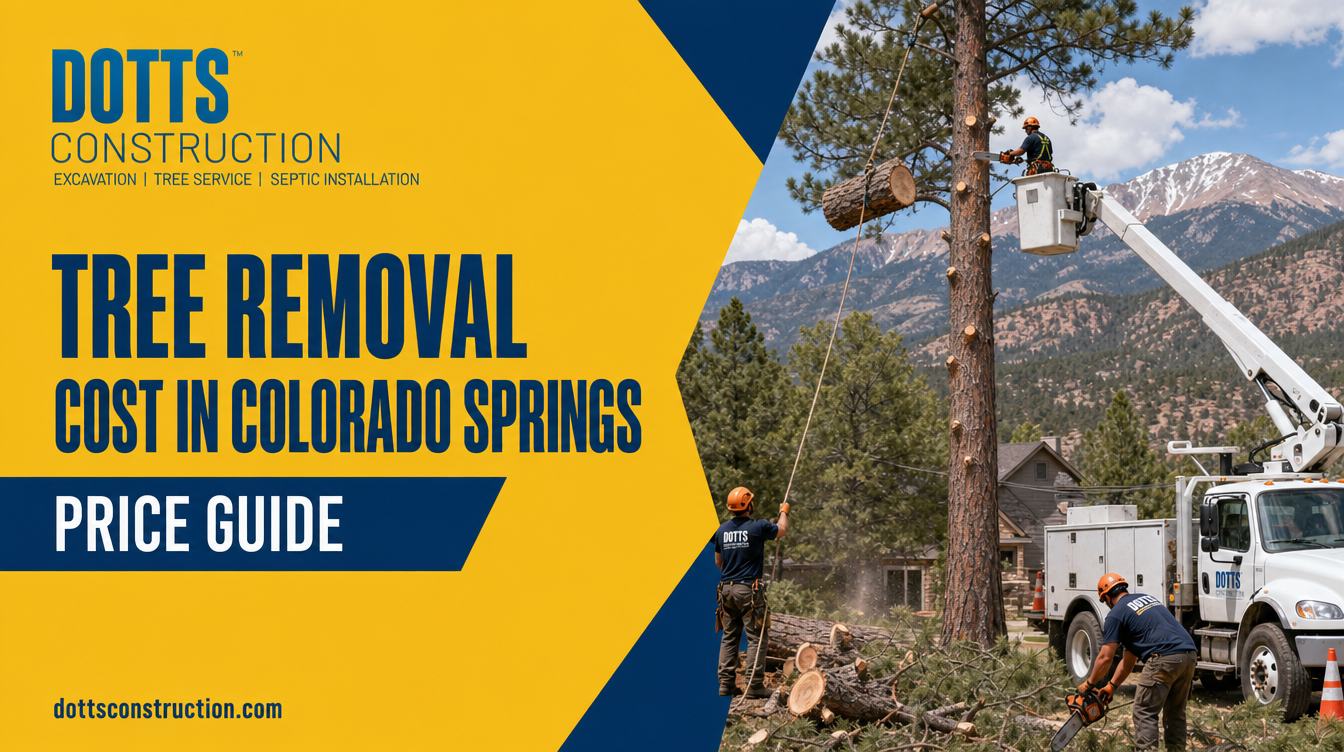
What Does Tree Removal Cost in Colorado Springs?
What Dotts actually charges: the tree removal jobs we take on typically run $3,000 to $6,000, and can reach $10,000 for large or high-risk trees close to buildings and power lines. We focus on bigger removals and don’t quote jobs under $3,000. Every tree is different, so request a free on-site estimate or call (719) 280-4141.
Tree removal in Colorado Springs typically costs between $350 and $2,500, depending on tree size, location, and difficulty. Most homeowners pay around $750 for a standard removal. Large trees near structures, power lines, or on steep terrain push costs well above $1,500. Here is what drives price and how to budget correctly before you call a crew.
Why Does Tree Removal Cost So Much in Colorado?
Let's be honest: tree removal pricing confuses a lot of people. You call two companies and get quotes that are $800 apart with no explanation. That gap is not random.
Colorado's landscape creates real complexity that other states don't face. You have ponderosa pines that grow 60 to 100 feet tall, cottonwoods with massive root systems, and properties on slopes where equipment access is limited or impossible. Every one of those factors adds labor time and risk, and risk costs money.
The three biggest cost drivers in Colorado tree removal are tree height, trunk diameter, and site accessibility. When all three are working against you, expect to pay at the high end of the range.
Here is a breakdown of how those factors translate to real price ranges:
| Tree Size | Typical Height | Estimated Cost Range |
|---|---|---|
| Small tree | Under 30 feet | $3,000 to $6,000 |
| Medium tree | 30 to 60 feet | $3,000 to $6,000 |
| Large tree | 60 to 80 feet | $3,000 to $6,000 |
| Very large / hazardous | 80+ feet or near structures | $2,000 to $3,500+ |
These ranges reflect Colorado Springs conditions specifically. Denver averages are often quoted at $3,000 to $6,000 for standard work, according to local contractor data, but Colorado Springs properties frequently involve steeper terrain and larger conifers, which increases the typical price floor.
What Specific Factors Drive Your Tree Removal Quote Higher?
Every quote you receive is built from a formula the crew runs in their head the moment they walk onto your property. Understanding that formula puts you in control.
Tree height and trunk diameter are the starting point. A crew charges more for taller trees because they require more rope work, more time in the air, and more passes with the chipper. Trunk diameter tells them how long each cut takes and how heavy each piece will be.
Location on your property matters just as much. A tree standing alone in an open yard is straightforward. A tree pressed up against your foundation, overhanging your roof, or tangled into a power line is a precision removal that requires a certified arborist and specialized rigging. That expertise is not free.
Slope and soil conditions are often overlooked. Colorado Springs sits at the base of the Rockies. Many residential lots have significant grade changes. When a crew cannot get a bucket truck or chipper close to the tree, they carry everything by hand, and that adds hours.
Health and structural integrity of the tree changes the risk profile. Dead or diseased trees are unpredictable. They can drop limbs without warning during removal. Crews price in that risk.
Stump removal is almost always quoted separately. Grinding a stump down to 6 to 12 inches below grade typically adds $3,000 to $6,000 depending on trunk diameter. Many homeowners skip this, then regret it when they are trying to prepare the land for a driveway or construction project.
Pro Tip: Always ask whether the quote includes chipping and haul-off of debris. Some contractors leave the wood piled on your property. Debris removal can add $3,000 to $6,000 to your final bill if it is not bundled.
How Do Colorado Springs Tree Removal Costs Compare to the Rest of Colorado?
The $3,000 to $6,000 range cited for Denver is real, but it is not the right benchmark for Colorado Springs homeowners.
Here is what the actual comparison looks like across major Colorado markets:
| Market | Low End | High End | Key Variable |
|---|---|---|---|
| Denver Metro | $350 | $1,500 | Urban density, smaller lots |
| Colorado Springs | $400 | $2,500+ | Slope, larger conifers, access |
| Boulder | $450 | $2,000 | High labor costs, tree ordinances |
| Fort Collins | $350 | $1,800 | Mix of urban/suburban lots |
| Rural Colorado | $500 | $3,500+ | Equipment access, haul distance |
Colorado Springs homeowners should budget at or above the Denver averages because El Paso County's terrain and tree species mix consistently push removal complexity higher. Planning around the Denver low-end figure and getting a surprise at $2,000 is one of the most common mistakes we see.
What Happens When a Tree Is Near Your House or a Power Line?
This is where standard pricing breaks down completely. A hazardous removal near a structure is a different job from a standard tree removal, and it needs to be priced that way.
When a tree is within falling distance of your house, your neighbor's fence, or a power line, the crew cannot simply drop the tree. They section it from the top down, lowering each piece with controlled rigging to prevent damage below. That process requires more climbers, more time, and significantly more skill.
Hazardous tree removal in Colorado Springs near structures or utilities typically starts at $1,500 and can reach $4,000 or more for a large tree requiring crane assistance or utility coordination. According to data compiled by the International Society of Arboriculture (ISA), hazardous tree removals represent roughly 30 percent of all residential removals in mountain-adjacent urban areas, and they carry a cost premium of 40 to 80 percent over standard removals.
If your tree is near a power line, contact your utility provider first. Colorado Springs Utilities may handle line-adjacent trimming under certain conditions at no cost, depending on proximity. This can reduce the scope of work your contractor needs to perform.
Note: Never attempt to remove a tree that is touching or within 10 feet of a power line without coordinating with Colorado Springs Utilities first. This is a safety and legal issue, not just a contractor preference.
Is Tree Removal Covered by Homeowners Insurance in Colorado?
Sometimes. The answer depends on why the tree needs to come down.
If a tree falls on your house or a covered structure during a windstorm or hail event (both common in Colorado Springs), your homeowners insurance policy typically covers the removal cost up to your policy limit, minus your deductible. According to the Insurance Information Institute, most standard homeowners policies cover tree removal when the fallen tree damages an insured structure.
If the tree is simply dead, diseased, leaning, or in a location that makes you nervous, that is considered preventive maintenance and is not covered. The policy only triggers after damage occurs.
Here is the practical takeaway: do not wait for a dead tree to fall on your garage before acting. The removal cost before it falls is always lower than the removal cost plus structural repair after it does.
Why Tree Removal and Land Clearing Are Often the Same Project
Here is something most homeowners do not expect: tree removal is rarely the whole job.
Once the tree is down, you are left with a stump, an exposed root system, disturbed soil, and often a section of your property that needs to be regraded before it is usable. If you are preparing land for a foundation, driveway, detached garage, or any construction project, the tree removal is step one in a larger sequence.
At Dotts Construction, we see this constantly. A homeowner calls for tree removal and then realizes the site is not ready for the next phase. The ground needs to be graded, compacted, and stabilized before any foundation work or paving can start. That is the work we specialize in.
When you bundle tree removal with excavation, grading, and site preparation through a single contractor, you eliminate the coordination gap that kills construction timelines. No waiting for crew A to finish before crew B can start. No conflicting site conditions. One company that owns the outcome from rough ground to a build-ready surface.
That is the foundation of the Dotts 3M Method: a structured, sequenced approach to getting your site prepared right the first time so your construction project does not get derailed by contractor drama or a site that was not properly cleared and graded from the start.
How to Get an Accurate Tree Removal Estimate in Colorado Springs
Getting a reliable quote is not complicated, but most homeowners make it harder than it needs to be by calling without the right information ready.
Before you contact a contractor, know these details:
- Approximate tree height. Stand at the base of the tree and estimate. If it is taller than your roofline, it is likely over 30 feet.
- Trunk diameter at chest height. Use a tape measure if you can. Larger than 24 inches is significant.
- Distance from structures. How far is the tree from your house, fence, driveway, or utility lines?
- Access to the site. Can a truck and chipper pull within 50 feet of the tree, or is it behind a gate, on a slope, or surrounded by landscaping?
- What you want done with the wood and stump. Do you want everything hauled off, or are you keeping the wood?
A contractor who quotes you over the phone without asking these questions is guessing. Guesses become change orders. Get an on-site estimate whenever possible.
Pro Tip: Get three quotes and do not automatically take the lowest. Ask each contractor for proof of liability insurance and, if they are doing any climbing or rigging, verify that the crew lead holds an ISA Certified Arborist credential. One accident on your property without proper coverage becomes your financial problem.
Frequently Asked Questions About Tree Removal Costs in Colorado
How much does it cost to remove a small tree in Colorado Springs?
Small tree removal in Colorado Springs (trees under 30 feet) typically costs between $350 and $650. Factors that can push a small tree removal higher include difficult access, proximity to structures, or significant root system exposure that requires additional excavation work after the tree is down.
Do I need a permit to remove a tree in Colorado Springs?
In most unincorporated El Paso County areas, you do not need a permit for tree removal on private property. However, Colorado Springs city limits and certain HOA communities have tree ordinances that require notification or approval, especially for mature trees or trees on public easements. Always check with your municipality before removal.
How long does tree removal take in Colorado Springs?
Most standard residential tree removals in Colorado Springs take between two and six hours. Large, hazardous, or complex removals near structures can take a full day or longer. If stump grinding, debris haul-off, and site cleanup are included, add two to four hours for a mid-size tree project.
Is stump grinding included in tree removal quotes?
Rarely. Most Colorado Springs tree removal contractors quote stump grinding as a separate line item, typically ranging from $3,000 to $6,000 per stump depending on trunk diameter. Always ask explicitly what is and is not included before signing any estimate.
What is the cheapest time of year to remove a tree in Colorado Springs?
Late fall and winter (November through February) are typically slower seasons for tree crews in Colorado Springs, which can translate to lower prices and faster scheduling. Demand spikes after major windstorms and in spring when homeowners are preparing sites for summer construction projects.
Can I remove a tree myself to save money in Colorado Springs?
For trees under 20 feet with clear drop zones and no proximity to structures or utilities, DIY removal is possible. For anything larger or more complex, the risk of property damage, personal injury, and utility line contact makes professional removal the correct financial decision. A $2,000 professional removal is far cheaper than a $15,000 roof repair or an emergency room bill.
How does tree removal connect to site preparation for construction?
Tree removal is often the first step in site preparation for foundations, driveways, and detached structures. After a tree is removed, the stump must be ground, the root zone excavated, the soil compacted, and the grade corrected before any construction work can begin. Contractors who handle both tree removal and excavation, like Dotts Construction, eliminate the sequencing delays that come with using separate crews for each phase.
Ready to Clear Your Site and Get Construction-Ready?
If you have trees that need to come down before a construction project, a new driveway, a foundation pour, or a septic system install, do not treat tree removal as a standalone task. It is the starting line of your site preparation sequence.
At Dotts Construction, we remove trees, grind stumps, excavate, grade, and compact. We get your ground ready for whatever comes next, on time and without the contractor drama. That is the Dotts 3M Method in action: a clear sequence, real communication at every step, and a site that is actually ready when we say it will be.
Call us for a free on-site estimate and we will walk your property, identify everything that needs to happen before your project can move forward, and give you a written quote with no surprises.
Request a free consultation or call (719) 280-4141
Related Guides
Need the pros? See Tree Removal Services. More reading:
About the Author
Michael Dotts brings over 15 years of hands-on experience in heavy construction and grading, with a specialty in the unique demands of building in the Rocky Mountains, where steep terrain, rocky ground, and harsh weather change the rules most flatland contractors are used to. Because Michael knows what it really takes to get the job done right in Colorado’s high country, you can count on honest, accurate quotes that won’t creep up halfway through the job.