
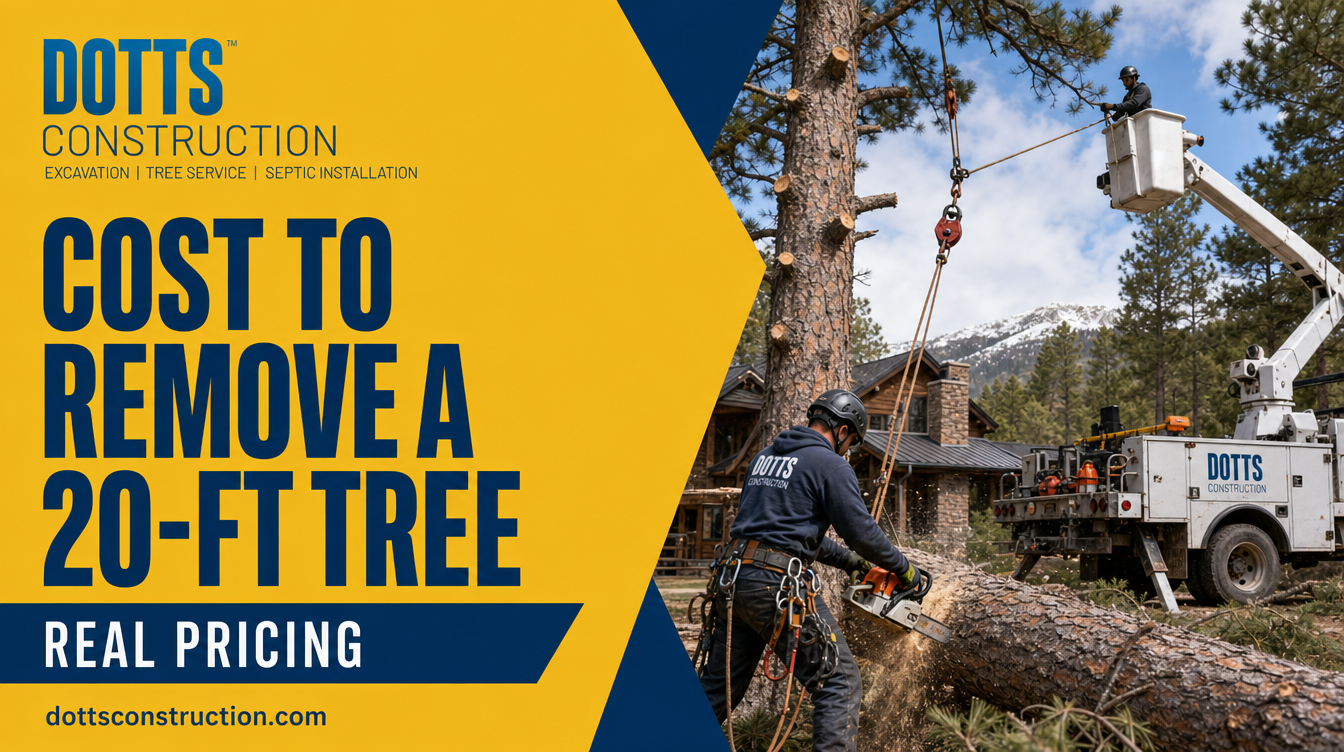
Removing a 20-Foot Tree?
What Dotts actually charges: the tree removal jobs we take on typically run $3,000 to $6,000, and can reach $10,000 for large or high-risk trees close to buildings and power lines. We focus on bigger removals and don’t quote jobs under $3,000. Every tree is different, so request a free on-site estimate or call (719) 280-4141.
Removing a 20-foot tree typically costs $3,000 to $6,000, with a national average near $350. Because a 20-foot tree falls in the small-to-medium category, it is far cheaper and safer to remove than a mature 60-foot tree. Most jobs are finished in a single morning.
At Dotts Construction, we handle tree removal as part of full-scale land clearing and site preparation across the region. We have seen every scenario: open-field stumps, trees wedged against foundations, root systems tangled in septic lines. This guide gives you the real numbers and the honest context behind them so you can call any tree service near you without getting blindsided.
What Is the Average Cost to Remove a 20 ft Tree Near You?
A 20-foot tree removal costs $3,000 to $6,000 in most U.S. markets, with the national average landing around $350. That range reflects real variation in access, tree condition, and local labor rates, not arbitrary padding from contractors.
Here is how pricing breaks down by tree size category, so you can see exactly where a 20-foot tree sits:
| Tree Height | Average Cost Range | Notes |
|---|---|---|
| Under 15 ft (shrub-scale) | $3,000 to $6,000 | Chainsaw-only job, no rigging |
| 15 to 25 ft (small tree) | $3,000 to $6,000 | Includes most 20 ft removals |
| 25 to 50 ft (medium tree) | $3,000 to $6,000 | Climbing and sectional cuts required |
| 50 to 100 ft (large tree) | $1,200 to $3,000 | Crane or aerial lift often needed |
| Over 100 ft (mature/giant) | $3,000 to $7,000+ | Specialist equipment, multi-day job |
A 20-foot tree is the easiest and least expensive category of professional tree removal. The job is straightforward when access is clear and the tree is healthy.
What Factors Change the Cost of Removing a 20 ft Tree?
The $3,000 to $6,000 range is accurate, but your specific quote will land somewhere in that range based on five concrete factors. Understanding these helps you evaluate a quote the moment you receive it.
Is the Tree Easy to Access?
Access is the single biggest price driver on a 20-foot tree removal. A tree standing in the middle of an open lot is a one-pass chainsaw job. A tree packed between a house wall and a privacy fence requires rigging, careful sectional dismantling, and extra labor hours.
Pro Tip: If your tree sits more than 15 feet from any structure or utility line, tell the estimator upfront. Open-access jobs frequently come in at the low end of the range.
Is the Tree Dead, Diseased, or Structurally Compromised?
A live, healthy tree behaves predictably. An arborist can control a felling cut with confidence. A dead or heavily rotted 20-foot tree is a different situation entirely. Rotted wood can split unpredictably, and climbing a deteriorated trunk carries real risk. According to the International Society of Arboriculture (ISA), dead tree removal can carry a 15 to 30 percent cost premium over comparable live-tree work because of the additional safety protocols and equipment required.
How Wide Is the Trunk and Canopy?
Height is only half the story. A 20-foot tree with a 10-inch trunk diameter and a wide canopy produces significantly more wood volume than a slender 20-footer. More volume means more cutting time, more debris, and a higher hourly labor total.
Is the Tree Near Power Lines or Structures?
Trees growing into utility lines require coordination with your utility provider in some states. That means slower, more deliberate sectional removal, often with a certified line-clearance arborist present. Even if the crew does not need utility coordination, a tree overhanging a roof or pool requires precision rigging to avoid damage. That precision takes time, and time costs money.
What Is the Local Labor Rate in Your Market?
Tree removal near you in a rural area will cost less than the same job in a dense suburban market. Labor rates, insurance costs, and equipment transport fees all vary by geography. Always get at least three local quotes.
What Add-On Services Should You Expect to Pay For?
Here is the part most homeowners miss: basic tree removal covers cutting the tree down to a short stump and leaving the debris on site. That is it. Everything else is an add-on, and those add-ons can nearly double your bill if you do not ask upfront.
Standard add-on costs for a 20-foot tree removal:
- Stump Grinding: $3,000 to $6,000 depending on trunk diameter
- Full Stump and Root Removal (excavation): $3,000 to $6,000 (often requires a mini excavator)
- Debris Hauling and Site Cleanup: $3,000 to $6,000 per load
- Log Splitting for Firewood: $3,000 to $6,000
- Emergency or After-Hours Service: 25 to 50 percent premium over standard rates
Pro Tip: If you are having land cleared for construction, a foundation, or a driveway, full stump and root removal is not optional. Leaving a root system underground under a new driveway or building pad is a structural problem waiting to surface in 18 months.
At Dotts Construction, stump removal is part of our standard land clearing and site preparation process because we understand what happens when it is skipped. Roots left in place under compacted fill compromise foundation integrity and septic system performance. We use our Dotts 3M Method to sequence tree removal, stump excavation, and grading so your site is ready for what comes next without backtracking.
How Do You Get the Best Price on Tree Removal Near You?
Getting a fair price is straightforward if you approach it correctly. Here is exactly what to do:
- Get at least three written quotes. Phone estimates are not quotes. A professional should assess the site in person before committing to a price.
- Ask what is included. Confirm whether the quote covers stump removal, debris hauling, and cleanup. Get it in writing.
- Verify license and insurance. Ask for a certificate of general liability insurance and, in most states, an arborist license or business license for tree work. If they cannot produce it in five minutes, walk away.
- Schedule during the off-season. Late winter and early spring are the slowest months for tree services. The tree is leafless, crews are available, and prices drop. Avoid peak summer and fall storm-season scheduling if the job is not urgent.
- Ask to keep the wood. If you have a fireplace or know someone who does, ask the crew to cut and leave the logs. This saves the hauling fee ($3,000 to $6,000) immediately.
- Bundle with other site work. If you need grading, driveway prep, or land clearing alongside tree removal, bundling the work with one contractor almost always produces a better total price than hiring separate specialists.
A single verified, licensed, local contractor who bundles tree removal with land clearing will consistently deliver better value than coordinating two separate crews. This is the most overlooked money-saving move in residential site work.
Should You Remove a 20 ft Tree Yourself?
Let's be honest about DIY tree removal. Yes, a 20-foot tree is smaller than a towering oak. But "small" is relative when you are holding a chainsaw and the tree is leaning toward your fence.
The risks of DIY tree removal on any tree over 15 feet include:
- Unpredictable fall direction if the hinge cut is wrong
- Kickback injuries from chainsaws (the leading cause of chainsaw-related emergency room visits, per the U.S. Consumer Product Safety Commission)
- Property damage liability if the tree falls on a neighbor's structure
- Voided homeowner's insurance claims if unlicensed work caused the damage
Pro Tip: If the tree is under 10 feet, stands completely in the open, and leans away from all structures, an experienced DIYer with proper safety equipment can handle it. Anything taller or more complex belongs to a professional.
For a 20-foot tree near a structure, driveway, septic system, or utility line, hire a professional every time. The $350 average cost is cheap compared to an insurance deductible or an ER visit.
How Does Tree Removal Fit Into Land Clearing and Site Preparation?
If you are removing a tree (or several) as part of getting land ready for construction, a driveway, a foundation, or a septic install, you are not looking at a simple tree removal job. You are looking at a sequenced site preparation process.
That sequence matters. Remove the trees first, grind or excavate the stumps, clear the brush, then grade the soil. If you grade before stump removal, you bury the problem. If you install a septic system without clearing root zones, you compromise the drain field. If you pour a foundation pad over residual organic material, you get settling.
Dotts Construction specializes in transforming rough ground into meticulously prepared land ready for foundations, driveways, and construction projects. Our team handles tree removal, stump excavation, land clearing, excavation, grading, and septic system design and installation as a complete, coordinated process. You work with one crew, one schedule, and one line of communication.
Frequently Asked Questions About Tree Removal Near You
How much does it cost to remove a 20 ft tree?
Removing a 20-foot tree costs between $200 and $600 in most markets, with a national average of approximately $350. The final price depends on access, tree health, trunk diameter, and proximity to structures or utilities. Always get three in-person quotes from licensed, insured contractors before committing.
Is stump removal included in tree removal pricing?
No. Standard tree removal quotes typically cover cutting the tree to a short stump and leaving debris on site. Stump grinding is a separate cost of $3,000 to $6,000. Full stump and root excavation costs $3,000 to $6,000 and is typically required for construction-ready sites.
How long does it take to remove a 20 ft tree?
A straightforward 20-foot tree removal in an open area takes one to three hours with a two-person crew. A tree near structures, power lines, or with a large canopy can take a full day due to sectional cutting and rigging requirements.
What is the cheapest time of year to remove a tree?
Late winter and early spring are the least expensive seasons for tree removal near you. Demand drops as crews finish storm-season work and before spring landscaping projects ramp up. Scheduling in January through March can yield 10 to 20 percent savings over peak summer rates.
Can I remove a 20 ft tree myself?
DIY removal is possible for trees under 10 to 15 feet in open areas with no nearby structures. A 20-foot tree carries meaningful risk of unpredictable fall direction, chainsaw injury, and property damage. Professional removal at $3,000 to $6,000 is consistently the safer and more cost-effective choice.
Do I need a permit to remove a tree on my property?
Permit requirements vary by municipality. Many cities and counties protect trees over a certain trunk diameter or in designated conservation zones. Contact your local planning or zoning office before removal. A reputable local contractor should know your area's rules and will tell you upfront.
What happens if I leave the stump in the ground?
A stump left in the ground will attract wood-boring insects, continue sending up sprouts, and, most critically for construction sites, leave a root system that causes soil settling and structural instability under foundations, driveways, and septic drain fields.
Ready to Clear Your Site? Here Is Exactly What to Do Next
If you have a tree that needs to come down, and especially if that tree removal is part of a larger site prep project, do not coordinate multiple crews. One contractor, one plan, one timeline.
Dotts Construction handles tree removal, land clearing, excavation, grading, and septic system design and installation across the region. We show up when we say we will, we communicate every step, and we get your site ready so your construction project does not sit idle waiting on contractor drama.
Here is your next step: call us for a free on-site quote. We will look at your trees, your site, and your project goals and give you a straight number in writing.
Request a free consultation or call (719) 280-4141
We do not do vague estimates. We do not ghost you after the first call. We show up, assess, and deliver a number you can plan around.
Related Guides
Need the pros? See Tree Removal Services. More reading:
About the Author
Michael Dotts brings over 15 years of hands-on experience in heavy construction and grading, with a specialty in the unique demands of building in the Rocky Mountains, where steep terrain, rocky ground, and harsh weather change the rules most flatland contractors are used to. Because Michael knows what it really takes to get the job done right in Colorado’s high country, you can count on honest, accurate quotes that won’t creep up halfway through the job.