
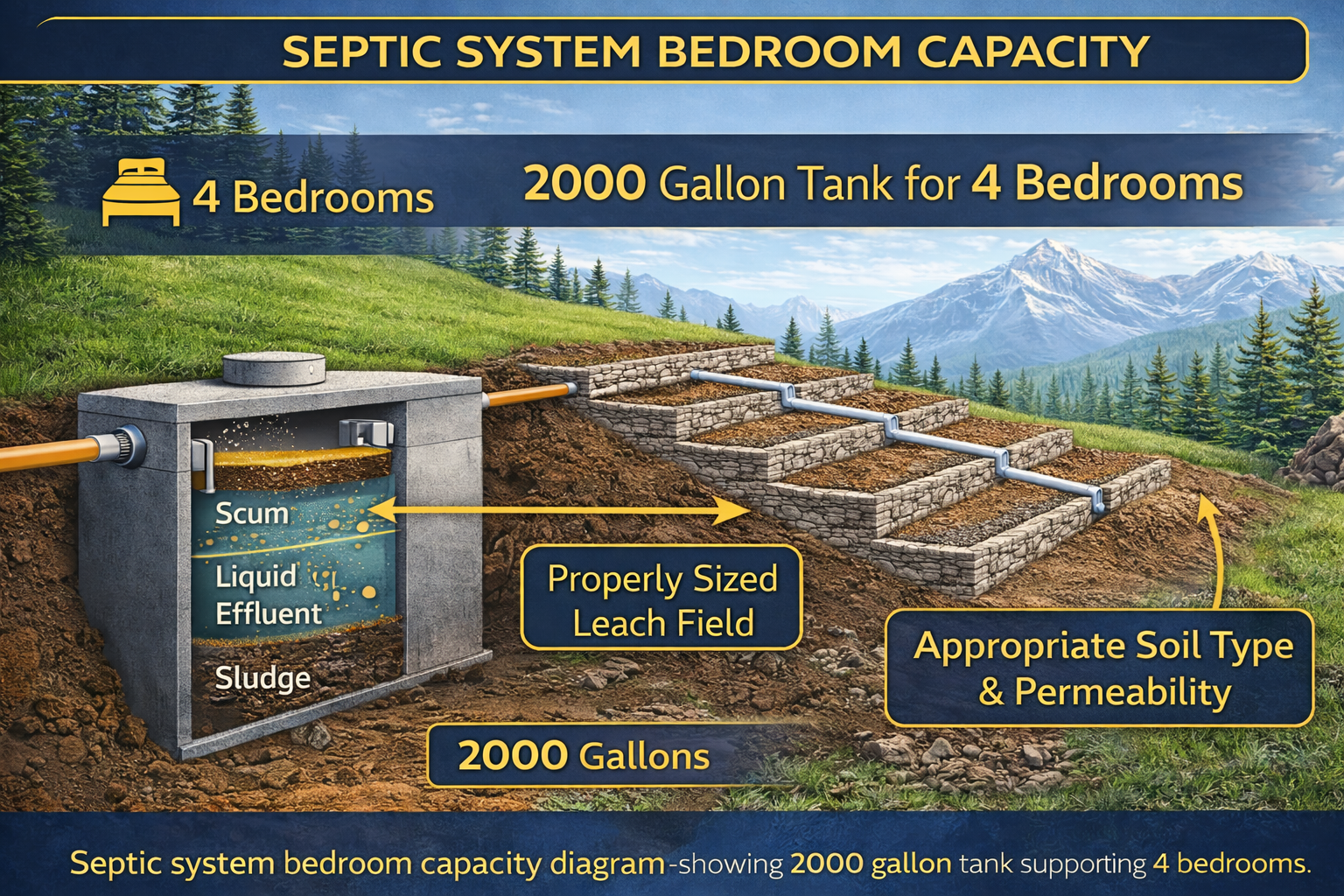
A 2000 gallon septic tank can safely support 3 to 5 bedrooms maximum, depending on your local health department regulations, soil conditions, and daily water usage patterns. Most Colorado counties allow 4 bedrooms with proper leach field sizing, but conservative installations limit capacity to 3 bedrooms to prevent system overload.
What Determines Septic Tank Bedroom Capacity?
Septic tank bedroom capacity isn’t arbitrary. Health departments use bedroom count as a proxy for occupancy because it directly correlates with wastewater volume. Each bedroom represents two people generating approximately 150 gallons of wastewater daily.
Here’s how the math works for a 2000 gallon tank:
- Hydraulic retention time: Wastewater must stay in the tank for 2-3 days for proper treatment
- Daily capacity: 600-750 gallons maximum daily flow
- Bedroom calculation: 600 gallons / 150 gallons per bedroom = 4 bedrooms maximum
The tank size itself is only half the equation. Your leach field must handle the same daily volume without saturating the soil. We’ve seen homeowners focus entirely on tank size while ignoring drain field capacity, leading to system failure within two years.
Pro Tip: Always size your system for peak usage, not average usage. Holiday gatherings and houseguests can double your daily wastewater volume overnight.
How Do Bedroom Requirements Vary by Location?
Colorado septic regulations vary significantly between counties, creating confusion for homeowners planning installations. Let me break down the key differences:
Jefferson County: Requires minimum 1000 gallon capacity plus 250 gallons per bedroom over 3 bedrooms. A 4-bedroom home needs 1250 gallons minimum, making a 2000 gallon tank oversized but acceptable.
Boulder County: Uses a stricter formula based on soil percolation rates. Sandy soils may allow 5 bedrooms with a 2000 gallon tank, while clay soils limit capacity to 3 bedrooms regardless of tank size.
El Paso County: Follows state minimums but requires professional soil evaluation. Rocky soil conditions common around Colorado Springs often reduce bedroom capacity below the tank’s theoretical maximum.
The bedroom count on your home’s blueprints doesn’t always match septic requirements. Health departments count any room that could be used as a bedroom, including finished basements, den spaces, and home offices with closets.
What Are the Standard Septic Tank Sizing Rules?
Modern septic sizing follows established hydraulic principles that ensure proper waste treatment. The International Plumbing Code provides baseline requirements that most states adopt with local modifications.
Minimum Tank Sizes by Bedroom Count:
- 1-2 bedrooms: 750 gallon minimum (1000 recommended)
- 3 bedrooms: 1000 gallon minimum
- 4 bedrooms: 1250 gallon minimum
- 5 bedrooms: 1500 gallon minimum
- 6+ bedrooms: Add 250 gallons per additional bedroom
A 2000 gallon tank exceeds requirements for up to 4 bedrooms, providing extra retention time that improves treatment quality. This oversizing helps during peak usage periods and extends the time between pumpings.
Why Size Matters for Treatment: Septic tanks work through anaerobic digestion. Bacteria need time to break down organic matter before effluent reaches the leach field. Undersized tanks don’t provide adequate retention time, sending partially treated wastewater to the soil.
I’ve replaced dozens of undersized systems where homeowners tried to save money with minimal capacity. The short-term savings disappear quickly when you’re facing soil contamination and expensive remediation.
How Does Daily Water Usage Affect Bedroom Calculations?
Raw bedroom count doesn’t tell the complete story. Modern appliances, lifestyle changes, and water conservation efforts significantly impact actual wastewater generation. Smart homeowners consider these factors during system planning.
High-Usage Scenarios That Reduce Bedroom Capacity:
- Jacuzzi tubs or large soaking tubs
- Multiple bathrooms with separate shower/tub combinations
- In-home business requiring frequent laundry
- Pool or spa equipment draining to septic system
- Irrigation system backwash (if connected)
Water-Saving Features That May Increase Capacity:
- High-efficiency toilets (1.28 gallons vs. 3.5 gallons per flush)
- Low-flow showerheads and faucet aerators
- ENERGY STAR dishwashers and washing machines
- Greywater systems that redirect laundry water
Our typical 4-bedroom installation in Colorado generates 450-550 gallons daily with modern fixtures. This leaves a comfortable margin in a 2000 gallon tank for occasional peak usage
Note: Some counties prohibit greywater diversion from septic systems. Check local regulations before implementing water-saving strategies that reduce septic flow.
When Should You Upsize Beyond Minimum Requirements?
Upsizing your septic tank beyond minimum requirements isn’t just about supporting more bedrooms. Extra capacity provides operational benefits that justify the additional cost, especially in challenging soil conditions.
Situations Where 2000 Gallons Benefits 3-Bedroom Homes:
- Clay or hardpan soil with slow percolation rates
- Homes with finished basements planned for future bedrooms
- Properties hosting frequent guests or extended family
- Locations where pumping services are expensive or infrequent
- High-water-usage lifestyles (large families, home businesses)
The cost difference between 1250 and 2000 gallon tanks is typically $800-1200. However, excavation, installation labor, and permitting costs remain nearly identical. This makes upsizing a relatively affordable insurance policy against system overload.
I recommend 2000 gallon capacity for any home where bedroom expansion is possible within 10 years. Retrofitting septic systems after home additions costs 3-4 times more than initial oversizing.
What’s the Complete Cost of 2000 Gallon Septic Installation?
Septic system installation cost extends far beyond the tank itself. Total system installation costs typically range from $30,000 to $65,000 depending on soil conditions, location, permit/zoning requirements, and system type.
|
Component |
Cost Range |
Notes |
|---|---|---|
|
Tank (including delivery/placement) |
$5,000-$12,000 |
Concrete vs. fiberglass, includes delivery and crane placement |
|
Excavation and Site Work |
$8,000-$20,000 |
Depth, soil conditions, access |
|
Drain Field/Leach Field |
$10,000-$25,000 |
Size varies by bedroom count and soil type |
|
Permits, Engineering, Inspections |
$2,000-$5,000 |
County-specific fees |
|
Total Installation |
$30,000-$65,000 |
Depends on system type and site conditions |
Cost by system type:
- Conventional gravity systems: $30,000-$40,000
- Pressure distribution systems: $35,000-$50,000
- Advanced treatment/ATU systems: $40,000-$55,000
- Mound systems: $45,000-$65,000
- Sand filter systems: $40,000-$55,000
- Engineered/alternative systems: $45,000-$65,000
Additional Costs to Consider:
- Soil percolation testing: $500-1,200
- Survey and site planning: $800-1,500
- Electrical connections (if required): $1,200-2,500
- Landscaping restoration: $2,000-5,000
Homeowners often focus on tank size while underestimating leach field requirements. A 4-bedroom system needs 600-800 square feet of drain field area in typical Colorado soil. Rocky or clay conditions may require twice that area or alternative systems at the higher end of the cost range.
How Do Soil Conditions Affect Bedroom Capacity?
Colorado’s diverse soil conditions dramatically impact septic system performance and bedroom capacity. Rocky mountain soils, clay deposits, and seasonal water tables create challenges that standard sizing charts don’t address.
Soil Types and Their Impact:
- Sandy loam: Excellent drainage, supports maximum bedroom count
- Clay: Poor percolation, may reduce capacity by 1-2 bedrooms
- Rocky/caliche: Requires special installation, limits drain field options
- Seasonal wet: May need mounded or elevated systems
Soil percolation testing determines actual absorption rates. Test results showing slower than 1 inch per hour typically require system modifications or capacity reductions regardless of tank size.
Pro Tip: Schedule perc tests during wet season for conservative results. Spring snowmelt conditions reveal worst-case drainage scenarios.
We’ve installed systems where 2000 gallon tanks support only 2-3 bedrooms due to poor soil conditions. The tank provides adequate treatment, but undersized leach fields create bottlenecks that lead to surface sewage and system failure.
Alternative Systems for Poor Soil:
- Mound systems: $45,000-$65,000
- Sand filter systems: $40,000-$55,000
- Engineered/alternative systems: $45,000-$65,000
Each alternative increases cost but may allow full bedroom capacity despite challenging soil conditions.
What Maintenance Keeps Your System Supporting Maximum Bedrooms?
Proper maintenance ensures your 2000 gallon septic tank continues supporting its designed bedroom capacity throughout its 20-30 year lifespan. Neglected systems lose capacity as sludge accumulates and drain fields deteriorate.
Essential Maintenance Schedule:
- Pumping: Every 3-5 years (3 years for 4-5 bedroom usage)
- Inspection: Annual visual check of tank lids and access ports
- Drain field protection: Avoid driving or building over leach lines
- Water usage monitoring: Watch for sudden increases that stress the system
Warning Signs of Capacity Problems:
- Slow draining fixtures throughout the house
- Sewage odors near tank or drain field areas
- Wet spots or lush grass over the leach field
- Backups during heavy usage periods
- Gurgling sounds from drains
Early intervention prevents small problems from becoming system failures. I’ve seen homeowners ignore minor symptoms until their 2000 gallon system could barely handle 2 bedrooms worth of waste.
Maintenance Costs:
- Pumping service: $300-500 every 3-5 years
- Inspection: $150-300 annually
- Minor repairs: $500-1,500 as needed
- Major component replacement: $3,000-8,000
Regular maintenance costs $200-400 annually but prevents $15,000-25,000 system replacement expenses.
Should You Choose Concrete or Fiberglass for Your 2000 Gallon Tank?
Tank material affects longevity, installation requirements, and total project cost. Both concrete and fiberglass tanks work effectively for 2000 gallon bedroom capacity, but each offers distinct advantages for Colorado installations.
Concrete Tank Benefits:
- Durability: 30-40 year lifespan with proper installation
- Stability: Heavy weight prevents flotation in high water table areas
- Cost: Lower upfront material cost ($1,200-1,800 for 2000 gallons)
- Repair: Can be patched and sealed if minor cracks develop
Fiberglass Tank Benefits:
- Installation: Lighter weight, easier crane placement
- Corrosion resistance: Won’t deteriorate from acidic soil conditions
- Tight seals: Reduced risk of groundwater infiltration
- Smooth interior: Better flow characteristics, less solids buildup
Material Cost Comparison:
- Concrete 2000 gallon: $1,200-1,800
- Fiberglass 2000 gallon: $2,000-2,800
- Installation labor: Similar for both materials
- Long-term maintenance: Slight advantage to fiberglass
I recommend concrete tanks for stable soil conditions and budget-conscious installations. Fiberglass works better in areas with high water tables, acidic soil, or difficult access requiring multiple crane moves.
Both materials support full bedroom capacity when properly sized and installed. Your soil conditions and site access requirements should guide material selection more than bedroom count considerations.
How Do Local Health Department Rules Affect Your Installation?
Each Colorado county interprets state septic regulations differently, creating variation in bedroom capacity requirements and installation standards. Understanding your local health department’s specific rules prevents costly design changes during permitting.
Common County Variations:
- Minimum tank size requirements beyond state codes
- Soil testing procedures and frequency requirements
- Setback distances from wells, property lines, and structures
- Alternative system approval processes
- Inspection timing and requirements
Jefferson County Example: Requires professional engineering for any system serving more than 4 bedrooms, regardless of tank size. This adds $2,000-4,000 in design costs but ensures proper sizing for your specific site conditions.
Boulder County Requirements: Mandates soil evaluation at multiple depths and seasonal monitoring for systems in flood-prone areas. These requirements may reduce bedroom capacity below what tank size alone would suggest.
Permit Process Timeline:
- Application submittal: 2-4 weeks processing
- Soil testing: 1-2 weeks (weather dependent)
- Plan review: 3-6 weeks
- Installation inspection: Scheduled during construction
- Final approval: 1-2 weeks after completion
Submit permit applications early in your construction timeline. Permit delays commonly extend project schedules by 6-12 weeks, especially during busy construction seasons.
Note: Never begin installation before permit approval. Unpermitted work requires expensive removal and reconstruction, even if properly designed.
Frequently Asked Questions
Can I add bedrooms after installing a 2000 gallon septic tank?
Adding bedrooms requires health department approval and may need leach field expansion. A 2000 gallon tank can support additional bedrooms if your original installation was conservatively sized, but you must verify drain field capacity and obtain proper permits before finishing additional bedroom spaces.
How often should I pump a 2000 gallon tank serving 4 bedrooms?
Pump every 3 years for reliable operation with 4 bedrooms. Heavy usage patterns or older tanks may require annual pumping. Monitor sludge levels annually and pump when accumulated solids reach 30% of tank volume to maintain proper treatment capacity.
What happens if I exceed my septic tank’s bedroom capacity?
Exceeding capacity causes system overload, leading to drain backups, surface sewage, soil contamination, and expensive repairs. Health departments can issue violations requiring immediate occupancy reduction or system upgrades costing $30,000-$65,000 to remedy.
Can water-saving fixtures let me add extra bedrooms?
Water conservation helps but doesn’t automatically allow additional bedrooms. Health departments use bedroom count regardless of actual water usage. However, efficient fixtures provide operational margin that improves system performance and may support occasional guest usage above rated capacity.
Do Colorado counties allow alternative systems for more bedrooms?
Yes, alternative systems like sand filters or mounded drain fields can support additional bedrooms in challenging soil conditions. These systems cost $40,000-$65,000 installed but may allow full bedroom capacity where conventional systems cannot.
How long does septic tank installation take in Colorado?
Complete installation typically requires 5-10 working days after permit approval. Excavation takes 2-3 days, tank installation 1 day, leach field construction 2-4 days, and backfilling/restoration 1-2 days. Weather delays extend timelines significantly during winter months.
Can I install my own septic system to save money?
Colorado requires licensed contractors for septic installation in most counties. DIY work is prohibited for health and safety reasons. Professional installation ensures proper sizing, installation techniques, and compliance with local regulations while providing warranty protection on your investment.
What Should You Do Next for Your Septic Installation?
Ready to install a properly sized septic system that supports your home’s bedroom count? Your next step is professional soil evaluation and system design based on your specific site conditions and bedroom requirements.
Contact our experienced excavation team for comprehensive septic system planning. We handle everything from soil percolation testing through final inspection, ensuring your 2000 gallon system delivers reliable performance for decades.
Get started with your septic installation project:
- Free consultation to assess your property and bedroom requirements
- Professional soil testing and percolation analysis
- Detailed cost estimates with transparent pricing
- Expert guidance through the permitting process
- Complete installation with warranty protection
Schedule your consultation today. Don’t risk undersized systems or permit violations. Our precision excavation and installation process ensures your septic system perfectly matches your home’s capacity needs while meeting all Colorado regulatory requirements.