
A 1200 gallon septic tank can support a 3-bedroom home with standard water usage patterns. This calculation is based on the standard formula of 400 gallons per bedroom, though local building codes, soil conditions, and actual occupancy levels can affect this recommendation.
What Determines Septic Tank Capacity Requirements?
The relationship between septic tank size and bedroom count isn’t arbitrary. It’s based on decades of wastewater engineering research that correlates bedrooms to daily water usage.
The International Residential Code (IRC) establishes the baseline formula: each bedroom requires 150 gallons of daily sewage capacity. A properly sized septic tank should hold approximately 2.5 to 3 days’ worth of wastewater, which translates to 400 gallons per bedroom for the tank itself.
Septic tank sizing follows this standard calculation:
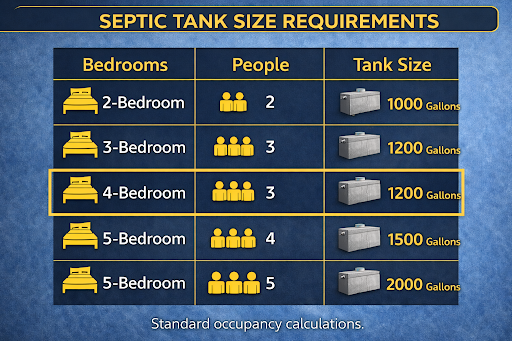
- 1 bedroom: 750-1000 gallon minimum
- 2 bedrooms: 1000-1200 gallon tank
- 3 bedrooms: 1200-1500 gallon tank
- 4 bedrooms: 1500-1800 gallon tank
- 5+ bedrooms: Add 300-400 gallons per additional bedroom
Here’s the critical factor most homeowners miss: bedroom count assumes two occupants per bedroom for calculation purposes, regardless of actual occupancy. A 3-bedroom house with just two residents still requires a system sized for six people.
Why 1200 Gallons Works for Three Bedrooms
A 1200 gallon septic tank provides the necessary detention time for proper wastewater treatment in a 3-bedroom home. The tank must accomplish three critical functions: separate solids from liquids, begin bacterial decomposition, and store accumulated sludge between pump-outs.
The 1200 gallon capacity breaks down functionally as:
- 400 gallons active liquid capacity
- 400 gallons sludge storage zone
- 400 gallons scum layer and safety buffer
This configuration allows wastewater to remain in the tank for 24-48 hours, which is essential for primary treatment. Without adequate retention time, solids escape into the drain field and cause system failure.
We’ve installed hundreds of septic systems across Colorado, and the 1200 gallon tank consistently performs well for 3-bedroom homes when properly matched to appropriate drain field sizing. The tank is only half the equation – your drain field must also be sized correctly for the daily flow volume.
Pro Tip: Local health departments often have more stringent requirements than the IRC minimum. In Colorado’s high-altitude counties, some jurisdictions require oversizing by 25% to account for slower bacterial activity in cold soils.
When a 1200 Gallon Tank Might Not Be Adequate
Standard sizing calculations don’t account for every real-world scenario. Several factors can push your home’s wastewater production beyond what a 1200 gallon tank can handle effectively.
High-usage situations requiring larger tanks:
- Home offices with multiple employees
- In-law suites or guest quarters with separate entrances
- Large families with 4+ occupants per bedroom
- High-efficiency washers that run multiple cycles daily
- Swimming pools with backwash discharge to septic
- Water softener regeneration cycles
Soil and site conditions affecting capacity needs:
- Clay soils requiring longer detention times
- High groundwater tables limiting drain field efficiency
- Steep slopes requiring pump systems and storage
- Small lot sizes with limited drain field area
We recently completed a septic installation for a 3-bedroom home office in Jefferson County where the homeowners needed a 1500 gallon tank despite having only three bedrooms. The business generated additional wastewater from a commercial coffee station and frequent client visits.
How Septic Tank Size Affects Installation Costs
Septic tank size directly impacts your total installation investment, but the tank itself represents only 15-20% of total system costs. The drain field, excavation, and permitting typically account for the majority of expenses.
Cost factors affected by tank size:
- Tank purchase: 1200 gallon concrete tanks cost $800-1200, while 1500 gallon tanks run $1000-1400
- Excavation: Larger tanks require deeper, wider excavation holes
- Transport: Bigger tanks need specialized equipment for delivery and placement
- Backfill: More material needed around larger tank dimensions
Here’s what surprises most homeowners: upgrading from a 1200 to 1500 gallon tank typically adds only $400-600 to total project costs. The excavation equipment is already on-site, and the incremental size increase requires minimal additional work.
Comparing 1200 Gallon vs Other Common Tank Sizes
|
Tank Size |
Bedroom Count |
Daily Flow |
Best For |
Cost Range |
|
1000 gallon |
2 bedrooms |
300 gallons |
Small homes, cabins |
$700-1000 |
|
1200 gallon |
3 bedrooms |
450 gallons |
Standard family homes |
$800-1200 |
|
1500 gallon |
4 bedrooms |
600 gallons |
Large families, home offices |
$1000-1400 |
|
1800 gallon |
5 bedrooms |
750 gallons |
Executive homes, multi-generational |
$1200-1600 |
The key difference isn’t just volume – it’s retention time and treatment effectiveness. Undersized tanks create cascading system failures that cost thousands to repair.
What Building Codes Say About 1200 Gallon Tanks
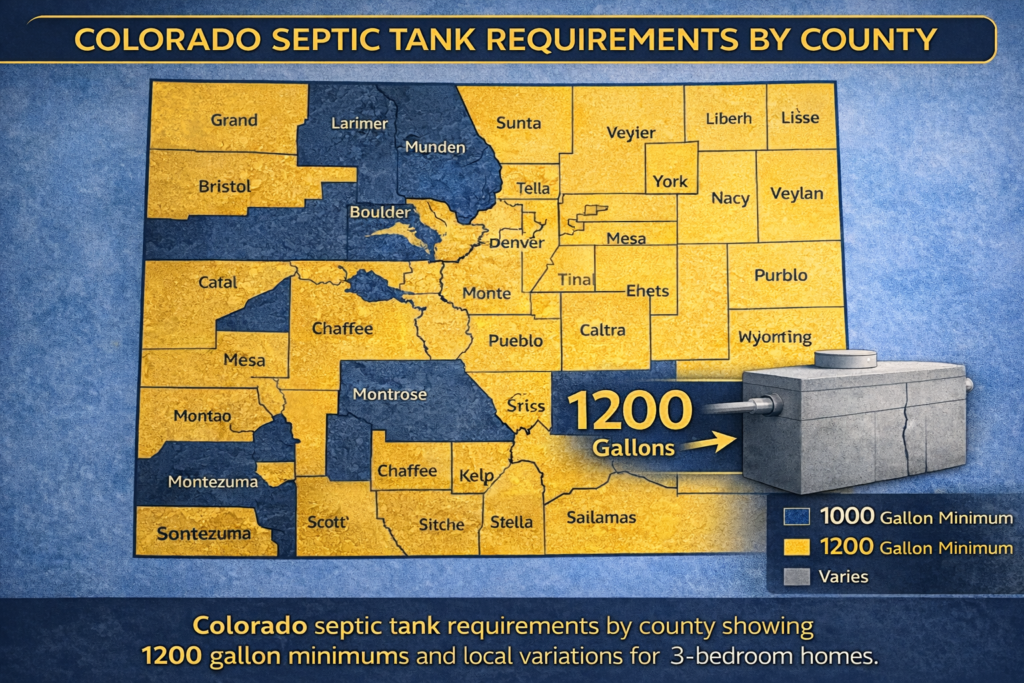
Colorado follows the International Residential Code (IRC) for septic system sizing, but individual counties can impose stricter requirements. The IRC sets 1200 gallons as the minimum for 3-bedroom homes, but many Colorado counties require larger tanks.
Current Colorado county requirements:
- Jefferson County: 1200 gallon minimum for 3BR, 1500 gallon recommended
- Boulder County: 1500 gallon minimum for 3BR homes
- Larimer County: 1200 gallon minimum, soil testing determines final sizing
- El Paso County: 1200 gallon minimum, additional capacity for high-use fixtures
Permit considerations for 1200 gallon installations:
- Soil percolation testing required in all counties
- Setback distances from wells, property lines, structures
- Reserve drain field area designation
- Professional design stamp required for challenging sites
The permit process typically takes 4-6 weeks in Colorado counties. We handle all permitting as part of our installation process because navigating county-specific requirements requires local expertise.
Note: Installing an undersized tank to save money will fail inspection and require complete system replacement at full cost.
Signs Your Current Tank Is Undersized
If you’re evaluating an existing 1200 gallon tank, several warning signs indicate inadequate capacity for your home’s actual usage patterns.
Performance indicators of undersized systems:
- Frequent backups (more than once per year)
- Sewage odors around the tank or drain field
- Lush grass growth over the drain field year-round
- Standing water in the yard after normal weather
- Gurgling sounds from drains when using large amounts of water
- Tank requires pumping more frequently than every 3-5 years
Occupancy changes that outgrow 1200 gallon capacity:
- Converting basement space to bedrooms
- Adding accessory dwelling units (ADUs)
- Multi-generational families moving in
- Home-based businesses with employees
- Installing hot tubs or large soaking tubs
We’ve replaced dozens of undersized systems where homeowners tried to make 1200 gallon tanks work for 4+ bedroom homes. The repair costs always exceed the initial investment in proper sizing.
Pro Tip: If your family uses more than 450 gallons per day consistently, your 1200 gallon tank is operating beyond design capacity regardless of bedroom count.
Professional Installation Considerations
Installing a 1200 gallon septic tank requires specialized equipment and expertise that most contractors don’t possess. The tank weighs 8,000-12,000 pounds when concrete-constructed, and placement precision is critical for long-term performance.
Critical installation factors:
- Excavation depth: Tank top should be 12-18 inches below finished grade
- Bedding material: 6-inch sand base prevents settling and cracking
- Backfill compaction: Improper compaction causes tank movement and pipe disconnection
- Inlet/outlet elevation: Precise pipe connections prevent backflow and blockages
Our installation process ensures lasting performance:
- Site survey and soil testing to verify drain field suitability
- Precision excavation using GPS-guided equipment to avoid underground utilities
- Professional tank placement with crane equipment rated for the load
- Quality backfill and compaction using engineered materials, not site dirt
- System testing and startup to verify all components function correctly
The difference between professional and amateur installation becomes apparent within the first year. We’ve never had a callback on a properly installed 1200 gallon system when sized appropriately for the home.
How Maintenance Affects 1200 Gallon Tank Performance
A 1200 gallon septic tank requires specific maintenance schedules to perform effectively for a 3-bedroom home. Tank size directly affects pumping frequency, inspection requirements, and system longevity.
Maintenance schedule for 1200 gallon tanks:
- Pumping frequency: Every 3-5 years for 3-person households
- Annual inspections: Check inlet/outlet baffles and measure sludge levels
- Drain field protection: Avoid parking, building, or planting over system components
- Water usage monitoring: Track consumption to prevent hydraulic overloading
Maintenance costs for 1200 gallon systems:
- Pumping service: $300-500 per service
- Annual inspection: $150-250
- Minor repairs: $200-800
- Major component replacement: $2000-4000
The key maintenance insight most homeowners miss: consistent pumping schedules prevent expensive repairs. A 1200 gallon tank that goes 7+ years without pumping will likely need drain field repairs costing $5000-8000.
We recommend our customers keep maintenance logs tracking pumping dates, inspection results, and any performance issues. This documentation proves invaluable for warranty claims and system troubleshooting.
What Should You Do Next?
If you’re planning a septic installation or evaluating your current system, the first step is determining your home’s actual wastewater generation patterns and local code requirements.
Immediate action steps:
- Calculate your daily water usage by monitoring your water meter for one week
- Contact your county health department to verify current septic sizing requirements
- Schedule a professional site evaluation to assess soil conditions and setback requirements
- Get multiple installation quotes from licensed excavation contractors with septic specialization
For Colorado homeowners, we provide free site evaluations and installation quotes that include all permitting, excavation, and system startup services. Our installations come with comprehensive warranties because we use precision placement techniques that prevent the common failures we see from other contractors.
Ready to move forward with your septic installation? Contact Dotts Construction for a detailed site assessment and accurate project quote. We deliver exactly what we promise and leave your property looking like the work happened by magic.
Frequently Asked Questions
Can I use a 1000 gallon tank for a 3-bedroom home?
No, a 1000 gallon tank is undersized for a 3-bedroom home and won’t meet building code requirements in most jurisdictions. The insufficient capacity leads to frequent backups and premature system failure.
How long does a 1200 gallon septic tank last?
A properly installed 1200 gallon concrete septic tank lasts 40-60 years with regular maintenance. Plastic and fiberglass tanks typically last 30-40 years. Installation quality significantly affects longevity.
What happens if I exceed the capacity of my 1200 gallon tank?
Exceeding tank capacity causes solids to escape into the drain field, leading to clogging, sewage backups, and expensive drain field replacement. Systems typically fail within 2-3 years of chronic overloading.
Can I add bedrooms to my home with a 1200 gallon tank?
Adding bedrooms requires recalculating septic capacity. A 1200 gallon tank cannot support more than 3 bedrooms without violating building codes and risking system failure.
How often should I pump my 1200 gallon septic tank?
Pump your 1200 gallon tank every 3-5 years for typical 3-person household usage. High-usage households may need annual pumping to prevent system overload.
Is a 1200 gallon tank suitable for a home office?
Home offices with multiple employees or high water usage may require larger tank capacity. Evaluate total daily wastewater generation including business activities when sizing your system.
What’s the difference between concrete and plastic 1200 gallon tanks?
Concrete tanks last longer (40-60 years vs 30-40 years) and resist flotation in high groundwater conditions. Plastic tanks cost less initially but may require additional anchoring systems.