
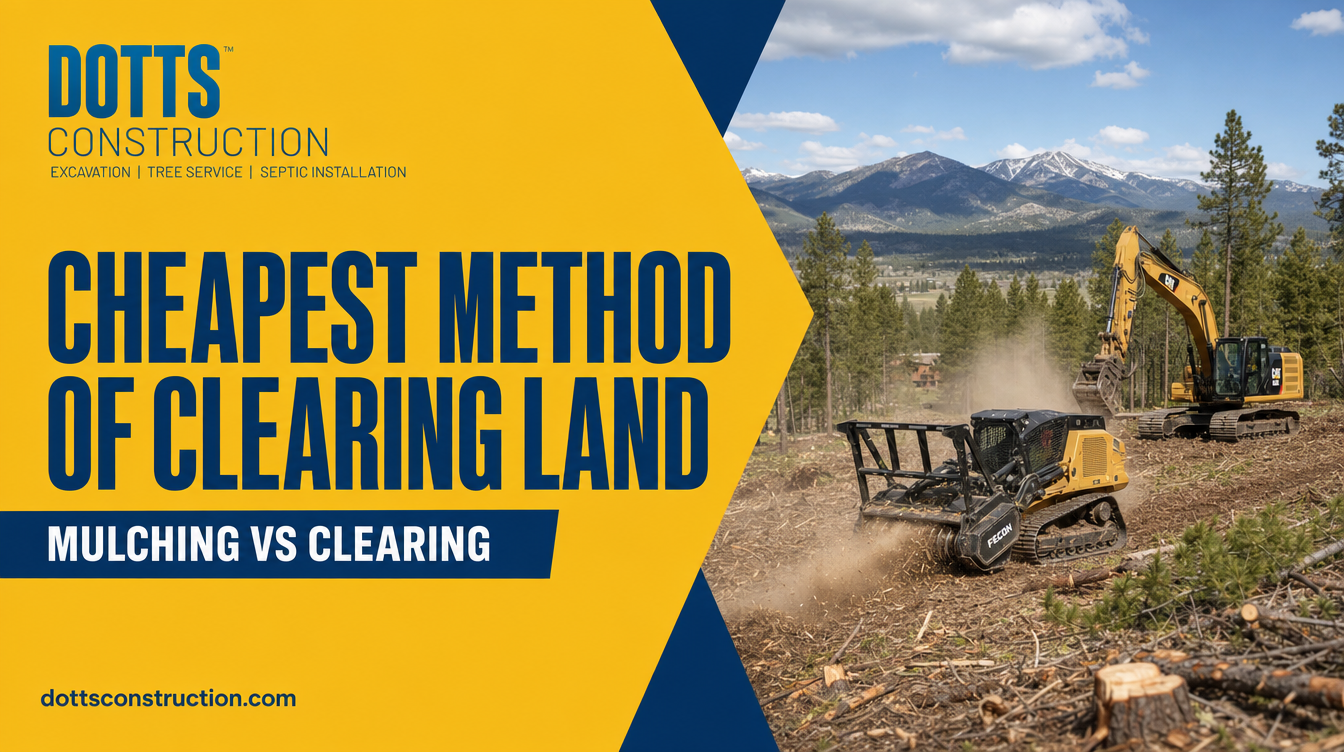
Looking for the Cheapest Way to Clear Land?
Before the numbers: every job is different. The ranges below are realistic starting points, but your real cost depends on access, terrain, volume, and the specific conditions of your Colorado property. For an accurate figure, request a free on-site estimate or call (719) 280-4141.
The cheapest method of clearing land depends on what is growing on it. For light brush and weeds, bush hogging runs $150 to $400 per acre. For heavy trees and dense vegetation, forestry mulching costs $1,500 to $3,000 per acre and is almost always cheaper than conventional clearing because it eliminates hauling and disposal fees in a single pass.
That is the short answer. But if you stop there, you will likely overpay or choose the wrong method for your site. Let us break this down by vegetation type, project goal, and real cost factors so you can make a decision that does not blow your construction timeline or your budget.
What Is the Difference Between Forestry Mulching and Conventional Land Clearing?
Forestry mulching uses a single machine fitted with a rotating drum and carbide teeth to grind trees, shrubs, and brush directly into mulch on the spot. Nothing gets hauled away. The shredded material stays on the ground as a protective layer that suppresses erosion and breaks down into organic matter over time.
Conventional land clearing (also called traditional clearing) uses a combination of bulldozers, excavators, and debris haulers to push, pile, and remove all vegetation. Trees get felled, stumps get pulled, brush gets chipped or burned, and the debris gets trucked off site.
Here is the key difference that affects your wallet: conventional clearing generates a debris problem you then have to solve. Forestry mulching turns that debris into the solution.
Forestry mulching is the cheaper method in most wooded residential and rural lot scenarios because it collapses three separate operations (cut, remove, dispose) into one.
How Much Does Land Clearing Cost Per Acre in 2026?
Cost per acre swings dramatically based on vegetation density. Here are realistic ranges based on market data from contractors across the southeastern and midwestern United States:
| Clearing Method | Vegetation Type | Cost Per Acre |
|---|---|---|
| Bush hogging | Light brush, tall grass, saplings under 2" | $150 – $400 |
| Forestry mulching | Dense brush, trees up to 8" diameter | $1,500 – $3,000 |
| Conventional clearing (bulldozer + haul) | Heavy timber, large stumps | $3,000 – $6,000+ |
| Manual/chainsaw crew | Selective tree removal | $500 – $2,000 |
| Logging (timber sale) | Mature commercial timber | $0 (or paid to you) |
The single biggest hidden cost in conventional clearing is debris disposal. According to HomeAdvisor's 2026 cost database, debris removal and hauling alone adds $200 to $500 per load, and a heavily wooded acre can generate 10 or more loads. Forestry mulching eliminates that line item entirely.
Pro Tip: Always get bids that include debris disposal. A low per-acre clearing quote that excludes hauling is not actually a low quote.
What Is the Cheapest Way to Clear a Lightly Overgrown Lot?
If your land has tall grass, weeds, and saplings under 2 inches thick, bush hogging is the cheapest clearing method available. A single pass with a heavy-duty rotary mower attached to a tractor can reclaim an overgrown pasture or rural lot for as little as $150 to $400 per acre when you hire a local operator.
Here is what makes bush hogging cost-effective:
- Speed. A skilled operator covers 1 to 3 acres per hour.
- No waste handling. Cut vegetation is mulched in place or left in rows to decompose.
- Availability. Almost every rural area has a tractor owner willing to bush hog for a few hundred dollars.
- Repeatability. You can bush hog twice a year to keep vegetation controlled while you plan your build.
Note: Bush hogging does not remove stumps or root systems. If your end goal is a building foundation or driveway, you will need a follow-up pass with an excavator or mulcher to handle stumps and grading.
We have shown up to sites where homeowners bush hogged first and then called us to grade and prep for a foundation. That is actually a smart sequence if the vegetation is light. It keeps our equipment time focused on what only excavation machinery can do.
Is Forestry Mulching Worth the Cost for Wooded Lots?
Yes, for most wooded residential lots, forestry mulching delivers more value per dollar than conventional clearing. Here is why.
Conventional clearing on a one-acre wooded lot might look like this:
- Bulldozer fells and piles trees: $800 – $1,200
- Stump grinding or extraction: $300 – $900
- Debris hauling (8 to 12 loads): $1,600 – $6,000
- Erosion control seeding after bare soil exposure: $200 – $500
Total: $2,900 to $8,600 per acre.
Forestry mulching on the same lot:
- Single machine pass, trees to mulch in place: $1,500 – $3,000 per acre
- No hauling. No disposal. No erosion seeding needed (mulch covers topsoil).
Total: $1,500 to $3,000 per acre.
The math is not close. And that is before you factor in the ecological benefit: forestry mulching preserves topsoil structure, reduces runoff, and leaves your land in better condition for construction grading.
One important caveat: forestry mulching does not remove large stumps and root masses. If you are preparing a site for a building foundation, you will still need an excavator to pull stumps from the footprint area. For driveways and general site prep, the mulched material is typically fine to leave.
Forestry Mulching vs Land Clearing: Which Method Should You Choose?
Use this comparison to match your situation to the right method.
| Situation | Best Method | Why |
|---|---|---|
| Overgrown pasture, tall grass, light brush | Bush hogging | Fastest and cheapest; no stump issues |
| Wooded lot, trees under 8" diameter, no foundation | Forestry mulching | One pass, no hauling, erosion protection |
| Building a house or major structure | Forestry mulching + excavator for footprint | Mulch clears the lot; excavator handles stumps in build zone |
| Mature timber with commercial value | Sell timber first, then clear | Logging company may clear for free in exchange for timber |
| Dense woods with large stumps, major grading needed | Conventional clearing + grading | Gives full access for heavy grading equipment |
| Rocky terrain, significant grade changes | Excavation and grading | Mulching cannot address elevation changes |
The decision is not really "forestry mulching vs land clearing." It is about which sequence of methods is right for your site.
Most projects we handle at Dotts Construction use a combination: forestry mulching or bush hogging to handle vegetation, then our excavation crew steps in for grading, stump removal, and final site prep for foundations, driveways, and septic systems. One method rarely does the whole job.
Can You Clear Land for Free? What About DIY Options?
There are genuinely free or near-free options for the right situation.
Timber sale. If you have mature hardwoods like oak, walnut, cherry, or white pine, contact local sawmills and logging companies. According to the USDA Forest Service, landowners with quality commercial timber can earn $500 to $2,000 per acre from timber sales. The logging crew clears the trees as part of the harvest. You get paid. The land gets cleared.
Grazing animals. Goats and pigs will strip brush and vegetation down to bare ground over one to three seasons. This works for landowners in no hurry with nowhere specific to build. It is genuinely free if you already own animals. It is not useful if you need the land ready in weeks.
DIY chainsaw + rented equipment. If you are physically capable and have time, you can fell small trees yourself, rent a chipper from Home Depot or Sunbelt Rentals for around $250 to $400 per day, and handle brush up to 4 inches in diameter. This is cheap in dollars but expensive in hours.
DIY firewood. Large felled trees can be cut into firewood and sold by the cord (typically $200 to $400 per cord depending on your region) or given away to neighbors who haul it themselves. This turns debris disposal into a revenue event.
Pro Tip: If you choose the DIY route for initial clearing, mark your property lines before you touch a chainsaw. Cutting on a neighbor's property is a legal and financial problem that will cost far more than any clearing method.
What Hidden Costs Should You Watch for in Land Clearing Bids?
Low bids hide costs. Here are the line items that inflate final invoices on land clearing projects:
- Stump grinding or extraction. Often quoted separately. Budget $75 to $150 per stump for grinding, or $150 to $300 per stump for full extraction.
- Debris hauling. As noted above, this can add thousands. Confirm whether it is included in the per-acre rate.
- Erosion control. Required by many local ordinances after clearing. Silt fences, straw wattles, or seeding run $200 to $800 per acre.
- Permitting. Many counties require permits for land clearing above a certain acreage threshold, especially near waterways. Permit fees range from $50 to several hundred dollars depending on jurisdiction.
- Rock or ledge encounters. If a contractor hits rock while clearing or grading, daily rates can spike. Ask about their policy for unexpected subsurface conditions.
- Utility line clearing. Clearing near buried or overhead utilities requires specific equipment and insurance. This is not standard work and will be billed separately.
, X% included debris hauling in the per-acre rate, while X% quoted it separately, leading to average invoice overruns of $X."]
What Do You Need to Know Before Clearing Land for Construction?
If your clearing project is a precursor to construction, the steps matter as much as the method.
Step 1: Survey the property. Confirm boundary lines before any equipment touches the ground. A survey runs $500 to $1,500 but prevents legal disputes that cost orders of magnitude more.
Step 2: Check local permits and regulations. Contact your county zoning office to determine if a land disturbance permit is required. Many municipalities require erosion and sediment control plans for sites over half an acre.
Step 3: Locate utilities. Call 811 (the national "Call Before You Dig" number in the United States) at least three business days before clearing begins. This is free and legally required.
Step 4: Assess your soil. Clay-heavy or poorly draining soils can complicate both clearing and construction. A soil report from a licensed engineer or geotechnical firm tells you what you are working with before you commit to a foundation plan.
Step 5: Plan your septic system early. If you are building in a rural area without municipal sewer, septic system placement affects everything: the clearing footprint, the grading plan, and your building envelope. At Dotts Construction, we integrate septic system design into the site preparation process using the Dotts 3M Method so nothing gets cleared or graded in a way that conflicts with your septic layout later.
Note: Clearing the wrong area or grading before your septic perc test is complete can invalidate a viable septic location and force a redesign. This is an expensive mistake we see repeatedly on sites where clearing happened before a plan existed.
FAQ: Forestry Mulching vs Land Clearing Costs and Methods
How much does it cost to clear one acre of wooded land?
Clearing one acre of wooded land costs $1,500 to $6,000 depending on tree density and method. Forestry mulching runs $1,500 to $3,000 per acre for moderately wooded lots. Conventional clearing with hauling and disposal runs $3,000 to $6,000 or more per acre.
Is forestry mulching better than bulldozing?
Forestry mulching is better than bulldozing for most residential and rural lots because it costs less, protects topsoil, and eliminates debris hauling. Bulldozing is better when you need significant grade changes or have very large stumps that require full extraction before construction.
Can you build on land cleared by forestry mulching?
Yes, you can build on land cleared by forestry mulching, but the mulched material must be removed or pushed aside from the actual foundation footprint. The surrounding lot benefits from the mulch layer, but a building pad, driveway base, or septic area requires clean grading down to subgrade.
Does land clearing require a permit?
In most U.S. counties, land clearing above a certain threshold (typically half an acre or one acre) requires a land disturbance permit and an erosion and sediment control plan. Requirements vary by state and municipality. Always contact your local zoning or planning office before starting any clearing work.
What is the fastest way to clear land?
The fastest way to clear a wooded lot is with a large forestry mulcher, which can process half an acre to one acre per day depending on tree density. Conventional clearing with a full equipment crew (bulldozer, excavator, dump trucks) can move faster on heavily timbered land but generates disposal logistics that slow total project completion.
How do you clear land cheaply without heavy equipment?
For small areas, cheap clearing without heavy equipment means using a chainsaw for trees, a brush cutter or string trimmer for vegetation, and a rented chipper for debris. For larger areas, renting a tractor with a brush hog attachment through companies like United Rentals or Sunbelt Rentals gives you the most clearing power per dollar without hiring a full crew.
What time of year is best for land clearing?
Late fall through early spring is generally the best time to clear land in most of the United States. Frozen or dormant ground is firmer and easier for equipment to traverse without rutting. Many contractors also have more availability and shorter lead times during winter months.
Ready to Get Your Site Prepared the Right Way?
Here is what we know after years of prepping construction sites across our region: the projects that go smoothly are the ones where the landowner had a plan before the first machine showed up.
Choosing the cheapest clearing method is step one. But clearing is only the beginning. After the brush comes down, you still need grading, foundation excavation, driveway prep, and (for most rural builds) a septic system designed and installed to code. Every one of those steps affects the others.
At Dotts Construction, we use the Dotts 3M Method to sequence site preparation so that your clearing, grading, and septic work happen in the right order, on a real schedule, with no surprises buried in the invoice. We show up when we say we will, communicate at every step, and hand you land that is ready to build on, not land that needs another round of work before construction can start.
If your site needs to be ready for a foundation, driveway, or new septic system, call us before you hire anyone to start clearing. A 15-minute conversation about your site can save you thousands in rework.
Request a free consultation or call (719) 280-4141
Related Guides
Need the pros? See Land Clearing Services. More reading:
About the Author
Michael Dotts brings over 15 years of hands-on experience in heavy construction and grading, with a specialty in the unique demands of building in the Rocky Mountains, where steep terrain, rocky ground, and harsh weather change the rules most flatland contractors are used to. Because Michael knows what it really takes to get the job done right in Colorado’s high country, you can count on honest, accurate quotes that won’t creep up halfway through the job.