
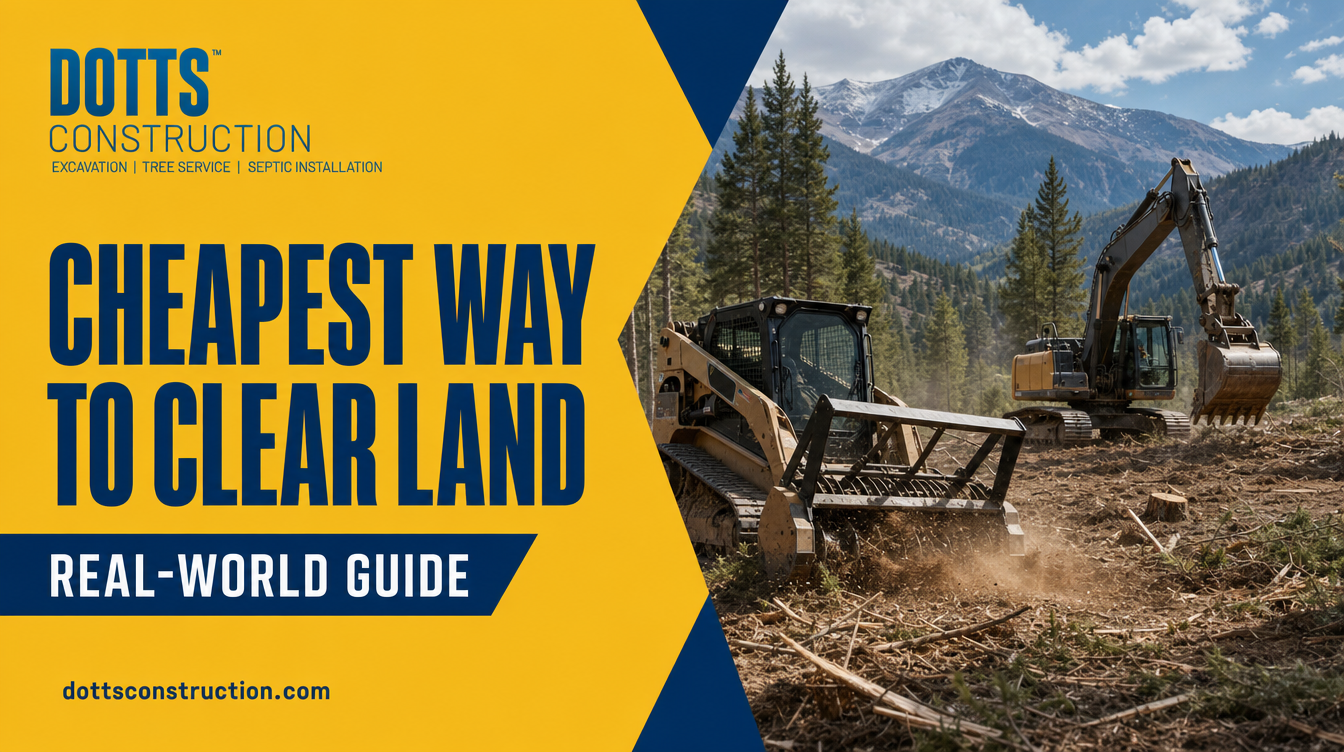
What’s the Cheapest Way to Clear Land?
Before the numbers: every job is different. The ranges below are realistic starting points, but your real cost depends on access, terrain, volume, and the specific conditions of your Colorado property. For an accurate figure, request a free on-site estimate or call (719) 280-4141.
The cheapest way to clear land is to do as much of the manual and light mechanical work yourself, then hire a professional crew only for the tasks that require heavy equipment. Combining a chainsaw, a rented stump grinder, and a tractor with a bucket attachment can handle most small-to-mid-size lots before a single excavator arrives on site.
That said, "cheap" only stays cheap when it's done right. Cut the wrong corner on land clearing and you're looking at drainage problems, foundation failures, and repair bills that dwarf what you saved. This guide breaks down every realistic cost-saving method, what it actually costs, and where Dotts Construction's Dotts 3M Method fits in to make sure your site is ready for the foundation, driveway, or septic system you're planning.
Why Does Land Clearing Cost So Much in the First Place?
Before you can save money, you need to understand where the money goes.
Land clearing costs are driven by four main variables:
- Lot size (acreage being cleared)
- Tree density and size (mature hardwoods cost far more to remove than scrub brush)
- Soil conditions (rocky or clay-heavy soil means more equipment hours)
- What "cleared" means for your project (rough clearing vs. full grading vs. construction-ready)
According to HomeAdvisor's 2026 national cost data, professional land clearing runs between $1,500 and $5,600 per acre for light clearing, and can climb above $8,000 per acre when large trees, stumps, and rocky terrain are involved.
That's a wide range. Where your project falls in it depends almost entirely on prep work. The more you handle before the professional crew arrives, the lower your bill.
What Can You Do Yourself to Lower Land Clearing Costs?
DIY land clearing is realistic on lots under 2 acres with light-to-moderate tree cover. Here's what you can handle without a professional crew.
Brush and Small Tree Removal
Small trees (under 6 inches in diameter) and dense brush can be cleared with:
- A chainsaw (a mid-range saw like a Husqvarna 455 Rancher handles most residential work)
- A brush cutter or clearing saw for thick undergrowth
- A tractor with a brush hog attachment for open areas with grass and light scrub
Cut trees at ground level, pile the debris, and either rent a wood chipper or arrange a debris haul-off. Many municipalities will take wood chips for free if you chip on site.
Pro Tip: Check with your county before burning debris. Open burning permits vary by region and burning without one can result in fines that erase any savings.
Stump Removal
Stumps are where most DIY efforts stall. Here's the honest breakdown:
- Stump grinder rental (like the Toro WG28 PRO or Vermeer SC252) runs $150 to $400 per day from most equipment rental yards.
- One person with zero experience can typically grind 4 to 6 stumps per day on average-sized trees.
- Chemical stump removal (potassium nitrate products like Spectracide Stump Remover) is the cheapest option at under $20 per stump, but it takes 4 to 6 weeks to work and isn't viable when you have a construction timeline.
For large stumps (over 24 inches in diameter), don't fight it. A professional with a 100HP+ grinder will do in 20 minutes what takes a rental unit 3 hours.
Moving Dirt and Light Grading
A tractor with a bucket or a box blade attachment can move dirt, level small depressions, and rough-grade areas up to about half an acre. If you own or can borrow a tractor, this is one of the most effective cost-saving moves available.
What a tractor and bucket cannot do:
- Compact soil to a load-bearing standard for foundations
- Cut and fill grade changes greater than 12 to 18 inches
- Establish proper drainage slopes across a full lot
Those tasks require a skid steer, excavator, or motor grader operated by someone who knows how to read a grade plan.
What Is the Cheapest Professional Option for Land Clearing?
When DIY isn't enough, you still have options that cost less than a full site prep contract.
Targeted Equipment Hire (Time-and-Materials)
Rather than hiring a contractor for a complete land clearing package, you can hire an excavation crew on a time-and-materials basis for specific tasks only. You handle brush removal and small stumps, then bring in the crew for one focused day of heavy machine work.
A single excavator or skid steer running for 8 hours at $85 to $150 per hour (operator included, per RSMeans 2026 data) can accomplish what would take a DIY crew several weekends.
Selective Clearing Instead of Full Clear-Cut
Not every tree on your lot needs to come down. Selective clearing removes only the vegetation that directly conflicts with your building footprint, driveway path, and septic field. The rest stays standing.
Selective clearing can reduce your total clearing cost by 30 to 50 percent compared to a full clear-cut, while improving the aesthetic value of the finished property.
Land clearing done right preserves existing trees outside the build zone. This matters for both resale value and erosion control. Bare ground with no root structure erodes fast, and erosion directly affects your grading work downstream.
Timber Value Offset
If your lot has mature hardwood timber, you may be able to offset clearing costs by selling the timber to a local sawmill or logging operation. Timber buyers will sometimes clear your trees for free in exchange for the wood, particularly on lots with walnut, oak, or poplar stands.
This only works for larger lots with marketable timber, but on a 5-to-10-acre site, it can reduce clearing costs to near zero.
How to Prepare Land for Construction After Clearing
Clearing is step one. Getting the land construction-ready is a different process, and confusing the two is one of the most expensive mistakes property owners make.
Here's what happens after the trees and stumps are gone:
Step 1: Soil Testing
Before any grading or excavation work begins, test your soil. A basic percolation test (perc test) determines whether your soil drains at a rate suitable for a septic system. A geotechnical soil report tells a structural engineer whether your ground can bear the load of a foundation without additional prep.
Soil problems caught early cost hundreds of dollars to address. Soil problems discovered after the foundation is poured can cost tens of thousands.
Step 2: Rough Grading
Rough grading establishes the general elevation and slope of your lot. It creates the basic pad where your structure will sit, directs water away from the building footprint, and cuts access paths for equipment.
Rough grading is not finish grading. Don't expect it to look polished.
Step 3: Utility and Septic Layout
Before finish grading happens, underground utilities (water, sewer, electrical conduit, and gas) need to be stubbed in. If you're outside a municipality, this is where septic system design and installation fits in.
At Dotts Construction, we handle septic system design and installation to code and spec as part of our full site prep process. Getting your septic field located correctly relative to your building footprint, setback lines, and soil conditions protects you from a failed inspection and a very expensive redo.
Pro Tip: Never start finish grading before your septic field location is confirmed and staked. Moving a drain field after grading work is complete adds real cost and delays.
Step 4: Finish Grading and Compaction
Finish grading brings the site to final elevation, establishes drainage slopes (typically a minimum 2 percent grade away from foundation walls, per International Residential Code Section R401.3), and prepares the pad for foundation work.
After grading, fill areas must be mechanically compacted in lifts (layers, usually 6 to 8 inches) using a plate compactor or roller. Uncompacted fill under a foundation settles. Settlement cracks foundations.
Step 5: Foundation Excavation or Driveway Prep
With the grade set and compaction complete, your site is ready for foundation excavation (footings, basement walls, or slab preparation) and driveway sub-base installation.
DIY vs. Professional Land Clearing: A Real Cost Comparison
| Method | Best For | Average Cost | Time Required | Risks |
|---|---|---|---|---|
| Full DIY (chainsaw, tractor, rented stump grinder) | Lots under 1 acre, light brush, small trees | $500 to $1,500 in rentals and equipment | Several weekends | Physical injury, missed stumps, improper grade |
| Hybrid (DIY brush + professional heavy equipment) | Lots 1 to 5 acres, moderate tree density | $1,500 to $4,000 | 1 to 2 weeks | Handoff coordination, sequencing errors |
| Selective professional clearing | Any size lot, build-footprint-only clearing | $1,200 to $3,500 per acre | 1 to 3 days | Requires accurate staking of build zone first |
| Full professional clear-cut and grade | Dense lots, large trees, tight timelines | $3,000 to $8,000+ per acre | 2 to 5 days | Budget scope creep if soil conditions surprise |
| Timber trade-off clearing | Lots with marketable hardwood timber | $0 to $1,500 | 1 to 2 weeks | Timber buyer availability, negotiation complexity |
The hybrid approach delivers the best cost-to-result ratio for most residential construction projects. Homeowners who clear their own brush and small-diameter trees, then bring in a professional crew for stumps, grading, and compaction, consistently pay 25 to 40 percent less than those who hand the entire job to a contractor from day one.
What Mistakes Make Land Clearing More Expensive Than It Has to Be?
We've seen these patterns repeat on job sites across the region. Avoid them.
1. Clearing before staking the build zone.
If you clear the whole lot and then discover the building footprint needs to shift 20 feet because of a setback or soil condition, you've done work you didn't need to do. Stake your footprint, driveway corridor, and septic field before a single tree comes down.
2. Skipping the perc test.
A failed perc test after clearing and grading forces you to redesign your septic system around soil conditions you could have known about for $300 before you started.
3. Treating rough clearing as finished site prep.
Rough-cleared land is not construction-ready land. Contractors who skip compaction testing and proper grading create liability for the property owner when the foundation fails inspection or the driveway ruts out in the first winter.
4. Hiring the lowest bidder without checking their site work sequencing.
Site prep is the only phase of construction where cutting costs can directly compromise every phase that follows. A slab poured on improperly compacted fill is the most expensive kind of cheap.
5. Not accounting for debris disposal.
Tree debris from a 1-acre clearing job can generate 8 to 12 full dump trailer loads of material. If debris haul-off isn't in your contractor's quote, you're paying for it separately, and it adds up fast.
How Does the Dotts 3M Method Reduce Your Land Clearing Costs?
At Dotts Construction, we built the Dotts 3M Method around the three most expensive failure points in residential site prep: miscommunication, missequencing, and missed soil conditions.
Here's what that means in practice:
Measure First. Before any equipment moves, we walk your site, stake your build zone, driveway corridor, and septic field location, and assess your soil and drainage conditions. This prevents clearing work you don't need and equipment hours you shouldn't pay for.
Map the Sequence. Clearing, grading, utility trenching, septic installation, compaction, and foundation excavation all have a correct sequence. We map it before we start so no phase undoes the one before it.
Make It Right. We show up when we say we will, communicate at every phase, and clean up at the end of each work day.
Our clients consistently tell us the same thing: they hired us because the contractor they called before us never called back. That's the gap we fill.
Frequently Asked Questions About Clearing Land for Construction
How much does it cost to clear 1 acre of land?
Clearing 1 acre of lightly wooded land costs between $1,500 and $3,500 when using a professional crew. Dense tree cover, large stumps, or rocky terrain can push costs above $6,000 per acre. DIY clearing with rented equipment costs $500 to $1,500 in materials on a comparable lot.
Can I clear land myself without a permit?
In many counties, you can remove trees and brush on your own property without a permit for small residential lots. However, lots near wetlands, waterways, or protected areas often require clearing permits or erosion control plans. Always check with your county planning or zoning office before starting.
How long does it take to clear land for a house?
A professional crew can clear and rough-grade a typical residential lot (under 2 acres) in 1 to 5 days depending on tree density, soil conditions, and site access. Full site preparation including grading, septic installation, and foundation excavation typically runs 1 to 3 weeks.
Do I need to remove all stumps before building?
Yes, if the stumps are within or adjacent to your building footprint, driveway, or septic field. Stumps left in fill areas decompose and create voids that collapse under load. Any stump within 5 feet of a foundation should be removed and the soil tested and compacted before building.
What equipment do I need to clear land myself?
For light clearing on less than 2 acres: a chainsaw, brush cutter, and rented stump grinder (such as the Vermeer SC252 or Toro WG28 PRO). For rough grading, a tractor with a box blade or bucket attachment handles small grade changes. Anything beyond this scope requires professional excavation equipment.
Is it cheaper to clear land in winter?
Often, yes. Many excavation contractors have lighter winter schedules in cold-weather regions and may offer reduced rates. Ground conditions matter: frozen ground can make tree removal easier but heavy grading more difficult. Ask your contractor about seasonal pricing.
What happens if I don't properly prepare land before building?
Improper site preparation leads to foundation settlement, drainage failures, septic system malfunctions, and driveway deterioration. These are not cosmetic problems. Foundation repair costs range from $5,000 to $100,000+ depending on severity, according to the Foundation Repair Network's 2026 industry report.
Ready to Get Your Site Cleared and Construction-Ready? Here's What to Do Next.
Stop waiting on contractors who don't call back.
If you're planning a foundation, driveway, or new construction project and need your land cleared, graded, and ready to build on, Dotts Construction handles the full process from first tree down to final grade. We also design and install septic systems to code, so your site is truly ready when your builder shows up.
Call us or request a site walk today. We'll stake your build zone, assess your soil conditions, and give you a real number, not a range designed to grow after we start.
Request a free consultation or call (719) 280-4141
Our clients describe working with us the same way every time: "on time, on budget, no surprises." That's not an accident. That's the Dotts 3M Method.
Related Guides
Need the pros? See Land Clearing Services. More reading:
About the Author
Michael Dotts brings over 15 years of hands-on experience in heavy construction and grading, with a specialty in the unique demands of building in the Rocky Mountains, where steep terrain, rocky ground, and harsh weather change the rules most flatland contractors are used to. Because Michael knows what it really takes to get the job done right in Colorado’s high country, you can count on honest, accurate quotes that won’t creep up halfway through the job.