
Can You Run a Septic Line Uphill? Mountain Installation Guide
Yes, you absolutely can run a septic line uphill using an ejector pump system. An ejector pump generates enough force to push wastewater through pipes regardless of slope, allowing pipes to run uphill, horizontally, or follow the natural contours of mountain properties.
What Makes Uphill Septic Lines Possible?
Standard gravity-fed septic systems rely on downhill flow from your house to the septic tank and drain field. But mountain properties often don’t offer that luxury. The solution lies in grinder pumps and ejector pumps that mechanically force wastewater through pipes.
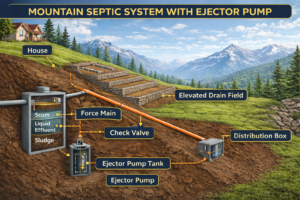
An ejector pump system includes a basin that collects wastewater from your home. When the basin fills to a predetermined level, the pump activates and pushes the sewage uphill through a force main to your septic tank or treatment system. This allows septic installation on properties where gravity alone won’t work.
Key components of uphill septic systems:
- Collection basin or pump chamber
- High-pressure ejector pump (typically 1-2 HP)
- Force main pipe (usually 2-4 inches in diameter)
- Control panel with float switches
- Alarm system for pump failures
The pumps are designed to handle solids and can push wastewater hundreds of feet uphill and over significant elevation changes.
Why Do Mountain Properties Need Uphill Septic Systems?
Mountain terrain creates unique challenges for conventional septic design. Steep slopes, rocky soil, and limited flat areas often make gravity-fed systems impossible or impractical.
I’ve seen mountain properties where the only suitable drain field location sits 50 feet uphill from the house. Without an ejector pump, these homeowners would face either expensive site modification or no septic system at all.
Common mountain septic challenges:
- House positioned below the only suitable drain field location
- Steep terrain preventing gravity flow
- Rocky outcroppings blocking direct pipe runs
- Environmental setbacks from wells or streams
- Limited space for conventional system layout
Mountain properties also deal with seasonal water table fluctuations and potential freeze-thaw cycles that can affect system performance. The elevation changes mean careful hydraulic design is essential for proper system function.
How Do Ejector Pumps Work for Mountain Installations?
Ejector pumps use centrifugal force and positive displacement to move wastewater against gravity. The pump sits in a sealed basin that collects sewage from your home’s plumbing.
Here’s the step-by-step process:
- Wastewater flows from your house into the collection basin
- Float switches monitor the liquid level in the basin
- When the “pump on” level is reached, the ejector pump activates
- The pump pressurizes the force main and pushes sewage uphill
- Once the “pump off” level is reached, the pump shuts down
- The cycle repeats as needed
Pro Tip: Most ejector pumps can handle vertical lifts of 50-100 feet and horizontal runs of several hundred feet, making them suitable for most mountain terrain challenges.
The force main typically runs at 2-4 feet per second velocity to prevent solids from settling in the pipe. This requires careful sizing based on pump capacity and the distance/elevation to overcome.
What Are the Installation Requirements for Uphill Septic Systems?
Installing uphill septic systems requires specific technical specifications and code compliance that differ from gravity systems.
Ejector pump specifications:
- Minimum 2-inch discharge connection
- Duplex pump systems for critical applications
- 20-gallon minimum basin capacity for residential use
- High water alarm system
- Accessible maintenance location
Electrical requirements:
- Dedicated 20-amp circuit for pump operation
- GFCI protection required
- Emergency power considerations for remote locations
- Control panel with manual override capability
The force main installation demands careful attention to pipe slope, cleanouts, and air release valves. We typically install the force main with a minimum 2% slope back toward the pump basin to allow drainage during maintenance.
Permit and inspection requirements:
- Site evaluation by certified soil scientist
- Engineering drawings for pump system design
- Electrical permits for pump installation
- Final inspection before system activation
How Much Does Mountain Septic Installation Cost?
Uphill septic systems cost significantly more than gravity-fed installations due to the additional equipment and complexity involved. Total system installation typically costs $30,000 to $65,000 depending on soil conditions, location, permit/zoning requirements, and system type.
Typical cost breakdown for mountain septic with ejector pump:
- Conventional gravity system: $30,000-$40,000
- Pressure distribution/ejector pump system: $35,000-$50,000
- Advanced treatment system with pump: $40,000-$55,000
- Mound or engineered system: $45,000-$65,000
Component cost breakdown:
- Tank (including delivery/placement): $5,000-$12,000
- Excavation and site work: $8,000-$20,000
- Drain field/leach field: $10,000-$25,000
- Permits, engineering, inspections: $2,000-$5,000
- Electrical installation: $2,000-$4,000
- Pump replacement (every 8-12 years): $1,200-$2,500
The force main installation adds $25-$50 per linear foot depending on terrain difficulty and depth requirements. Rocky mountain soil often requires specialized excavation equipment that increases labor costs.
Pro Tip: Budget an additional 20-30% for mountain installations due to access challenges and potential rock encountered during excavation.
What Are the Maintenance Requirements for Uphill Systems?
Uphill septic systems require more frequent maintenance than gravity-fed systems due to the mechanical components involved.
Regular maintenance schedule:
- Monthly: Test alarm system operation
- Quarterly: Inspect pump basin for unusual odors or noises
- Annually: Professional pump inspection and cleaning
- Every 3-5 years: Septic tank pumping (same as gravity systems)
- Every 8-12 years: Ejector pump replacement
Warning signs of pump problems:
- Sewage backup into house
- Unusual gurgling sounds from drains
- High water alarm activation
- Pump running continuously
- Sewage odors around pump basin
Mountain installations face additional challenges from power outages common in remote areas. Many homeowners install backup generators or battery backup systems to maintain sewage pumping during outages.
The force main requires annual inspection for leaks, especially in areas with freeze-thaw cycles. A single leak can cause environmental contamination and expensive remediation.
How Do Weather and Terrain Affect Mountain Septic Performance?
Mountain environments create unique operational challenges that don’t exist with lowland installations.
Winter considerations:
- Pump basins require insulation in freeze-prone areas
- Force main depth below frost line (typically 4-6 feet)
- Heat tape installation for exposed piping
- Snow load considerations for above-ground components
Seasonal water table fluctuations can affect system performance, especially during spring snowmelt. High groundwater can cause pump basin infiltration and increased pump runtime.
Rocky terrain impacts:
- Limited soil for drain field installation
- Potential for pump basin flotation in saturated conditions
- Difficult access for maintenance vehicles
- Higher risk of pipe damage from settling
I’ve seen mountain systems that work perfectly all summer fail during winter due to inadequate freeze protection. Proper design must account for the specific climate conditions of your mountain location.
Pro Tip: Install redundant pump systems for critical mountain locations where service access is difficult during winter months.
Can You Install Multiple Pump Stations for Long Uphill Runs?
For extreme elevation changes or very long horizontal runs, multiple pump stations provide the most reliable solution.
A typical single ejector pump can handle about 100 feet of vertical lift efficiently. Beyond that distance, a second pump station often provides better performance and reliability than trying to oversize a single pump.
Multiple station benefits:
- Reduced strain on individual pumps
- Better system reliability
- Easier maintenance access
- Lower individual pump replacement costs
- Improved flow characteristics
Design considerations:
- Each station requires its own collection basin
- Electrical service to multiple locations
- Coordinated control systems
- Multiple alarm points
- Increased maintenance requirements
The engineering design becomes more complex with multiple stations, but the operational benefits often justify the additional cost for challenging mountain terrain.
What Alternatives Exist to Traditional Mountain Septic Systems?
When uphill pumping isn’t practical or cost-effective, several alternative wastewater solutions work well for mountain properties.
Advanced treatment systems:
- Aerobic treatment units with surface discharge
- Constructed wetland systems
- Evapotranspiration beds for arid climates
- Lagoon systems for larger properties
Composting toilet systems eliminate the need for liquid waste pumping entirely, though they require different lifestyle adjustments and local code compliance.
Holding tank systems provide temporary solutions while planning permanent installations, though they require regular pumping service that can be challenging in remote mountain areas.
|
System Type |
Upfront Cost |
Maintenance |
Best For |
|---|---|---|---|
|
Conventional Gravity |
$30,000-$40,000 |
Low |
Standard properties with proper slope |
|
Pressure Distribution/Ejector Pump |
$35,000-$50,000 |
Moderate |
Standard mountain homes |
|
Mound/Engineered System |
$45,000-$65,000 |
Moderate |
Extreme elevation changes |
|
Advanced Treatment (ATU) |
$40,000-$55,000 |
High |
Environmentally sensitive areas |
|
Holding Tank |
$5,000-$10,000 |
Very High |
Temporary solutions |
How Do You Choose the Right Mountain Septic Contractor?
Mountain septic installation requires specialized experience that many standard contractors lack. The combination of difficult terrain, pump systems, and environmental challenges demands expertise beyond basic septic knowledge.
Essential contractor qualifications:
- Pump system installation experience
- Mountain terrain excavation capability
- Electrical contractor partnerships
- Environmental permit experience
- Emergency service availability
Questions to ask potential contractors:
- How many mountain pump systems have you installed?
- Do you handle electrical work or subcontract it?
- What’s your warranty on pump system installation?
- Can you provide references from recent mountain projects?
- Do you offer emergency repair service?
I’ve seen too many mountain septic projects go wrong because homeowners chose the lowest bidder without verifying mountain-specific experience. The complexity of these systems requires contractors who understand both the technical and logistical challenges.
Red flags to avoid:
- No pump system installation experience
- Unwillingness to provide local references
- Significantly low bids compared to others
- No discussion of electrical requirements
- Lack of environmental permit familiarity
What Should You Expect During Mountain Septic Installation?
Mountain septic installation typically takes 5-10 days depending on terrain complexity and weather conditions. The process involves more steps than standard gravity system installation.
Installation timeline:
- Day 1-2: Site excavation and rock removal
- Day 3-4: Pump basin and tank installation
- Day 5-6: Force main and electrical installation
- Day 7-8: Drain field construction
- Day 9-10: System testing and final inspection
Site preparation challenges:
- Equipment access to steep terrain
- Rock removal and disposal
- Temporary road construction
- Environmental protection measures
- Weather-dependent scheduling
Pro Tip: Plan mountain septic installation during dry weather months when access is easier and excavation conditions are optimal.
The electrical installation often requires trenching additional utilities to the pump location. This coordination between excavation and electrical work requires experienced project management.
Expect soil testing and engineering to take 2-4 weeks before installation begins. Mountain properties often require custom design solutions that take time to develop properly.
Frequently Asked Questions
How long do ejector pumps last in mountain installations?
Ejector pumps typically last 8-12 years in mountain installations with proper maintenance. Harsh weather conditions and power fluctuations common in mountain areas may reduce lifespan compared to standard residential installations.
Can ejector pumps handle solid waste effectively?
Yes, modern ejector pumps include grinder mechanisms that break down solids before pumping. However, they’re not designed for non-biodegradable items like feminine hygiene products or excessive grease.
What happens if the ejector pump fails?
When an ejector pump fails, sewage will back up into your home once the collection basin overflows. Most systems include high water alarms to warn of pump failure before backup occurs.
Do mountain septic systems require special permits?
Mountain septic systems often require additional environmental permits, especially near water sources or in sensitive ecological areas. Your contractor should handle all permit requirements as part of the installation process.
Can you gravity feed from house to pump then pump uphill?
Yes, most mountain installations use gravity flow from the house to the ejector pump basin, then pump the collected sewage uphill to the septic tank and drain field.
How much electricity do ejector pumps use?
Ejector pumps typically use 1-2 HP motors that draw 8-15 amps during operation. Most residential systems run 2-4 hours daily, adding $30-$50 monthly to electrical costs.
What’s the maximum distance you can pump sewage uphill?
With proper sizing, ejector pumps can push sewage 500+ feet horizontally and 100+ feet vertically. Longer distances may require multiple pump stations for optimal performance.
How to Get Started with Your Mountain Septic Installation
Mountain septic installation requires careful planning and experienced contractors who understand the unique challenges of uphill pumping systems. The investment in proper design and installation pays off through years of reliable operation in challenging terrain.
Start by contacting contractors with specific mountain septic experience for site evaluation and system design. Don’t let your construction project get delayed by septic issues that could have been addressed earlier in the planning process.
Ready to solve your mountain septic challenges? Contact Dotts Construction today for expert evaluation of your property and a detailed installation plan that gets your site ready for construction. Our team understands mountain terrain and delivers reliable septic solutions that work year-round.