
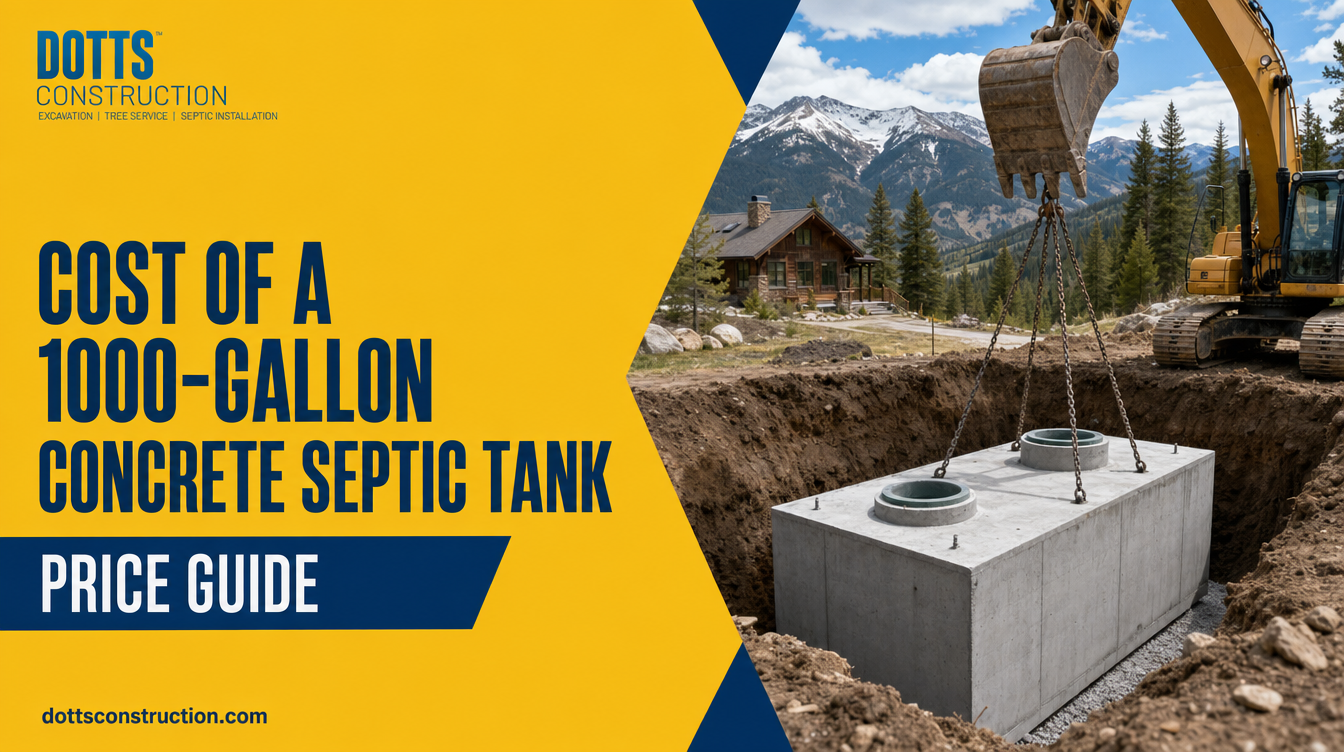
Pricing a 1,000-Gallon Concrete Septic Tank?
Before the numbers: every job is different. The ranges below are realistic starting points, but your real cost depends on access, terrain, volume, and the specific conditions of your Colorado property. For an accurate figure, request a free on-site estimate or call (719) 280-4141.
A 1000 gallon concrete septic tank costs an average of $1,412.50 at retail. With professional installation, total project costs typically range from $3,000 to $9,000 depending on your soil conditions, local permitting requirements, and site accessibility. Here is everything you need to budget accurately before your project starts.
What Is a 1000 Gallon Concrete Septic Tank and Who Needs One?
A 1000 gallon concrete septic tank is an underground wastewater treatment vessel made from precast concrete that holds and separates solids from liquids before releasing effluent into a drain field. It is the most common tank size installed across the United States for single-family homes.
The 1000 gallon size is typically code-minimum for homes with up to 3 bedrooms and a daily wastewater flow of 450 gallons or less, according to guidance from the National Environmental Services Center (NESC).
Here is who this tank size is the right fit for:
- New home construction on a lot without access to municipal sewer
- Replacement of a failed or aging tank on an existing residential property
- Smaller households (1 to 3 bedrooms, up to 5 occupants)
- Cabins or rural properties with seasonal or full-time occupancy
If your home has 4 or more bedrooms, your local health department will likely require a 1250 or 1500 gallon tank. Always check with your county before purchasing.
Concrete is the industry-standard material for residential septic tanks because it is durable, heavy enough to resist buoyancy in wet soils, and accepted by virtually every local health code in the country.
How Much Does a 1000 Gallon Concrete Septic Tank Cost? (Full Price Breakdown)
The retail cost of a 1000 gallon concrete septic tank averages $1,412.50, but that number covers the tank alone. Your real out-of-pocket cost depends on four additional factors: delivery, installation labor, drain field construction, and permitting.
Here is a complete cost breakdown so there are no surprises on your invoice:
Tank-Only Cost
| Item | Low | Average | High |
|---|---|---|---|
| 1000 gallon concrete septic tank (retail) | $900 | $1,412.50 | $2,000 |
| Delivery and crane placement | $150 | $300 | $600 |
| Tank subtotal | $1,050 | $1,712.50 | $2,600 |
Full System Installation Cost
| Item | Low | Average | High |
|---|---|---|---|
| Tank (with delivery) | $1,050 | $1,712 | $2,600 |
| Excavation and backfill | $500 | $1,200 | $2,500 |
| Drain field / leach field | $1,500 | $3,500 | $7,000 |
| Permits and inspections | $200 | $600 | $1,500 |
| Riser and lid installation | $100 | $300 | $500 |
| Total installed cost | $3,350 | $7,312 | $14,100 |
The tank itself is rarely the most expensive line item. Excavation and drain field construction account for the majority of your total investment, especially on lots with clay-heavy soil, high water tables, or difficult site access.
Pro Tip: Always get an itemized quote. Any contractor who cannot break these costs apart is hiding something in the margin.
What Factors Drive the Cost of Septic Installation Up or Down?
The retail price of a concrete septic tank is relatively stable. What swings your total project cost is everything that happens around that tank once it hits your property.
Soil Conditions and Percolation Test Results
A percolation test (perc test) measures how fast your soil absorbs water. It is required by most counties before a septic permit is issued. Soil that drains too fast or too slow will either require a modified drain field design or disqualify the site from a conventional system entirely.
According to the U.S. Environmental Protection Agency's Onsite Wastewater Treatment Systems Manual, fast-draining sandy soils may require deeper fields or filter fabric, while slow-draining clay soils often require a mound system or alternative drain field technology. Both add cost.
Expect to pay $150 to $500 for a perc test, and budget an additional $2,000 to $5,000 if your soil requires a non-standard drain field design.
Site Accessibility and Excavation Difficulty
Rocky ground, steep slopes, existing trees, and utility conflicts all increase excavation time and equipment requirements. A straightforward dig on open, flat ground can take half a day. A rocky hillside can take three times as long at three times the cost.
This is where choosing an experienced septic system installer near me pays for itself immediately. A crew with the right equipment and site knowledge moves faster and avoids costly mistakes.
Local Permits and Health Department Requirements
Permit fees vary widely by county. Some jurisdictions charge a flat fee under $200. Others require engineered drawings, licensed designer sign-off, and multiple inspections, pushing permitting costs above $1,500 on complex sites.
Pull the permit. Always. Unpermitted septic systems create title problems when you sell the property and personal liability if the system fails and affects neighboring groundwater.
Riser and Lid Upgrades
A standard concrete tank is buried with only a small access point. Most installers now recommend adding concrete or plastic risers that bring the access lid to grade level, making future pumping easy and cheap. Risers cost $100 to $300 and pay for themselves the first time you avoid a $500 locate-and-dig charge from your pumping company.
How Does a 1000 Gallon Concrete Tank Compare to Other Sizes and Materials?
Not every property needs a 1000 gallon tank, and not every tank needs to be concrete. Here is how the most common options stack up:
Septic Tank Size Comparison
| Tank Size | Ideal Home Size | Retail Cost (Tank Only) | Notes |
|---|---|---|---|
| 750 gallon concrete | 1 bedroom / cabin | $900–$1,200 | Not accepted by all counties |
| 1000 gallon concrete | 2–3 bedrooms | $1,000–$2,000 | Most common residential size |
| 1250 gallon concrete | 3–4 bedrooms | $1,400–$2,400 | Recommended for growing families |
| 1500 gallon concrete | 4–5 bedrooms | $1,800–$3,000 | Required for higher-use homes |
| 2000 gallon concrete | Commercial / large homes | $2,500–$5,000+ | Requires engineered design |
Concrete vs. Plastic vs. Fiberglass Septic Tanks
| Material | Average Cost | Lifespan | Pros | Cons |
|---|---|---|---|---|
| Concrete | $1,000–$2,000 | 40+ years | Durable, code-accepted everywhere, heavy | Can crack with settlement, heavy to transport |
| Plastic (HDPE) | $800–$2,000 | 30–40 years | Lightweight, no cracking | Can float in high water table soils |
| Fiberglass | $1,200–$2,000 | 30–40 years | Lightweight, corrosion-resistant | More expensive, limited local availability |
Concrete is the right choice for most residential installations because it is heavy enough to stay put in wet soils, accepted by every county health code we have worked in, and built to outlast the house it serves.
What Does the Septic Installation Process Actually Look Like?
Knowing what happens step by step helps you evaluate contractor bids with confidence and set realistic timeline expectations.
Here is how a professional septic installation unfolds from permit to finish:
- Site evaluation and perc test (1 to 3 days, depending on county scheduling)
- System design by a licensed septic designer or engineer (3 to 10 days)
- Permit application and approval (1 to 6 weeks depending on county backlog)
- Site preparation and excavation (1 to 2 days for a standard installation)
- Tank delivery and placement using a crane or excavator (half-day)
- Inlet and outlet pipe installation, connecting the home's plumbing to the tank (half-day to 1 day)
- Drain field excavation and installation (1 to 3 days)
- Inspection by county health official (scheduled 1 to 5 days out)
- Backfill and site restoration (1 day)
Total timeline from permit application to finished installation: 3 to 8 weeks on a straightforward residential site. Complex sites or backlogged counties can stretch to 12 weeks or more.
Pro Tip: Start your permit application before you hire a contractor. The approval wait time runs whether you have a crew lined up or not. Getting the permit moving early can cut your total project timeline by 2 to 4 weeks.
Why the Cheapest Septic Quote Is Usually the Costliest Decision
Here is a hard truth about the septic installation industry: low bids often exclude line items that are not optional.
We see it constantly. A homeowner gets three quotes. The low bid is $2,000 less than the others. They go with the cheap crew. Two weeks in, they get hit with "extras" for rocky soil, a longer pipe run, or permit drawings that "weren't included." They end up paying more than the highest original bid and still deal with delays and rework.
The contractors who communicate clearly upfront, provide itemized quotes, and actually show up when they say they will are worth every dollar of their rate. A botched septic install does not just cost money to fix. It can contaminate your well water, fail a home sale inspection, or result in a county shutdown of the project.
At Dotts Construction, we use what we call the Dotts 3M Method: a structured approach that covers your site from the first evaluation through final inspection, with clear communication at every milestone. No surprise invoices. No disappearing crews. You know what is happening and when, from the day we quote to the day we sign off.
How to Find a Reliable Septic System Installer Near You
Searching for a septic system installer near me will return dozens of options. Here is how to separate the professionals from the problem contractors:
Check for proper licensing. Most states require septic installers to hold a specific contractor license. Ask for the license number and verify it with your state licensing board before signing anything.
Confirm they pull permits. Any installer who suggests skipping the permit is saving themselves paperwork at your expense. A permitted installation protects your property value and keeps you out of legal trouble.
Ask for itemized quotes. A professional quote breaks out the tank, delivery, excavation, drain field, and permitting as separate line items. A lump-sum quote with no detail is a red flag.
Read reviews for communication and reliability. The number one complaint against septic and excavation contractors is not quality of work. It is not showing up on time and not returning calls. Look for reviews that specifically mention the contractor answered questions, showed up when promised, and left the site clean.
Verify their equipment. A septic installation on rocky or sloped ground requires specific excavation equipment. Ask what machines they plan to use and whether they own them. Crews who rent equipment for every job often schedule around availability, not your timeline.
FAQ: 1000 Gallon Concrete Septic Tank Cost and Installation
How much does a 1000 gallon concrete septic tank cost without installation?
The average retail cost of a 1000 gallon concrete septic tank is $1,412.50. Depending on your region and supplier, prices range from $900 on the low end to $2,000 on the high end. Delivery and crane placement add $150 to $600 on top of the tank price.
How long does a concrete septic tank last?
A properly installed concrete septic tank lasts 40 years or more. Concrete is the most durable residential septic tank material available. The drain field and distribution system typically need attention before the tank itself, with drain fields lasting 20 to 30 years under normal use.
Can a 1000 gallon tank serve a 4 bedroom home?
In most counties, a 1000 gallon tank is the minimum size for homes with up to 3 bedrooms. A 4 bedroom home typically requires a 1250 or 1500 gallon tank to meet local health code. Always verify the required size with your county health department before purchasing.
What is included in a full septic system installation quote?
A complete septic system installation quote should include the tank price, delivery, excavation, drain field construction, riser and lid installation, permitting fees, and final inspection scheduling. If a quote does not break these out separately, ask for an itemized version before signing.
How often does a 1000 gallon concrete septic tank need to be pumped?
According to the U.S. EPA's Septic Systems Overview, a 1000 gallon tank serving an average household of 4 people should be pumped every 2.6 years. Smaller households can extend this to 3 to 5 years. Consistent pumping on schedule is the single best way to extend the life of your drain field.
What is the difference between a septic tank and a drain field?
A septic tank holds and separates wastewater solids from liquid. The drain field (also called a leach field) distributes the clarified liquid into the surrounding soil for natural filtration. Both components are required for a complete septic system, and both have separate costs in any installation quote.
Does concrete or plastic make a better septic tank?
Concrete is the superior choice for most residential installations. It is heavier, making it resistant to floating in high water table conditions, and it is accepted by every county health code. Plastic tanks are lighter and easier to transport but can shift or float in saturated soils if not properly anchored.
What Should You Do Before You Call a Septic Installer?
You are now more informed than 90% of homeowners who call for a septic quote. Here is how to use that knowledge to get the project right the first time.
Step 1: Check your county's minimum tank size requirements. Call the health department or look up their residential septic guidelines online. Do this before any contractor visit so you know what you are actually required to install.
Step 2: Request a site evaluation. Any legitimate installer will walk your lot before quoting. Soil type, slope, tree locations, and proximity to your well all affect the design and the cost.
Step 3: Get three itemized quotes. Compare them line by line, not just the bottom number. A lower total with fewer line items means hidden costs are coming.
Step 4: Verify licenses and permits before signing. Confirm your installer is licensed in your state and will pull the required permits as part of the job scope.
If you are in our service area, call Dotts Construction for a straight-shooting site evaluation and itemized quote. We handle everything from initial site prep and excavation through full septic system design and installation to local code. No runaround. No surprises.
Request a free consultation or call (719) 280-4141
Related Guides
Need the pros? See Septic System Installation. More reading:
About the Author
Michael Dotts brings over 15 years of hands-on experience in heavy construction and grading, with a specialty in the unique demands of building in the Rocky Mountains, where steep terrain, rocky ground, and harsh weather change the rules most flatland contractors are used to. Because Michael knows what it really takes to get the job done right in Colorado’s high country, you can count on honest, accurate quotes that won’t creep up halfway through the job.