
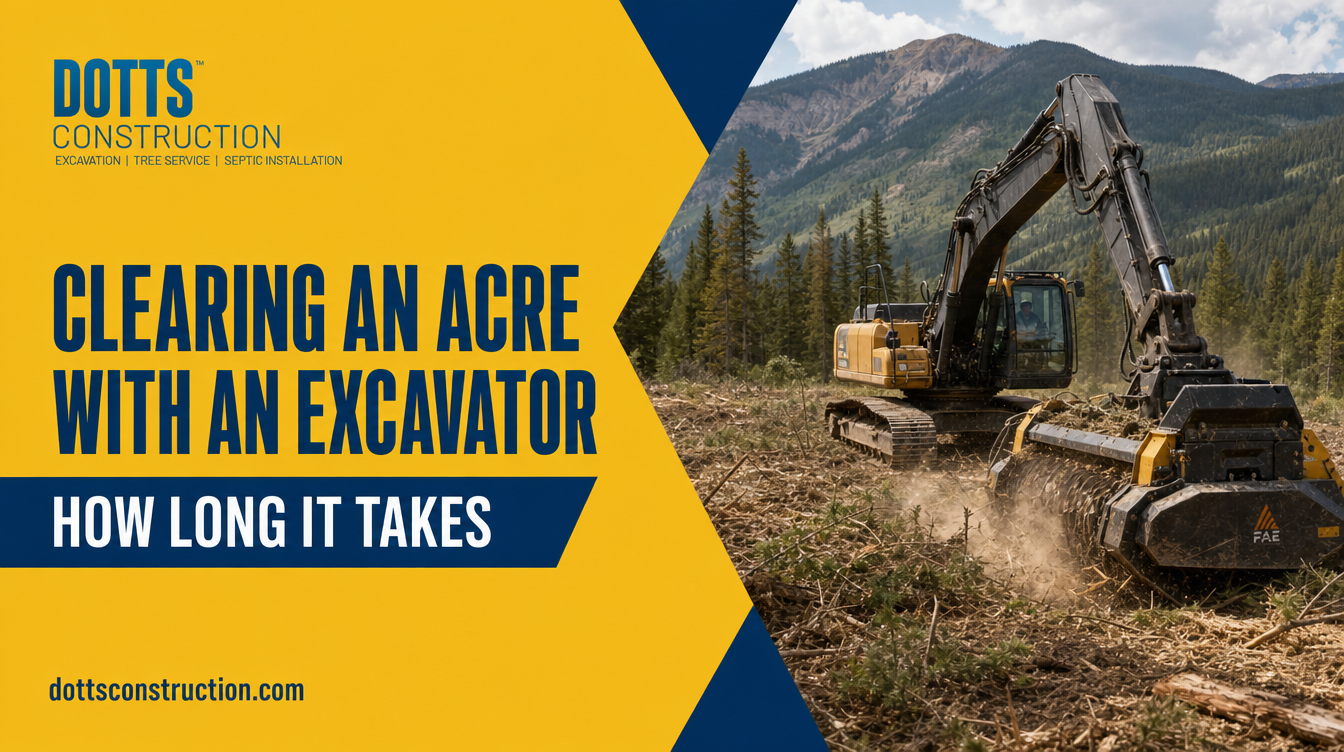
Clearing an Acre With an Excavator?
Clearing one acre of land with an excavator typically takes 8 to 60 hours depending on vegetation density, tree size, stump count, and soil conditions. Light brush and small trees fall on the lower end. Dense forest with large hardwoods and rocky ground can push a single crew well past the 60-hour mark. Here is what actually drives that number.
What Does "Land Clearing" Actually Mean for an Excavator?
Land clearing is the process of removing trees, brush, stumps, roots, and surface debris from a property so the ground becomes usable for construction, grading, or development. With an excavator specifically, the machine handles tree pushing, stump extraction, root ball removal, and debris piling or loading.
This is different from brush hogging (mowing surface vegetation) or bulldozing (which pushes material rather than selectively removing it). An excavator gives an operator precision. They can target individual stumps, work around utilities, and handle irregular terrain that a dozer would chew through blindly.
At Dotts Construction, land clearing is the first step in our Dotts 3M Method: Measure the site, Mobilize the right equipment, and Mechanically prepare the ground so your foundation, driveway, or septic system install goes in clean and on schedule.
How Long Does It Take to Clear an Acre of Land With an Excavator?
The straight answer: plan for 8 to 60 hours per acre. The range is wide because land conditions vary more than most homeowners expect. Below is the breakdown by vegetation type that we use to estimate every project.
Light Brush and Grass (8 to 15 Hours Per Acre)
Light vegetation means knee-high scrub, small saplings under 3 inches in diameter, and sparse ground cover. An excavator with a thumb attachment or a land clearing head moves through this terrain fast. A skilled operator running a mid-size machine (10 to 20 tons) can finish close to an acre in a single long day.
Pro Tip: Even on light brush jobs, budget an extra 2 to 3 hours for debris piling and site cleanup. Moving material off-site or chipping it takes real time and is often overlooked in estimates.
Mixed Woodland With Medium Trees (20 to 35 Hours Per Acre)
Trees from 4 to 12 inches in diameter with established root systems shift this into a 2 to 4 day job per acre. The excavator must push each tree, extract the root ball, and move the debris before repositioning. Ground conditions matter here too. Wet clay soil grips root systems tighter than sandy loam, adding hours per stump.
Dense Forest or Large Hardwoods (40 to 60+ Hours Per Acre)
Old-growth timber, hardwoods over 18 inches in diameter, or heavily rooted woodland with thick understory can take a full week per acre. Each large tree is a multi-step process: fell or push, extract root system, break down the debris, and clear the path for the machine to advance.
Large hardwood stumps alone can take 45 to 90 minutes each to fully extract. Multiply that across 15 to 20 trees per acre and you quickly see where the hours go.
Rocky or Root-Bound Terrain (Add 25 to 40% to Any Estimate)
Rock ledge, boulders, or heavily compacted root mats are the biggest wildcard in any land clearing job. They slow extraction, risk machine damage, and sometimes require a rock hammer attachment or blasting coordination. If your property has visible rock outcroppings or hardpan soil, factor in a significant time buffer before any estimate is finalized.
How Does Excavator Size Affect Land Clearing Time?
Not all excavators are built for the same job. Machine class is one of the biggest levers on clearing speed.
| Excavator Class | Operating Weight | Best Use Case | Approximate Clearing Speed |
|---|---|---|---|
| Mini Excavator | 3 to 8 tons | Residential lots, tight access, light brush | 0.25 to 0.5 acres/day |
| Mid-Size Excavator | 10 to 20 tons | Mixed woodland, residential acreage, moderate trees | 0.5 to 1 acre/day |
| Large Excavator | 25 to 45 tons | Dense forest, commercial clearing, large hardwoods | 1 to 2+ acres/day |
| Excavator With Mulching Head | 15 to 40 tons | Fast vegetation reduction, no debris hauling needed | 1 to 3 acres/day |
A 5-ton mini excavator clearing light forest can process roughly 1 acre in 40 to 60 hours. According to data published by the Association of Equipment Manufacturers (AEM), mini excavators are the fastest-growing equipment segment in residential site prep, but they are often misapplied to jobs that require larger machines, adding unnecessary hours and cost to projects.
Matching machine to job is not just about speed. An undersized machine on a heavy clearing job creates safety risks and can destroy the productive topsoil layer you need for future landscaping or construction.
Pro Tip: Always ask your contractor what size machine they are sending before they mobilize. If they plan to use a mini excavator on a job with 12-inch-plus trees, ask why. The answer will tell you a lot about their experience.
What Factors Slow Down Land Clearing the Most?
Here are the variables that blow up timelines on land clearing projects near you:
- Tree diameter and species. Hardwoods (oak, hickory, maple) have dense root systems that take far longer to extract than softwoods.
- Stump depth and root spread. Older stumps have lateral roots that can extend 15 to 20 feet in all directions.
- Slope and terrain. Steep grades slow machine movement and limit attachment reach.
- Soil type. Clay retains root systems; sandy soil releases them more easily.
- Debris management plan. Hauling debris off-site takes longer than on-site burning or chipping. Local burn permits and hauling logistics add real scheduling complexity.
- Utility locations. Underground lines and overhead wires require hand clearing in buffer zones, which is slow by necessity.
- Permit requirements. Some counties require tree removal permits for heritage trees or trees above a set diameter. That process adds pre-work time before the excavator ever arrives.
Should You Clear Brush and Surface Debris First?
Yes, and this is something a lot of homeowners get wrong when they try to manage part of the clearing themselves before the crew arrives.
Clear light vegetation and surface debris before dealing with stumps or grading. Here is why this sequence matters:
- Visibility. Brush hides stumps, roots, buried debris, and grade changes. Clearing surface vegetation first gives the excavator operator a clean view of what they are working with.
- Machine efficiency. An excavator working through layers of tangled brush while trying to extract stumps works twice as hard for half the output.
- Safety. Buried objects (wire fencing, old foundation material, junk) are a serious machine and operator hazard. Surface clearing reveals them before the excavator is on top of them.
At Dotts Construction, every clearing job starts with a site walk to identify hazards, map utility locations, and establish the debris staging zone before any machine touches the ground. This is part of how we keep projects on schedule and on budget.
How Do You Prepare for a Land Clearing Project?
Preparation before the excavator arrives is the difference between a smooth job and a mess that sets your construction timeline back by weeks.
Here is the sequence we follow on every Dotts Construction land clearing project:
- Mark your property boundaries. Know exactly where your lot lines are. Clearing over a property line creates legal liability fast.
- Locate all underground utilities. Call 811 (the national Call Before You Dig line) at least 72 hours before any ground disturbance. This is required by law in most states.
- Obtain necessary permits. Check with your county planning office. Tree removal permits, grading permits, and erosion control plans are often required before work begins.
- Decide on debris disposition. Will debris be burned on-site (if permitted), chipped and used as mulch, hauled to a landfill, or left in piles for later? This decision affects timeline and cost directly.
- Establish site access. The machine has to get in and out. Identify the access point and make sure the ground can support equipment weight, especially after rain.
- Plan for erosion control. Cleared land is exposed land. Silt fences, erosion blankets, and proper drainage planning protect your investment and keep you in compliance with local stormwater rules.
What Does Land Clearing Cost Per Acre?
Land clearing costs range from $1,500 to $6,000 per acre for light to moderate vegetation. Dense forest or rocky terrain with large hardwoods can push costs to $8,000 to $12,000 per acre or higher, according to homeowner cost data published by HomeAdvisor and Angi in 2026.
The factors that drive cost are the same ones that drive time: tree density, species, debris removal method, site access, and any permitting requirements. Here is a general breakdown:
- Light brush clearing: $1,500 to $3,000 per acre
- Mixed woodland clearing: $3,000 to $6,000 per acre
- Dense forest with stump removal: $6,000 to $12,000+ per acre
- Stump grinding (separately contracted): $100 to $400 per stump depending on diameter
Pro Tip: Get itemized quotes, not flat-per-acre pricing. A contractor who gives you a single number without knowing your debris disposal plan, soil type, or tree sizes is guessing. That guess will become a change order.
One thing we hear constantly from clients who found Dotts Construction after a bad experience elsewhere: the previous contractor gave them a vague estimate, showed up late, and hit them with extra charges mid-job. Our Dotts 3M Method specifically addresses this. We measure the site, mobilize the right equipment for the actual conditions, and mechanically prepare the ground with zero surprises. The whole construction project should not be on hold because your site crew is unreliable.
What Happens After Land Clearing Is Complete?
Clearing is not the finish line. It is the starting line for what comes next.
After the vegetation is removed and debris is managed, the ground still needs to be prepared for whatever you are building. Here is what typically follows:
- Grading and leveling. Raw cleared land is uneven. Grading establishes the slope and elevation needed for proper drainage and foundation work.
- Topsoil management. Stripping and stockpiling topsoil before clearing and returning it after grading protects the productive soil layer.
- Foundation excavation. If a structure is being built, footings and foundation walls require precise excavation after the site is cleared and graded.
- Driveway or road preparation. Subbase material needs to be cut in, graded, and compacted before any surface is applied.
- Septic system design and installation. If the property is outside municipal sewer service, a properly permitted septic system must be designed to site-specific soil conditions, installed by a licensed contractor, and inspected before use.
Dotts Construction handles all of this. We do not just clear the land and hand it back to you as a muddy field. We transform rough ground into land that is ready for foundations, driveways, and full construction projects, including new and repaired septic systems designed and installed to code.
Frequently Asked Questions About Land Clearing With an Excavator
How long does it take to clear 1 acre of land with a mini excavator?
A 5-ton mini excavator can clear 1 acre of light forest or scrub vegetation in 40 to 60 hours with an experienced operator. Heavier trees, rocky soil, or dense root systems extend that timeline significantly. Mini excavators are best suited to residential lots with light to moderate vegetation density.
Can an excavator clear land with large trees?
Yes. A mid-size to large excavator (15 tons and up) can push, fell, and extract large trees. For hardwoods over 18 inches in diameter, the process is slow and deliberate. Each tree may take 45 to 90 minutes to fully extract and move. A mulching head attachment can speed up debris reduction on large clearing jobs.
How much does it cost to clear 1 acre of land?
Expect to pay between $1,500 and $6,000 per acre for light to moderate vegetation, and $6,000 to $12,000 or more per acre for dense forest with stump removal. Debris disposal method, permit costs, and site access conditions are the biggest variables beyond vegetation density.
Do I need a permit to clear land?
In most counties, yes. Grading permits, tree removal permits (especially for heritage or protected trees), and stormwater management plans are commonly required before land clearing begins. Check with your local planning or zoning office and call 811 to locate underground utilities before any excavation work starts.
Is it faster to use an excavator or a bulldozer for land clearing?
It depends on the goal. A bulldozer moves material faster across open ground but lacks the precision of an excavator. An excavator with a thumb or grapple attachment can selectively remove specific trees and stumps while leaving others, which is valuable on residential lots where you want to keep mature trees. For large commercial clearing with no precision requirement, a dozer or mulcher may be faster.
What is the best time of year to clear land?
Late summer through early fall is generally ideal in most U.S. climates. Vegetation is drier and easier to move, ground conditions are typically firmer than spring, and you avoid freeze-thaw cycles that complicate grading. Spring clearing is common but wet conditions can cause equipment to sink and compact soil unevenly.
What should I ask a land clearing contractor before hiring them?
Ask what size machine they plan to use for your specific site, how they handle debris disposal, whether they pull permits, and what their policy is on unexpected costs like buried debris or rock. Get an itemized estimate, not a single per-acre price. Ask for references from jobs with similar vegetation density and soil conditions to yours.
Ready to Clear Your Land? Here Is How to Get Started With Dotts Construction
Your construction project should not be sitting idle because you cannot find an excavation crew that actually shows up, communicates clearly, and delivers what they promised.
At Dotts Construction, we built the Dotts 3M Method specifically because homeowners and builders kept telling us the same story: they hired someone cheap, the crew showed up late (or not at all), gave them a vague estimate that ballooned mid-job, and left their site in a worse state than they found it.
We do not operate that way.
We measure the site before we mobilize anything. We match the right machine to the actual job conditions. We mechanically prepare your ground to be ready for the next phase, whether that is a foundation, a driveway, a road, or a new septic system. And we communicate every step of the way so you are never guessing what is happening on your property.
If you are searching for land clearing near me and you need a crew that delivers what they promise, call Dotts Construction today.
Request a free consultation or call (719) 280-4141
Request your no-surprise site estimate and we will walk your property, measure what needs to come out, and give you a clear, itemized quote before a single machine moves.
Related Guides
Need the pros? See Land Clearing Services. More reading:
About the Author
Michael Dotts brings over 15 years of hands-on experience in heavy construction and grading, with a specialty in the unique demands of building in the Rocky Mountains, where steep terrain, rocky ground, and harsh weather change the rules most flatland contractors are used to. Because Michael knows what it really takes to get the job done right in Colorado’s high country, you can count on honest, accurate quotes that won’t creep up halfway through the job.