
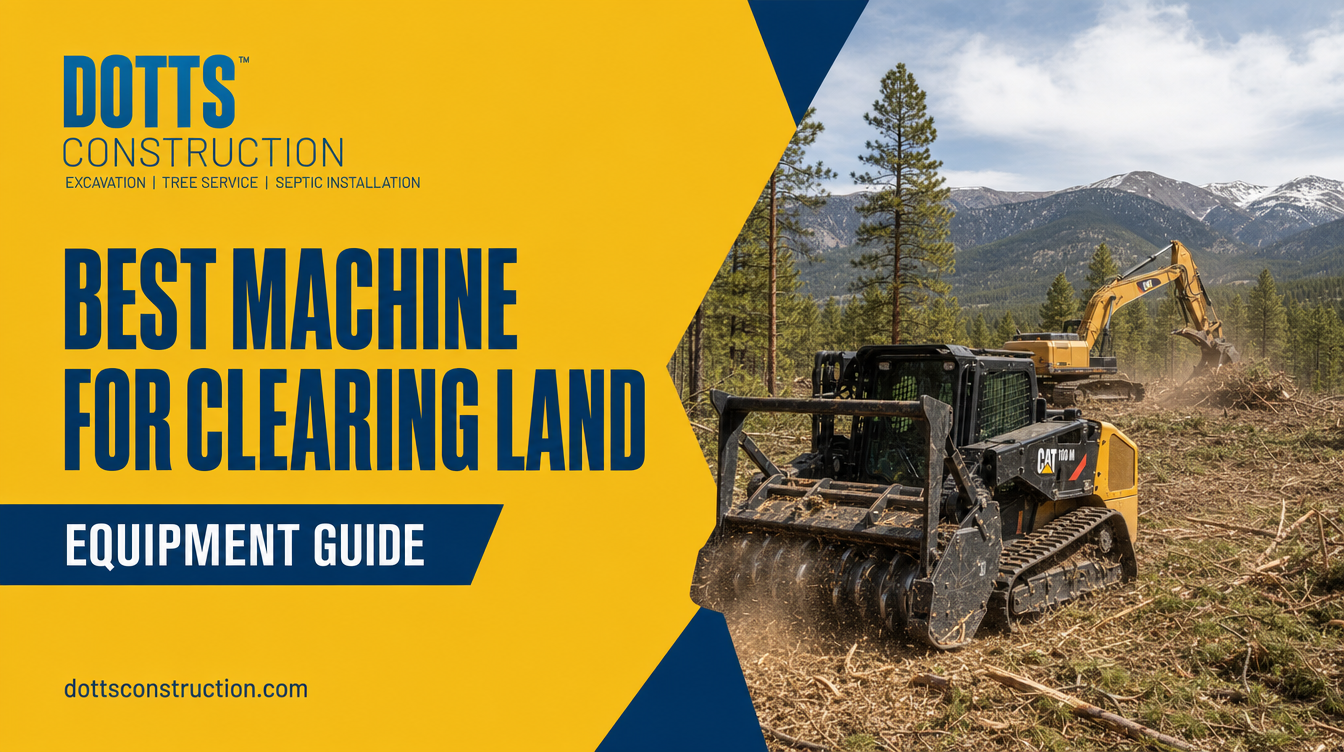
Which Machine Clears Land Best?
The most effective machine for clearing land depends on what's on your lot. For dense brush and small saplings, a skid steer with a forestry mulcher attachment wins. For large trees and root balls, an excavator is the right tool. For raw, heavily wooded acreage, a bulldozer delivers the brute force to get the job done fast. Most real homesites need a combination of all three.
That said, if you're preparing a specific homesite or building lot, the machine choice is only one piece of the puzzle. The condition of your land, the scope of your build, and the experience of your excavation crew all determine whether your site gets done right or becomes a problem that derails your entire construction timeline.
At Dotts Construction, we've prepared dozens of homesites using our proven Dotts 3M Method: the right Machine, in the right Manner, on the right Mission. Here's exactly how we think about lot clearing equipment, and what you need to know before a single tree hits the ground.
Why Does Choosing the Right Machine for Lot Clearing Matter So Much?
Using the wrong machine on your lot doesn't just slow the job down. It can compact soil in ways that affect your foundation, leave root systems underground that cause future drainage problems, and create a site that your builder can't start on.
The machine your crew selects directly affects your foundation's long-term stability.
We've walked onto lots where a previous crew used a bulldozer to push everything around on ground that needed precision grading. The result was uneven soil density, drainage that ran toward the footprint instead of away from it, and a homeowner who had to pay twice to get the site corrected.
The right equipment also determines how much debris you'll deal with after clearing. A forestry mulcher grinds material in place. A bulldozer pushes it into piles that need hauling. An excavator pulls root balls that need to be trucked off-site. Each approach changes your cost, your timeline, and your site's readiness for the next phase.
What Machine Works Best for Clearing Thick Brush and Small Trees?
For lots covered in thick brush, brambles, and saplings up to 4 inches in diameter, a skid steer or compact track loader with a forestry mulcher attachment is the most versatile and efficient option.
Here's why this combination dominates residential lot clearing:
- Skid steers are attachment-based machines. Swap the mulcher head for a root grapple, a bucket, or a brush cutter and you have a completely different tool on the same machine.
- Compact track loaders (like those made by Bobcat and Cat) distribute their weight across rubber tracks instead of wheels, which reduces ground compaction on soil you're about to build on.
- Forestry mulcher heads grind brush, small trees, and saplings directly into wood chips that spread across the lot as organic mulch, eliminating the need for burn piles or debris hauling.
- High-flow hydraulic systems on modern track loaders run heavy-duty mulcher heads without power loss, even in thick, tangled vegetation.
Pro Tip: If your lot has mostly brush and trees under 6 inches in trunk diameter, a mulching skid steer can clear an average residential homesite (typically half an acre to 2 acres) in a single day. That speed directly compresses your project timeline.
Best for: Clearing 1- to 4-inch saplings, heavy weeds, and underbrush in both open fields and tight access areas near property lines.
When Is an Excavator the Right Machine for Land Clearing?
An excavator is the right choice when your lot has large, mature trees with deep root systems that need to come out completely, not just get ground down.
Leaving root balls in the ground is one of the most common mistakes on homesite clearing jobs. Roots decay over time, creating voids beneath the soil. Those voids shift. And shifted soil under a foundation is expensive.
Here's what an excavator brings to a land clearing job that other machines can't match:
- Sheer pulling power. An excavator can grip a large tree at the base and pull the entire root ball out of the ground in one clean motion.
- Reach and precision. The boom arm can work at angles that a bulldozer can't, making it valuable on lots with varying terrain, slopes, or tight clearances near property lines.
- Attachment flexibility. Pair an excavator with a thumb attachment for log handling, a tree shear for clean cuts at the stump line, or a dedicated grubber for root extraction.
On homesites with trees over 18 inches in diameter, an excavator is not optional. It's the only machine that removes the root system cleanly enough to support foundation work.
Best for: Large-scale tree removal, boulder clearing, root ball extraction, and building lots with steep or uneven terrain.
When Should You Use a Bulldozer for Lot Clearing?
A bulldozer is the machine of last resort, and we mean that as a compliment. When you have a raw, completely wooded lot and you need it cleared fast, nothing else generates that level of force.
A bulldozer is most appropriate for:
- Fully wooded lots where speed matters more than precision in the initial clearing phase
- Large-scale raw land development where the dozer handles the first pass and other equipment does finish work
- Pushing felled trees and slash piles into windrows for burning or chipper processing
- Situations where you need to cover ground fast on acreage measured in acres, not square feet
Here's the honest truth about bulldozers on residential homesites: They're often overkill for a single-family lot, and experienced operators know this. An inexperienced crew that grabs a dozer for a lot that needed a track loader and excavator will leave you with compacted, disrupted soil that takes extra work to remediate before grading can begin.
At Dotts Construction, we pull out the bulldozer when the job genuinely demands it. Otherwise, we're using machines matched to the actual scope of your site.
Best for: Raw, undeveloped acreage where speed and volume of clearing matter most.
What Machine Clears an Overgrown Field or Maintained Lot?
Not every lot clearing job involves heavy timber. Some homesites have been sitting fallow for years and are covered in head-high weeds, grass, and scattered saplings. For these jobs, a compact tractor with the right attachment is the right choice.
- Brush hog (rotary cutter): Designed for high grass, weeds, and light brush. Covers ground quickly and cheaply.
- Flail mower: Produces finer mulch than a rotary cutter and handles thicker material. Better for lots where you want the organic material worked into the surface.
Pro Tip: If your lot had a prior house or structure on it, be cautious with tractor work around old fence lines, buried debris, and remnant foundations. A brush hog hitting a buried wire or concrete chunk causes expensive damage and delays.
Best for: Rural property maintenance, shooting lanes, light vegetation management, and lots where the primary growth is grass and weeds with occasional small saplings.
How Does Machine Choice Affect Homesite Readiness for Construction?
This is the question most homeowners forget to ask, and it's the most important one.
Clearing the land is step one. But the machine used for clearing directly affects every step that follows:
| Machine Used | Soil Impact | Debris Management | Effect on Next Phase |
|---|---|---|---|
| Forestry Mulcher (Skid Steer) | Low compaction | Material mulched in place | Minimal site prep needed before grading |
| Excavator (Tree Removal) | Low to moderate | Root balls and logs hauled off | Site clean, ready for grading immediately |
| Bulldozer (Heavy Push) | High compaction possible | Debris pushed into piles, hauled or burned | May need additional tillage before grading |
| Compact Tractor | Very low | Material left on surface | Typically fine for light grading |
| Walk-Behind Mower | None | Material dispersed | Appropriate only for very small lots |
The machine that clears your land fastest is not always the machine that leaves your site most ready for a foundation. This is the distinction that separates experienced excavation crews from those who show up, push dirt, and leave.
Our crew at Dotts Construction plans the clearing phase around your construction sequence. We're thinking about where your foundation sits, how your driveway will grade, and where your septic system will run before we select the first machine to start the job.
What Is the Dotts 3M Method for Lot Clearing?
The Dotts 3M Method is the framework we apply to every lot clearing and site preparation job:
- Machine: Select the right equipment for the specific vegetation density, tree size, terrain, and soil type on your lot. Not the machine that's easiest to mobilize. The right one for your conditions.
- Manner: Operate the selected machine in a way that protects the soil structure your construction project depends on. Clearing done recklessly leaves a mess that costs real money to fix.
- Mission: Keep the end goal of every clearing decision tied to the construction or site use outcome. Every tree removed, every stump pulled, every pass of the grader should move your project forward, not just clear the calendar.
This is the difference between a crew that shows up with whatever machine is available and a crew that shows up with a plan. Our clients don't lose weeks waiting for rework because we planned the clearing around their build.
How Much Does Lot Clearing Cost for a Homesite?
Lot clearing costs vary widely based on lot size, tree density, and what the site needs to be ready for. Here are realistic ranges based on typical residential homesite work:
- Light brush and field clearing (under 1 acre): $1,500 to $4,500
- Mixed brush and trees on a typical residential lot (0.5 to 2 acres): $3,500 to $12,000
- Heavy timber clearing with stumps and root removal: $5,000 to $20,000 or more for larger lots
- Complete site prep (clearing, grading, drainage, driveway rough-in): $15,000 to $50,000+ depending on site complexity
Note: These ranges reflect general market rates. Your specific lot may fall above or below these figures based on access, soil conditions, burn permit requirements, and hauling distances for debris. Always get a site-specific estimate before budgeting.
, the average cost per acre for combined clearing and rough grading was $X, with root removal adding an average of $X per large tree removed."]
Can I Rent Equipment and Clear My Own Lot?
Technically, yes. Practically, it depends on your experience level, your lot's complexity, and what you're building on it.
Walk-behind brush mowers like the DR Field and Brush Mower handle lots up to a few acres with light to moderate vegetation. If your lot is overgrown with weeds and saplings under 2 inches in diameter and you have time to spend, DIY clearing with a rentable brush mower is feasible.
But here's where DIY lot clearing goes wrong:
- Renters rarely have the operator experience to avoid over-compacting soil with heavy machinery
- Missing a root ball or failing to clear stump wood to the required depth creates foundation risks
- Improper clearing near utility lines, easements, or setbacks creates legal exposure
- Skipping the grading and drainage phase after clearing is the single biggest mistake DIY lot clearers make
For a homesite where you're building a permanent structure, the cost of a professional crew is almost always justified by the reduced risk to your foundation, your timeline, and your septic system design.
Frequently Asked Questions About Land Clearing Machines for Homesites
What is the single best machine for clearing a residential homesite?
A compact track loader with a forestry mulcher attachment is the single most versatile machine for the majority of residential homesites. It handles brush, small trees, and underbrush efficiently, minimizes soil compaction, and eliminates debris hauling by mulching material in place. Most lots under 2 acres with mixed vegetation can be cleared with this combination alone.
Do I need to remove tree stumps before building a house?
Yes. Any stump within your foundation footprint, driveway corridor, or septic field must be removed, including the root ball. Decomposing organic material underground creates voids that cause soil settlement, foundation cracking, and septic system failure. Grinding stumps to ground level is not enough for construction sites.
How long does it take to clear a lot for a house?
A typical residential homesite of half an acre to 2 acres takes one to three days with a professional crew and proper equipment. Heavily wooded lots with large trees can take longer. Site complexity, debris management, and access all affect the timeline. Most experienced excavation companies can give you a time estimate after a brief site visit.
What is a forestry mulcher and how does it work on a homesite?
A forestry mulcher is a rotating drum attachment studded with carbide teeth that grinds brush, saplings, and small trees into wood chips on contact. Mounted on a skid steer or compact track loader, it processes vegetation in a single pass without creating debris piles. The resulting mulch stays on-site, reduces erosion, and improves the soil's organic content ahead of grading.
Is a bulldozer good for clearing a homesite?
A bulldozer works well for the initial push on heavily wooded, large lots but creates significant soil compaction when used on smaller residential homesites. For a standard building lot, an excavator and a mulching track loader produce better results with less remediation work before grading begins.
What should I clear a lot down to before a builder starts?
Before construction begins, your lot should be cleared of all trees, stumps, and roots within the build zone; rough-graded to establish drainage flow away from the foundation footprint; and accessible via a rough driveway cut. Septic system areas should be identified and kept free of heavy equipment traffic to preserve perc test validity.
How do I know if my lot needs clearing before I can build?
Any lot with existing trees, brush, or structures in the building envelope needs clearing before construction. Your builder or excavation contractor can walk the lot and identify what needs to go based on your proposed site plan. Even lots that look "clear" often have stumps, buried debris, or root systems that affect grading and foundation work.
Ready to Clear Your Lot? Here's How to Get Your Homesite Prepared the Right Way
If you're planning a build and your lot isn't ready, the clock is already running. Every week your site sits unprepared is a week your construction timeline slides.
At Dotts Construction, we handle the full sequence from raw land to build-ready homesite: tree removal, lot clearing, foundation excavation, grading, driveway construction, and septic system design and installation. You get one crew, one timeline, and a site that's ready when your builder shows up.
We built the Dotts 3M Method specifically for homeowners and builders who can't afford surprises. Our clients describe working with us like this: "on time, on budget, no surprises." That's not an accident. That's a process.
Call Dotts Construction today or request your site assessment online. We'll walk your lot, identify what needs to happen, and give you a clear plan with a real number before any machine touches your ground.
Request a free consultation or call (719) 280-4141
Related Guides
Need the pros? See Land Clearing Services. More reading:
About the Author
Michael Dotts brings over 15 years of hands-on experience in heavy construction and grading, with a specialty in the unique demands of building in the Rocky Mountains, where steep terrain, rocky ground, and harsh weather change the rules most flatland contractors are used to. Because Michael knows what it really takes to get the job done right in Colorado’s high country, you can count on honest, accurate quotes that won’t creep up halfway through the job.