
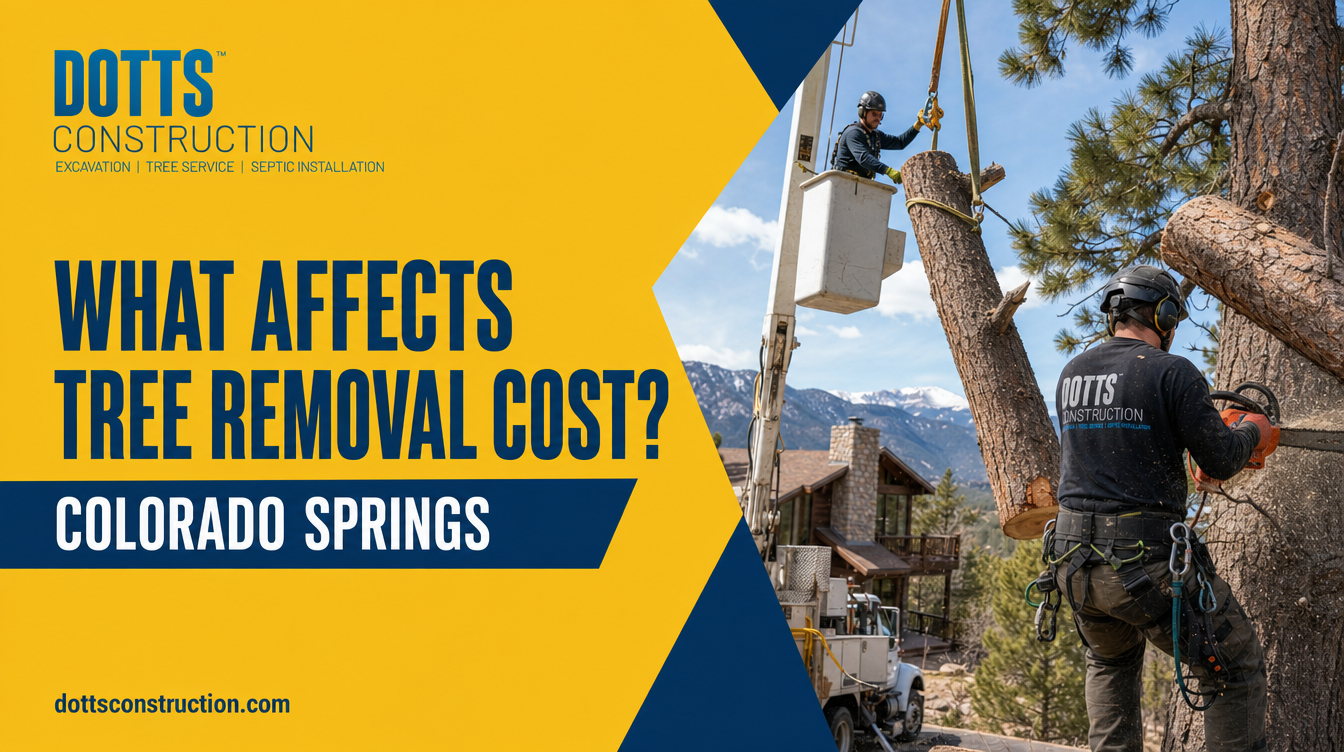
Wondering What Drives Tree Removal Costs?
What Dotts actually charges: the tree removal jobs we take on typically run $3,000 to $6,000, and can reach $10,000 for large or high-risk trees close to buildings and power lines. We focus on bigger removals and don’t quote jobs under $3,000. Every tree is different, so request a free on-site estimate or call (719) 280-4141.
Tree removal cost in Colorado Springs typically ranges from $3,000 to $6,000 per tree, depending on height, species, location, condition, and site access. Most homeowners and property owners pay somewhere in the $3,000 to $6,000 range for a standard removal. The factors below explain exactly why prices vary so widely and what drives your specific number up or down.
Why Does Tree Height Drive the Cost of Tree Removal So Much?
Tree height is the single biggest cost driver in any tree removal job. Taller trees require larger equipment, longer work times, more crew members, and more complex rigging to bring sections down safely. Here is how height brackets typically translate to cost:
- Under 30 feet: $3,000 to $6,000. Small ornamental trees, young growth, shrubs that have gotten out of hand.
- 30 to 60 feet: $3,000 to $6,000. This is the most common range for Colorado Springs residential yards. Think mature cottonwoods, Ponderosa pines, and spruce trees at middle age.
- 60 to 80 feet: $3,000 to $6,000. Large established trees that require aerial work or a bucket truck.
- Over 80 feet: $3,000 to $6,000 or higher. These removals often involve a crane, extended crew time, and road or property access coordination.
The taller a tree grows, the more material comes down, the more landings the crew must manage, and the more risk every cut carries. That risk pricing is real and necessary.
Pro Tip: Get your tree measured before calling for quotes. Knowing the approximate height in advance helps you immediately filter quotes that are priced too low to be credible, which usually signals an underequipped crew.
How Does Tree Species Affect What You Pay for Removal?
Not all trees are created equal, and species directly affects the difficulty and cost of removal. In Colorado Springs, the most common trees fall into a few categories that matter for pricing.
Wood density and hardness matter. A mature Gambel oak has dense, twisted grain that fights every cut. A cottonwood of the same height comes down much faster because the wood is soft and predictable. Harder wood means slower cuts, faster blade wear, and more labor.
Root systems vary by species. Trees like Siberian elm and Russian olive develop aggressive, spreading root systems that complicate stump grinding and can entangle underground utilities. That adds time and risk.
Tree shape and canopy spread matter. A wide-spreading cottonwood with a 50-foot canopy takes far longer to section down safely than a narrow blue spruce of identical height.
Here is a quick breakdown of common Colorado Springs tree species and how they rank for removal complexity:
| Tree Species | Complexity | Reason |
|---|---|---|
| Cottonwood | Low to Medium | Soft wood, predictable grain |
| Blue Spruce | Medium | Dense branching, resin buildup |
| Ponderosa Pine | Medium to High | Height, weight, pitch pockets |
| Gambel Oak | High | Dense wood, multi-stem growth |
| Siberian Elm | High | Aggressive root system, brittle wood |
| Russian Olive | Very High | Thorns, density, invasive roots |
Pro Tip: If you have multiple trees to remove, group quotes by species. A contractor who prices everything at one flat rate per tree is not accounting for real complexity differences. That often means corners get cut somewhere.
Does Location on Your Property Change the Price?
Yes. Where a tree sits relative to your home, fence, utility lines, and neighboring structures is one of the largest cost variables in tree removal, independent of size or species.
Here is why location matters so much:
- Trees near structures require directional felling or sectional removal, which takes two to three times longer than open-area felling.
- Trees near power lines may require coordination with Colorado Springs Utilities (CSU) before work begins. In some cases, CSU must be present or lines must be de-energized. That adds scheduling time and potential fees.
- Trees on slopes or hillsides, common across El Paso County and the foothills west of the city, create additional rigging complexity because cut sections cannot simply be dropped without controlling where they land.
- Trees in backyards with limited access often require hand-carrying debris to the street rather than using a wood chipper truck. That manual labor adds hours to every job.
We have seen the same 45-foot Ponderosa pine quoted at $800 in an open front yard and $1,800 in a tight backyard with a fence line, a shed, and a buried gas line nearby. The tree was identical. The location made all the difference.
How Does Tree Condition and Health Affect Removal Cost?
A dead, diseased, or structurally compromised tree does not cost less to remove. In most cases, it costs more.
Here is the logic: Healthy wood is predictable. You can read the grain, estimate how a limb will fall, and control the cut. Diseased or dead wood is unpredictable. Limbs fail without warning. Trunk sections can split or shatter mid-cut. Root systems may have already failed, making the entire tree unstable before a single chainsaw touches it.
Specific conditions that raise the price:
- Storm-damaged trees with hanging limbs (called "widow makers" in the industry) require extra caution, added crew, and often aerial rigging before any ground work starts.
- Trees with root rot or fungal disease at the trunk base can fail during removal. Crews must plan for that possibility and work more slowly.
- Leaning trees that have already begun to fall toward a structure require counterbalancing rigging lines, which adds equipment cost.
- Insect-damaged wood (such as pine beetle kill, which has devastated thousands of acres across El Paso County and Teller County) is often structurally compromised all the way through. A beetle-killed Ponderosa may look solid from the outside and be hollow inside.
Note: If you have beetle-killed pines on your Colorado Springs property, prioritize removal before next fire season. documents the compounding risk of standing dead timber near structures.
What Role Does Site Access Play in Your Final Quote?
Site access is the silent cost factor most homeowners never think about until the crew shows up.
Tree crews rely on:
- Chipper trucks that must park close to the work area to process debris efficiently.
- Bucket trucks or cranes for tall removals, which require a clear, level approach path and enough overhead clearance from other trees and wires.
- Skid steers or mini excavators if stump grinding or root removal is part of the scope.
If your property has a narrow driveway, a low-clearance gate, steep grade changes, or soft ground that cannot support heavy equipment, the crew must adapt. That adaptation costs money.
At Dotts Construction, when we assess a tree removal site, we walk the full access path before we price anything. That is the only way to give a number that holds when we actually show up. We have seen crews from other contractors arrive, realize they cannot get equipment in, and either walk away or dramatically reprice on the spot. That kind of surprise is exactly what we are built to eliminate.
Does Stump Removal Add to the Total Tree Removal Cost?
Yes, stump removal is almost always priced separately from tree removal, and it adds $3,000 to $6,000 per stump depending on size, root depth, and proximity to underground utilities.
Two main methods exist:
- Stump grinding: A grinding machine chips the stump down below grade, typically 6 to 12 inches deep. This is the most common method and leaves the root system in place to decompose naturally. Fast, cost-effective, and suitable for most residential applications.
- Full stump and root extraction: The stump and primary root ball are mechanically excavated and removed. This is necessary when the stump sits in the footprint of a planned foundation, driveway, or septic drain field. This is where Dotts Construction's excavation capability becomes directly relevant; we can pull a stump and grade the resulting hole in a single site visit rather than requiring separate contractors.
Pro Tip: If you are removing a tree because you are preparing land for construction, tell your contractor upfront. Full excavation and grading of the stump area now prevents expensive rework later when your foundation contractor arrives.
How Do Permits and Regulations Affect Tree Removal Cost in Colorado Springs?
Colorado Springs does not currently require a permit for removing a tree on private residential property in most circumstances, but there are important exceptions you need to know about.
- Protected and heritage trees: El Paso County and the City of Colorado Springs have provisions protecting trees above a certain size in specific zones. Check with the City of Colorado Springs Development Services before removing any large, established tree, particularly in older neighborhoods or near waterways.
- HOA restrictions: Many neighborhoods in Colorado Springs, particularly in newer developments and planned communities, have CC&Rs that require HOA approval before removing any tree on a lot. Violating this can result in fines that exceed the cost of the removal itself.
- Utility coordination: If the tree is near power lines, contact Colorado Springs Utilities (CSU) at 719-448-4800 before scheduling any work. CSU provides guidance on clearance requirements and, in some cases, may handle removal of limbs in contact with their lines at no charge.
Permit fees, when they do apply, typically run $3,000 to $6,000 and should be factored into your total project budget.
What Is the Average Tree Removal Cost in Colorado Springs by Project Type?
Here is a realistic cost reference table built for Colorado Springs conditions, elevation, and common species:
| Project Type | Estimated Cost Range |
|---|---|
| Small tree under 30 ft, open access | $3,000 to $6,000 |
| Medium tree 30 to 60 ft, standard access | $3,000 to $6,000 |
| Large tree 60 to 80 ft, good access | $3,000 to $6,000 |
| Very large tree over 80 ft or crane required | $2,000 to $3,500+ |
| Stump grinding per stump | $3,000 to $6,000 |
| Emergency/storm damage removal | Add 25% to 50% |
| Multiple tree discount (3+ trees, same visit) | Deduct 15% to 25% |
| Land clearing (multiple trees, full site prep) | Priced per acre, starting at $1,500 per acre |
Multiple trees on a single property typically earn a volume discount because the mobilization cost (getting equipment and crew to your location) is spread across more work. If you have three or more trees to remove, always request a combined quote rather than individual pricing.
Why Does Tree Removal Cost More When It Is Part of Land Clearing?
Land clearing is a fundamentally different scope than removing a single tree, and the pricing model changes accordingly.
When you are clearing land for a foundation, driveway, or septic system install in Colorado Springs, you are not just removing trees. You are removing stumps, grinding roots, grading the surface, managing erosion, and preparing soil to a specification that a construction crew can actually work from. That is excavation work layered on top of tree removal.
At Dotts Construction, we call this the Dotts 3M Method: we Mobilize all necessary equipment in a single visit, we Manage the clearing and grading in coordinated sequence, and we Materialize a finished, build-ready surface that does not require rework from your foundation or paving contractor. That methodology exists specifically because we watched homeowners pay for tree removal, then pay again for grading, then discover the grade was not right for their foundation, then pay again to fix it. Doing it in proper sequence the first time is the cheaper path, always.
Land clearing rates in Colorado Springs and El Paso County typically start at $1,500 per acre for light clearing (sparse trees, minimal brush) and can reach $6,000 or more per acre for dense timber, steep terrain, or sites requiring rock removal.
Frequently Asked Questions About Tree Removal Cost in Colorado Springs
How much does it cost to remove a tree in Colorado Springs?
Tree removal in Colorado Springs costs between $300 and $2,500 for most residential trees. The average homeowner pays $3,000 to $6,000 for a standard removal. Height, species, location, site access, and tree condition all affect the final number. Get an on-site quote for any tree over 40 feet.
Is stump removal included in tree removal quotes?
No, stump removal is almost always priced separately. Stump grinding typically adds $3,000 to $6,000 per stump to your total. Always ask whether your quote includes stump grinding or whether it covers tree removal only. Assuming it is included is the most common source of billing surprises.
Do I need a permit to remove a tree in Colorado Springs?
Most private property tree removals in Colorado Springs do not require a city permit. However, HOA rules may require approval, utility clearance may be required for trees near power lines, and certain heritage or protected trees may need city review. Check with Colorado Springs Development Services and your HOA before scheduling work.
Why does tree removal cost more for dead trees?
Dead and diseased trees cost more to remove because the wood is unpredictable and structurally compromised. Limbs fail without warning, trunk sections can split, and root systems may have already failed. Crews must work more slowly and use additional rigging to control the removal safely.
Can I get a discount for removing multiple trees at once?
Yes. Most tree removal contractors in Colorado Springs offer a 15% to 25% discount when three or more trees are removed in a single visit. The mobilization cost of bringing equipment to your property is spread across more work, which reduces the per-tree price. Always ask for a combined quote.
What is the cheapest way to get a tree removed?
The cheapest option is to schedule removal during the off-season (late fall and winter), bundle it with other trees on your property, and have good site access for equipment. Be cautious of quotes that are dramatically lower than market range; they usually signal an unlicensed crew, inadequate insurance, or a scope that excludes stump grinding and debris hauling.
Does Dotts Construction handle tree removal as part of land clearing?
Yes. Dotts Construction offers tree removal as part of full land clearing, site preparation, foundation excavation, and septic system install. This means one crew, one mobilization cost, and one site that comes out build-ready at the end, rather than coordinating separate tree, stump, and grading contractors.
Ready to Get a Straight Answer on Your Tree Removal Cost in Colorado Springs?
You now know every factor that affects tree removal pricing. The next step is getting a quote that actually reflects your specific site, not a generic number pulled from a website.
At Dotts Construction, we show up when we say we will, we walk your property before we price it, and we give you a number that does not change when the crew arrives. Whether you need a single tree removed, a full lot cleared, or a site prepared for a foundation or septic install, we do the work right the first time.
Call us or fill out our estimate request to get an on-site quote for your Colorado Springs tree removal project.
Request a free consultation or call (719) 280-4141
Related Guides
Need the pros? See Tree Removal Services. More reading:
About the Author
Michael Dotts brings over 15 years of hands-on experience in heavy construction and grading, with a specialty in the unique demands of building in the Rocky Mountains, where steep terrain, rocky ground, and harsh weather change the rules most flatland contractors are used to. Because Michael knows what it really takes to get the job done right in Colorado’s high country, you can count on honest, accurate quotes that won’t creep up halfway through the job.