
Looking for Land Clearing Near You?
Before the numbers: every job is different. The ranges below are realistic starting points, but your real cost depends on access, terrain, volume, and the specific conditions of your Colorado property. For an accurate figure, request a free on-site estimate or call (719) 280-4141.
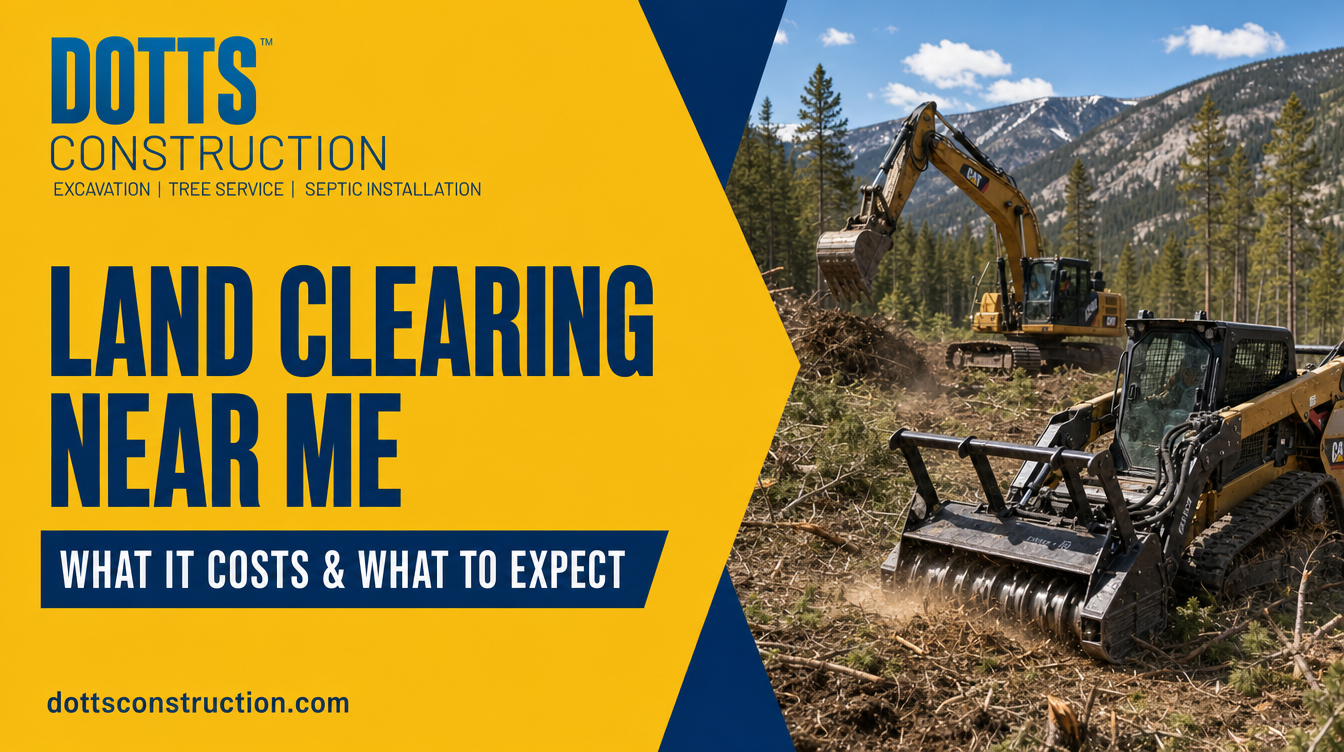
Land clearing is the process of removing trees, brush, stumps, debris, and vegetation from a piece of property so it's ready for construction, grading, or development. If you're searching "land clearing near me," you're probably staring at a rough lot that needs to become a foundation, driveway, or buildable site, and you need someone you can actually trust to get it done right.
Here's the honest truth: land clearing is one of those services where hiring the wrong crew can set your entire project back by weeks and cost you thousands in repairs. This guide gives you everything you need to hire smart, know what to pay, and get your site ready without the drama.
What Does Land Clearing Actually Include?
Land clearing is not a single task. It's a collection of related site preparation services that may include all or some of the following depending on your lot:
- Tree removal: Cutting and hauling trees of any size, including root systems.
- Stump grinding and removal: Eliminating stumps below grade so they don't interfere with grading or foundations.
- Brush and vegetation clearing: Removing scrub, overgrowth, vines, and invasive species.
- Debris removal and haul-away: Transporting logs, wood chips, and organic material off-site.
- Grubbing: Removing root mats and sub-surface organic matter before grading.
- Rough grading: Initial leveling and shaping of the land after vegetation is removed.
Not every clearing job needs all of these. A heavily wooded lot going through a full home build will need deep grubbing and stump removal. A smaller residential lot with scrub brush may just need brush clearing and a light grade pass.
Pro Tip: Always ask contractors to separate their quote by task. A lump-sum price tells you almost nothing. A line-item breakdown shows you what you're actually paying for and makes it easy to compare bids.
How Much Does Land Clearing Cost Near Me?
Land clearing costs vary widely based on lot size, vegetation density, terrain, and regional labor rates. Here's what you can expect as a realistic baseline:
| Project Type | Typical Cost Range |
|---|---|
| Light brush clearing (per acre) | $500 – $2,000 |
| Moderate clearing with trees (per acre) | $2,000 – $5,000 |
| Heavy wooded lot clearing (per acre) | $5,000 – $10,000+ |
| Stump grinding (per stump) | $75 – $350 |
| Full residential lot clearing (under 1 acre) | $1,500 – $6,000 |
| Clearing + rough grading combined | $3,000 – $12,000+ |
These ranges are based on national industry benchmarks from HomeAdvisor and Angi's 2026 cost data. Local markets can push costs higher or lower by 20 to 30 percent.
The single biggest cost driver is tree density. A lot covered in mature hardwood trees with deep root systems will cost three to four times more to clear than a lot covered in scrub brush and young growth. Before you call anyone, walk the lot and get a rough estimate of tree count and average trunk diameter. That information helps contractors give you accurate bids faster.
Note: Permits are often required for land clearing, especially when the clearing is adjacent to wetlands, floodplains, or protected areas. Always ask your contractor if a permit is required in your municipality before work begins.
What Questions Should You Ask Before Hiring a Land Clearing Company?
This is where most homeowners go wrong. They call three companies, take the lowest bid, and find out later that the "lowest price" came with missing debris haul-away, no stump grinding, and zero communication once work started.
Ask every contractor these questions before you sign anything:
- Are you licensed, bonded, and insured? Never hire a crew that can't hand you proof of general liability and workers' comp coverage.
- What exactly is included in this quote? Get it in writing. Verbal promises disappear.
- Will you handle debris removal and haul-away, or is that extra?
- Do you pull permits, or is that my responsibility?
- What equipment will you use? The right equipment for the job matters. A small residential lot doesn't need a full mulching forestry machine. A dense two-acre clearing needs more than a chainsaw crew.
- What is your timeline? Get a start date and a completion date in writing.
- How do you communicate during the project? Do you have a project manager? How do I reach you if something comes up?
That last question is critical. The land clearing industry is notorious for poor communication. Crews show up late, leave early, and leave homeowners guessing. A contractor who gives you a clear communication plan before you even hire them is telling you everything about how they'll run your job.
How Long Does Land Clearing Take?
Most residential land clearing jobs are completed in one to three days. Large acreage projects or heavily wooded sites can take a week or more. Here's a simple breakdown:
- Under half an acre, light brush: 4 to 8 hours
- Half to one acre, moderate vegetation: 1 to 2 days
- One to three acres, mixed trees and brush: 2 to 5 days
- Three-plus acres, heavy timber: 1 to 2 weeks or more
Weather, soil conditions, and equipment availability all affect the timeline. A wet site can add days because heavy machinery can tear up saturated ground and create drainage problems. Ask your contractor what happens to the schedule if it rains.
What Happens After Land Clearing?
Land clearing is step one. What comes next depends on your project. Understanding the full sequence prevents delays and scheduling gaps between contractors.
Typical post-clearing sequence for a new home build:
- Land clearing and stump removal
- Rough grading (shaping the lot for drainage and elevation)
- Soil testing and compaction assessment
- Utility layout and trenching (water, sewer, electric)
- Septic design and installation (if not on municipal sewer)
- Foundation excavation
- Fine grading and driveway prep
The most common mistake homeowners make is hiring separate contractors for each of these steps without confirming that the handoff timing works. If your clearing crew finishes on a Friday but your foundation excavator can't start for three weeks, your cleared lot sits exposed and vulnerable to erosion and re-growth.
The cleanest solution is hiring one company that handles multiple phases of site preparation. That single point of accountability eliminates the finger-pointing that happens when two separate crews have to work with each other's results.
At Dotts Construction, we handle land clearing, excavation, grading, driveway prep, and septic design and installation as a connected system, not as isolated services handed off between strangers. That's the core of our Dotts 3M Method: one team that manages, executes, and communicates across every phase of your site prep so your construction project doesn't stall waiting on someone else.
Land Clearing vs. Tree Removal: What's the Difference?
Homeowners often confuse these two services. They're related but not the same.
| Service | What It Covers | Best For |
|---|---|---|
| Tree Removal | Single trees or small groups, often with ISA-certified arborists | Removing hazard trees, clearing specific areas |
| Land Clearing | Full vegetation removal across a defined area | Site prep for construction, development, pasture |
| Forestry Mulching | Grinding all vegetation into mulch on-site | Cost-effective clearing for large acreage |
| Brush Clearing | Light scrub and overgrowth removal only | Maintaining fields, ROW clearing |
For construction site prep, you almost always need land clearing, not tree removal. Tree removal services are typically priced per tree and done with small equipment. Land clearing is priced by the acre and uses heavy machinery designed to process large volumes of vegetation efficiently.
Why Reliability Is the Real Differentiator in Land Clearing
Let's be honest about something. Most land clearing companies know how to operate equipment. The technical skill is not the problem.
The problem is showing up when they promise, communicating when something changes, and leaving your site in the condition they agreed to leave it in. Those three things separate a professional land clearing company from a liability.
We've heard from clients who lost weeks on their construction timeline because their clearing crew disappeared after the first day. We've seen homeowners hit with unexpected haul-away fees that doubled the original quote. We've watched foundations get delayed because the clearing crew didn't grub deep enough and the grading contractor had to come back and redo work.
One homeowner we worked with described his experience with a previous contractor: "They were totally professional, good timekeepers, and had a great work ethic. The work went smoothly and I was able to progress with the construction work myself." That should be the standard, not the exception. It's what every site prep job should deliver.
A land clearing company that communicates clearly, documents the work at each phase, and holds to the agreed timeline is worth paying a fair price for. The cheapest bid that disappears mid-job costs more than the professional who charges right.
Do You Need a Permit for Land Clearing?
Permit requirements for land clearing vary by state, county, and municipality. There is no single national standard. Here's what you need to know:
- Most urban and suburban jurisdictions require a grading or land disturbance permit for clearing that affects more than a defined threshold (often 5,000 square feet or half an acre).
- Wetland buffer zones almost always require a separate wetland disturbance permit or Army Corps of Engineers review under Section 404 of the Clean Water Act.
- Erosion and sediment control plans are required in many states before any land disturbance over a certain acreage.
- HOA restrictions may govern tree removal even on private property within a development.
Your contractor should be familiar with local permitting requirements. If they tell you "you don't need a permit" without actually checking, that's a red flag. Unpermitted land clearing can result in stop-work orders, fines, and mandatory restoration of the site at your expense.
Pro Tip: Call your county planning and zoning office before you hire anyone. A five-minute call can confirm what permits are needed and who is responsible for pulling them.
How to Find a Reputable Land Clearing Company Near You
Searching "land clearing near me" surfaces dozens of results. Here's how to sort the professionals from the chaos:
- Check Google reviews and read them carefully. Look for patterns around communication, timeline, and job site cleanup. One bad review is noise. Five reviews mentioning the crew disappeared mid-job is signal.
- Verify insurance before the first meeting. Ask for a certificate of liability insurance naming you as an additional insured.
- Request references from similar jobs. A crew that cleared a one-acre residential lot is not the same as one that prepped a five-acre commercial site.
- Get at least three written quotes that are itemized by task.
- Ask about project management. Who is your direct contact? What is their cell number? How quickly do they respond?
- Look for companies that offer connected services. If you also need grading, foundation excavation, or septic installation, a company that handles all of it reduces your coordination risk dramatically.
Frequently Asked Questions About Land Clearing Near Me
How do I find a reliable land clearing company near me?
Start with Google reviews and look for contractors with a consistent pattern of positive feedback around communication, professionalism, and on-time delivery. Request itemized written quotes from at least three companies, verify insurance, and ask for references from jobs similar to your property size and terrain.
What is the average cost of land clearing per acre?
According to 2026 data from HomeAdvisor, land clearing costs range from $500 to $10,000 per acre depending on vegetation density, terrain, tree size, and whether stump removal and debris haul-away are included. Light brush is on the low end; heavy wooded timber is on the high end.
How long does it take to clear a one-acre lot?
Most one-acre lots with moderate vegetation take one to two days to clear with professional equipment. Heavily wooded lots may take three to five days. Weather conditions and soil saturation can extend timelines.
Do I need a permit for land clearing on my own property?
In most jurisdictions, yes. Many counties require a grading or land disturbance permit for clearing above a certain threshold. Wetland adjacent properties almost always require additional permits. Check with your local county planning or zoning office before any work begins.
What is the difference between land clearing and grading?
Land clearing removes vegetation, trees, stumps, and debris from a site. Grading shapes the exposed soil to achieve proper elevation, drainage, and slope. Clearing always happens before grading. Many professional excavation companies offer both services as part of a connected site preparation package.
Can land clearing damage surrounding trees or neighboring property?
Yes, if done by an inexperienced crew. Proper land clearing includes defined clearing boundaries, protection of root zones for trees you want to keep, and careful equipment operation near property lines. Always confirm with your contractor that boundary trees and neighbor buffers are understood before equipment hits the lot.
What happens to the trees and debris after clearing?
Cleared material is typically chipped into mulch on-site, hauled away to a wood recycling facility, or burned where local ordinances permit. Some contractors offer to leave mulched material on-site at no charge. Make sure your contract specifies what happens to debris so you're not surprised by haul-away fees.
Ready to Get Your Site Cleared? Here's What to Do Next
If you're ready to move from a rough, overgrown lot to a construction-ready site, the next step is straightforward. Get a site assessment from a contractor who can look at your actual property, walk the boundaries, assess vegetation density, and give you an accurate itemized quote that accounts for your full project, not just the clearing portion.
At Dotts Construction, we use the Dotts 3M Method to take your site from raw land through clearing, grading, foundation excavation, and septic installation as one connected process. You get one point of contact, clear communication at every phase, and a site that's genuinely ready for what comes next, not a surface-level clear that leaves problems underground.
Call us or request your site assessment online to get started.
Request a free consultation or call (719) 280-4141
Related Guides
Need the pros? See Land Clearing Services. More reading:
About the Author
Michael Dotts brings over 15 years of hands-on experience in heavy construction and grading, with a specialty in the unique demands of building in the Rocky Mountains, where steep terrain, rocky ground, and harsh weather change the rules most flatland contractors are used to. Because Michael knows what it really takes to get the job done right in Colorado’s high country, you can count on honest, accurate quotes that won’t creep up halfway through the job.