
Need to Clear Land Fast?
The fastest way to clear land is to hire a professional land clearing crew armed with heavy machinery. A trained crew using excavators, bulldozers, or forestry mulchers can clear 1 to 15 acres in a single day. DIY methods using rented equipment can work for smaller lots, but nothing beats the speed, safety, and site-ready results a professional delivers.
If you've got a construction project on hold because your site isn't ready, you already know how expensive waiting is. Every day the ground isn't prepped is another day your build is delayed. Here's exactly what speeds up land clearing and what slows it down.
Why Does Land Clearing Speed Matter So Much?
Time is money on any construction project. When your foundation contractor, septic installer, or framing crew is waiting on a cleared site, you're paying for delays you didn't budget for.
Professional land clearing services eliminate that bottleneck. A crew equipped with the right machines can move from raw, heavily wooded ground to a stripped, graded surface in hours, not weeks. That kind of speed keeps your entire project timeline intact.
Let's be honest: most homeowners and property developers underestimate how much vegetation, root systems, and debris can set back a project. A lot that looks manageable from the road can hide dense root networks, large stumps, and soil conditions that add days of manual labor.
Here's the core truth: the speed of your land clearing is almost entirely determined by the equipment used and the experience of the crew operating it.
What Equipment Clears Land the Fastest?
The machine you put on a lot determines how fast that lot gets cleared. Here's how the major equipment options break down by speed and application.
Forestry Mulchers: The Single-Pass Solution
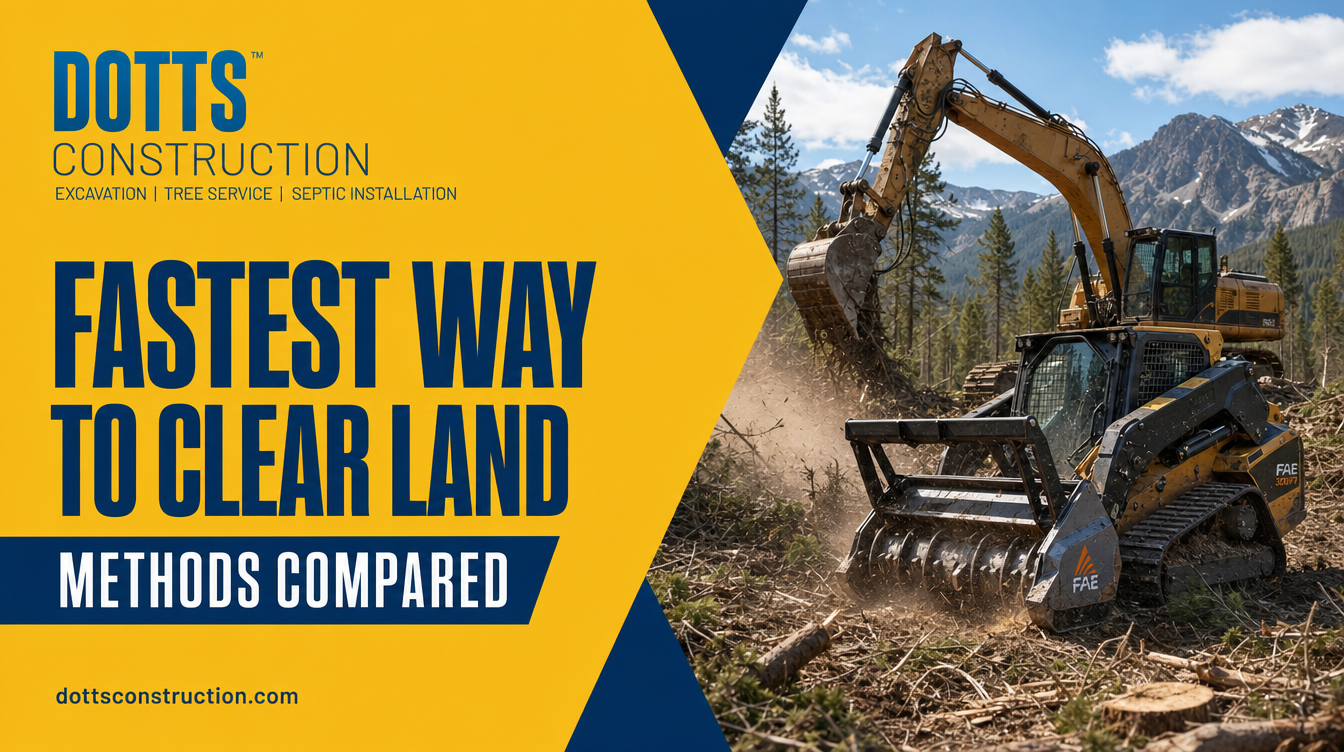
A forestry mulcher is the fastest machine for clearing dense brush and light to medium timber. It shreds trees, shrubs, and heavy vegetation directly on the ground and leaves a layer of nutrient-rich mulch behind. No hauling. No burn piles. No secondary debris removal.
For lots with trees under 12 inches in diameter, a forestry mulcher often completes in one pass what would take a manual crew several days. According to the Forest Resources Association, commercial forestry mulchers process up to 5 acres per day on moderately wooded ground.
Pro Tip: Forestry mulching is ideal when you want to preserve topsoil and avoid deep soil disturbance. It's a strong choice for lots that will be landscaped or seeded after clearing.
Bulldozers: Raw Power for Heavily Wooded Sites
A bulldozer is the go-to machine when you're dealing with large trees, heavy root systems, or lots that need significant topsoil removal before grading. A dozer pushes over standing trees and strips the top layer of earth in a single pass, making it fast and efficient for construction prep.
The tradeoff: dozers leave debris piles that need to be moved, burned, or chipped. That adds a second phase to the process. On heavily wooded, stump-dense lots, though, nothing clears ground faster.
Excavators: Precision Land Clearing for Complex Sites
An excavator trades raw speed for control. It digs deep root systems cleanly, grades slopes precisely, and works in confined spaces where dozers can't maneuver. For foundation excavation, septic system preparation, or sites near existing structures, an excavator is the right call.
At Dotts Construction, our excavators are a core part of how we prep sites for foundations and septic system installation. They let us remove what needs to go without disturbing what needs to stay.
Skid Steers with Attachments: Versatile Midrange Speed
A skid steer fitted with a brush hog or root grapple handles smaller lots and areas too tight for larger machines. For 1 to 3 acre sites with moderate overgrowth, a skid steer with the right attachment is fast, maneuverable, and cost-effective.
Note: Skid steers slow down significantly on heavily wooded ground with large stumps. They're best suited to overgrown fields, light brush, and debris removal after a bulldozer or mulcher has done the heavy work.
How Do Professional Land Clearing Services Compare to DIY?
Here's a direct comparison so you can make an informed decision before renting equipment or calling a crew.
| Factor | Professional Land Clearing Crew | DIY Rented Equipment |
|---|---|---|
| Clearing Speed | 1 to 15 acres per day | 0.25 to 1 acre per day |
| Equipment Access | Commercial-grade, purpose-built machines | Consumer or light commercial rental units |
| Debris Handling | Managed on-site (mulch, haul, or burn) | Requires separate disposal plan |
| Utility Safety | Crew identifies and avoids underground lines | DIY operator risk of hitting utilities |
| Site-Ready Result | Graded, compacted, construction-ready | Cleared only; additional grading often needed |
| Permit Navigation | Experienced with local codes and burn bans | Operator must research regulations independently |
| True Cost | Higher upfront, lower total project cost | Lower upfront, often higher after delays and errors |
The numbers tell the story. A professional crew takes a day to do what takes a motivated DIYer a week or more. And the professional crew hands you a site that's actually ready for the next phase of your project.
What Slows Down the Land Clearing Process?
Speed isn't guaranteed just because you hire a crew or rent equipment. Several site factors act as brakes on clearing timelines.
Vegetation density and tree size. Light brush clears fast. A forested lot with mature hardwoods and dense undergrowth takes significantly longer per acre than an overgrown field.
Stump and root depth. Surface stumps come out quickly. Deep tap-root systems from oaks or pines add time because the root mass extends well below the surface and must be fully extracted for a stable foundation or driveway base.
Soil conditions. Wet, clay-heavy, or rocky soil slows equipment movement and adds resistance to every dig. This is especially relevant if your lot holds water after rain.
Lot accessibility. A cleared access road to the work area means machines move faster. Lots with no access require time to cut a path before clearing even begins.
Debris management requirements. If local regulations prohibit burning (many municipalities have strict burn ban ordinances), all debris must be chipped or hauled. That adds a second machine and additional time.
Pro Tip: Ask your land clearing contractor to walk your site before providing a quote. Any crew that quotes purely by acreage without a site visit is guessing. The variables above can double or triple clearing time on the same square footage.
What Happens After Land Is Cleared?
Clearing is the beginning, not the end. A cleared lot still needs additional work before any construction begins.
Grading and Leveling
Grading establishes the proper slope and elevation for your project. Without it, you end up with drainage problems that flood foundations, erode driveways, and compromise septic systems. Grading follows clearing on virtually every job we take on at Dotts Construction.
Erosion Control
Bare soil is vulnerable soil. According to the U.S. Environmental Protection Agency, a single inch of rain on a cleared, unprotected acre can move several tons of topsoil. Seeding, erosion control blankets, or silt fencing should go in immediately after clearing to protect what you just invested in clearing.
Foundation Excavation or Driveway Prep
Once graded, your site is ready for foundation excavation, driveway construction, or road installation. Each of those phases builds directly on the quality of the clearing and grading work beneath them.
Septic System Installation
If your project requires a septic system, site clearing and grading directly affect where the system can be installed and how it performs. A cleared, properly graded lot gives your septic designer the layout they need to get a system permitted and installed correctly the first time. You can learn more about septic system design and installation and how site work connects to it.
How Does the Dotts 3M Method Speed Up Land Clearing?
At Dotts Construction, we clear land using what we call the Dotts 3M Method: Machine Selection, Methodical Sequencing, and Meticulous Cleanup.
Machine Selection means we match equipment to your specific site conditions before we mobilize. A forested lot with large timber gets different iron than an overgrown field with light brush. Sending the wrong machine is the single biggest source of wasted time on clearing jobs.
Methodical Sequencing means we execute clearing phases in an order that eliminates backtracking. We establish site access first, then work from the perimeter inward, then address stumps, then grade. Each phase sets up the next.
Meticulous Cleanup means your site is construction-ready when we leave, not just cleared. Debris is managed, topsoil is protected, and the ground is graded to spec. You don't have to hire a second crew to finish what we started.
How Much Does Professional Land Clearing Cost?
Pricing for land clearing services varies by site conditions, acreage, and project scope. National averages from HomeAdvisor's 2026 cost database place professional land clearing between $1,500 and $6,000 per acre, with heavily wooded lots trending toward the top of that range.
Here's what influences your cost:
- Acreage: Larger lots typically reduce per-acre cost through economies of scale.
- Vegetation type: Light brush costs less than mature timber with deep root systems.
- Debris disposal method: Mulching on-site costs less than hauling debris to a disposal facility.
- Grading inclusion: Clearing-only contracts cost less than clearing-plus-grading packages.
- Permit fees: Some localities require permits for tree removal or brush burning, which adds cost.
Pro Tip: Get itemized quotes. A quote that bundles clearing, grading, stump removal, and erosion control into a single number makes it impossible to compare contractors accurately. Line-item quotes protect you.
What Should You Clear and What Should You Keep?
Not everything on your lot should go. Strategic preservation of certain trees and vegetation can save money, improve drainage, and increase property value.
Keep:
- Mature hardwoods well outside the building footprint
- Trees that serve as windbreaks on the northern or western property edge
- Natural drainage buffers near streams or low-lying areas
- Trees that will anchor a future landscaping plan
Clear:
- All vegetation within the building footprint and 10 feet beyond it
- Dead or diseased trees anywhere on the lot
- Invasive species that will compete with future plantings
- Dense brush that creates fire risk or pest habitat
Before clearing starts, flag every tree you want preserved. Once a bulldozer is moving, verbal instructions get lost.
Frequently Asked Questions About Land Clearing Services
How long does it take to clear 1 acre of land?
A professional land clearing crew can clear 1 acre in 2 to 8 hours depending on vegetation density, tree size, and soil conditions. Light brush and overgrown fields clear faster. Heavily wooded, stump-dense acreage takes longer. Manual or DIY clearing of 1 acre typically takes 3 to 7 days.
Do I need a permit to clear land?
Permit requirements vary by municipality. Many localities require permits for removing trees above a certain diameter or for burning cleared debris. Some areas in protected watersheds require erosion control plans before clearing begins. Always check with your local planning or zoning office before starting work.
Should I clear land myself or hire a professional?
For lots under half an acre with light brush, DIY rented equipment is a reasonable option. For anything larger, heavily wooded, or tied to a construction deadline, hiring a professional land clearing service is almost always cheaper in total project cost because it eliminates delays, errors, and inadequate site prep that create expensive problems downstream.
What is the difference between land clearing and grading?
Land clearing removes all vegetation, trees, stumps, and surface debris from a lot. Grading reshapes the cleared earth to a specific slope and elevation for drainage and construction requirements. Most construction projects require both, and clearing always comes before grading.
Can cleared land be used immediately for construction?
Not always. After clearing, most sites need grading, compaction testing, and sometimes soil amendment before a foundation or driveway can be installed. Rushing into construction on a freshly cleared but ungraded or poorly compacted site leads to settling, cracking, and drainage failures.
What is a forestry mulcher and should I request one?
A forestry mulcher is a machine that grinds trees, brush, and stumps into mulch on-site. It's the fastest single-machine solution for clearing lots with dense vegetation and light to medium timber. Request it when you want to avoid hauling debris and preserve topsoil structure. It's not the right call for lots with large hardwood stumps that need full extraction.
How do I find a reliable land clearing contractor?
Look for contractors who own their equipment rather than subcontracting it, who provide itemized written quotes, and who walk the site before quoting. Ask for references from projects of similar scope. Check that they carry general liability insurance and that their crew has experience with your specific site conditions, whether that's wooded lots, rocky terrain, or sites near waterways.
Ready to Get Your Site Cleared? Here's How to Move Forward.
Your project doesn't start when concrete is poured or lumber arrives. It starts with the ground beneath your feet. Land clearing services are the first critical step that every downstream phase of your construction project depends on.
At Dotts Construction, we combine the Dotts 3M Method with the right equipment for your specific site to deliver cleared, graded, construction-ready ground. We show up when we say we will, communicate every step of the way, and leave your site ready for the next phase without drama or surprises.
If your project is waiting on site work, let's fix that.
Schedule your site walkthrough and quote today. We'll assess your lot, tell you exactly what clearing and grading it needs, and give you an itemized quote you can actually use to plan your project.
Request a free consultation or call (719) 280-4141
You can also learn more about our full range of site preparation services, including foundation excavation, driveway and road construction, and septic system design and installation.
Related Guides
Need the pros? See Land Clearing Services. More reading:
About the Author
Michael Dotts brings over 15 years of hands-on experience in heavy construction and grading, with a specialty in the unique demands of building in the Rocky Mountains, where steep terrain, rocky ground, and harsh weather change the rules most flatland contractors are used to. Because Michael knows what it really takes to get the job done right in Colorado’s high country, you can count on honest, accurate quotes that won’t creep up halfway through the job.